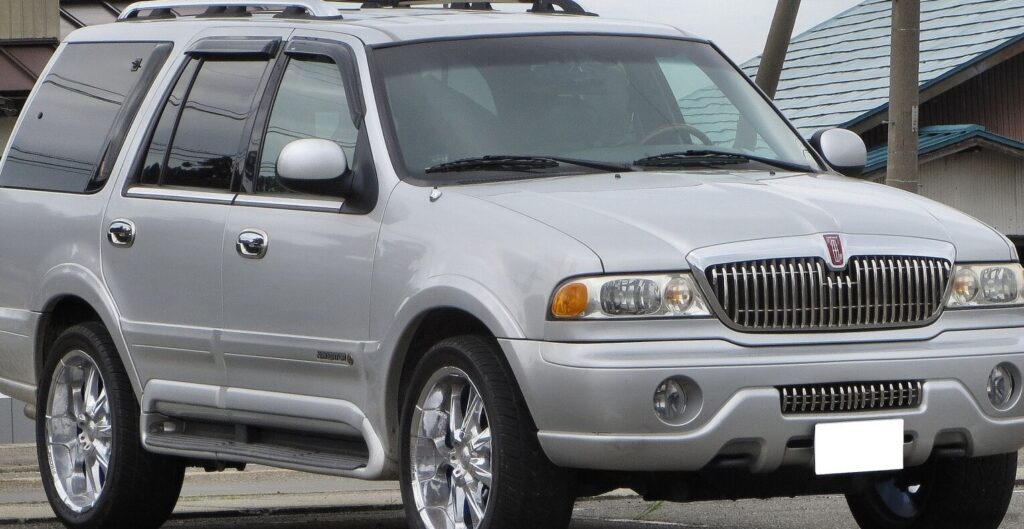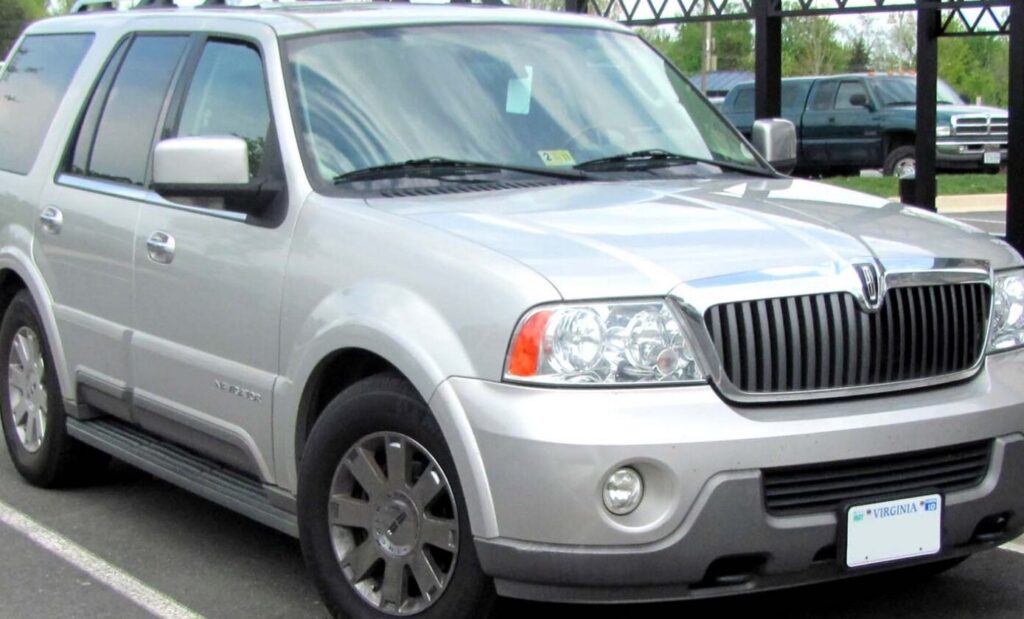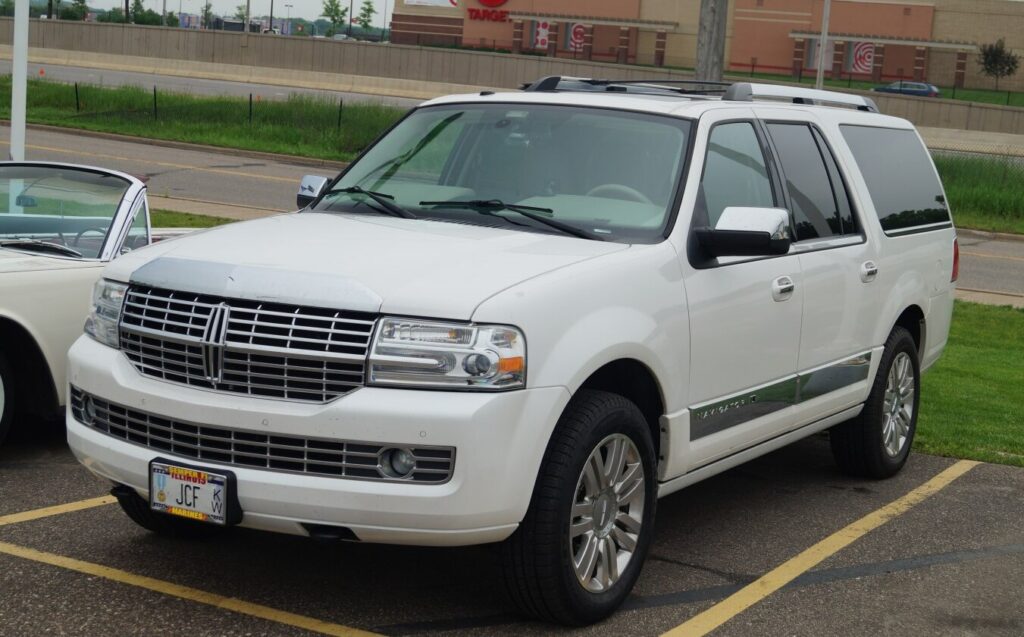
The Lincoln Navigator III L 5.4i, produced from 2006 to 2008, represented the third generation of Lincoln’s full-size luxury SUV. Positioned as the flagship model in the Lincoln lineup, the Navigator III aimed to compete with offerings from Cadillac, GMC, and Lexus. The “L” designation indicated the extended wheelbase version, offering increased interior space and cargo capacity. This particular variant, equipped with the 5.4-liter Triton V8 engine producing 300 horsepower and paired with a six-speed automatic transmission, and a four-wheel drive system, was a popular configuration, balancing power, luxury, and capability. It sat towards the higher end of the Navigator trim levels, offering a substantial step up from the base models.
Technical Specifications
| Brand | Lincoln |
| Model | Navigator |
| Generation | Navigator III L |
| Type (Engine) | 5.4i V8 (300 Hp) 4×4 Automatic |
| Start of production | 2006 |
| End of production | 2008 |
| Powertrain Architecture | Internal Combustion engine |
| Body type | SUV |
| Seats | 8 |
| Doors | 5 |
| Fuel Type | Petrol (Gasoline) |
| Weight-to-power ratio | 9.4 kg/Hp, 106.3 Hp/tonne |
| Weight-to-torque ratio | 5.7 kg/Nm, 175.4 Nm/tonne |
| Power | 300 Hp @ 5000 rpm |
| Power per litre | 55.5 Hp/l |
| Torque | 495 Nm @ 3750 rpm, 365.09 lb.-ft. @ 3750 rpm |
| Maximum engine speed | 5400 rpm |
| Engine layout | Front, Longitudinal |
| Engine Model/Code | Triton |
| Engine displacement | 5408 cm3, 330.02 cu. in. |
| Number of cylinders | 8 |
| Engine configuration | V-engine |
| Cylinder Bore | 90.2 mm, 3.55 in. |
| Piston Stroke | 105.9 mm, 4.17 in. |
| Compression ratio | 9.8:1 |
| Number of valves per cylinder | 3 |
| Fuel injection system | Multi-port manifold injection |
| Engine aspiration | Naturally aspirated engine |
| Valvetrain | SOHC, VVT |
| Engine oil capacity | 6.6 l, 6.97 US qt | 5.81 UK qt |
| Coolant | 19.5 l, 20.61 US qt | 17.16 UK qt |
| Kerb Weight | 2822 kg, 6221.45 lbs |
| Max. weight | 3606 kg, 7949.87 lbs |
| Max load | 784 kg, 1728.42 lbs |
| Trunk (boot) space – minimum | 1209 l, 42.7 cu. ft. |
| Trunk (boot) space – maximum | 3630 l, 128.19 cu. ft. |
| Fuel tank capacity | 127 l, 33.55 US gal | 27.94 UK gal |
| Length | 5672 mm, 223.31 in. |
| Width | 2002 mm, 78.82 in. |
| Width including mirrors | 2332 mm, 91.81 in. |
| Height | 1984 mm, 78.11 in. |
| Wheelbase | 3327 mm, 130.98 in. |
| Front track | 1699 mm, 66.89 in. |
| Rear (Back) track | 1702 mm, 67.01 in. |
| Ride height (ground clearance) | 231 mm, 9.09 in. |
| Drag coefficient (Cd) | 0.40 |
| Minimum turning circle (turning diameter) | 13.39 m, 43.93 ft. |
| Approach angle | 22.2° |
| Departure angle | 20.8° |
| Ramp-over (brakeover) angle | 18.4° |
| Drive wheel | All wheel drive (4×4) |
| Number of gears and type of gearbox | 6 gears, automatic transmission |
| Front suspension | Independent coil spring |
| Rear suspension | Independent coil spring |
| Front brakes | Ventilated discs |
| Rear brakes | Ventilated discs |
| Assisting systems | ABS (Anti-lock braking system) |
| Steering type | Steering rack and pinion |
| Tires size | 255/70 R18 |
| Wheel rims size | 18 |
Powertrain & Engine Architecture
The heart of this Navigator variant was the 5.4-liter Triton V8 engine. This engine, a staple of Ford and Lincoln trucks and SUVs for many years, featured a cast-iron block with aluminum cylinder heads. The engine utilized a single overhead camshaft (SOHC) design per bank, incorporating variable valve timing (VVT) to optimize performance and fuel efficiency. Fuel delivery was handled by a multi-port fuel injection system. The 300 horsepower output was achieved through a combination of the engine’s displacement, cylinder head design, and the VVT system. The six-speed automatic transmission, a significant upgrade from the four-speed units found in earlier Navigators, provided smoother shifts and improved fuel economy. This transmission was designed to handle the engine’s substantial torque output and provide a comfortable driving experience.
Driving Characteristics
The 5.4-liter V8 and six-speed automatic combination delivered a respectable driving experience for a full-size SUV. While not particularly sporty, the Navigator offered ample power for everyday driving and towing. Acceleration from 0 to 60 mph was typically in the 7.5-8.5 second range. The automatic transmission was tuned for comfort, with relatively smooth shifts and a focus on drivability. Compared to the base 4.6-liter V8 Navigator, the 5.4-liter offered a noticeable increase in power and responsiveness. However, it didn’t match the quicker acceleration of the higher-performance models that would later emerge. The four-wheel drive system provided enhanced traction in inclement weather and off-road conditions, making it a capable all-weather vehicle.
Equipment & Trim Levels
The Navigator III L 5.4i typically came standard with a generous array of features, including leather upholstery, tri-zone automatic climate control, a premium audio system, power-adjustable front seats, and a rear entertainment system. Optional extras included navigation system, power-folding running boards, and upgraded wheels. The extended wheelbase “L” version provided significantly more third-row legroom and cargo space compared to the standard Navigator. Interior trim options included various woodgrain accents and color combinations, allowing buyers to personalize their vehicle.
Chassis & Braking
The Navigator III L utilized a body-on-frame construction, providing a robust and durable platform. The suspension consisted of independent coil springs at all four corners, offering a comfortable ride quality. The rear brakes were ventilated discs, a step up from the drums found on some lower trims. Anti-lock brakes (ABS) were standard, enhancing safety and control during emergency braking situations. The steering system employed a rack-and-pinion setup, providing precise and responsive steering feel.
Market Reception & Comparison
The Navigator III L 5.4i was generally well-received by critics and consumers. It was praised for its spacious interior, comfortable ride, and powerful engine. However, some reviewers noted its relatively low fuel economy compared to newer, more fuel-efficient SUVs. Compared to the base 4.6-liter Navigator, the 5.4-liter offered a significant performance upgrade, justifying the higher price tag for many buyers. Reliability was generally good, although some owners reported issues with the spark plugs breaking during removal, a common problem with the Triton V8 engine.
Legacy
The Lincoln Navigator III L 5.4i remains a popular choice in the used car market, particularly for those seeking a large, luxurious SUV with ample space and towing capacity. The Triton V8 engine, while known for the spark plug issue, is generally considered durable and reliable when properly maintained. Parts availability is good, and the Navigator’s relatively simple mechanical design makes it relatively easy to repair. While fuel economy is not its strong suit, the Navigator III L 5.4i continues to offer a compelling combination of luxury, capability, and value.