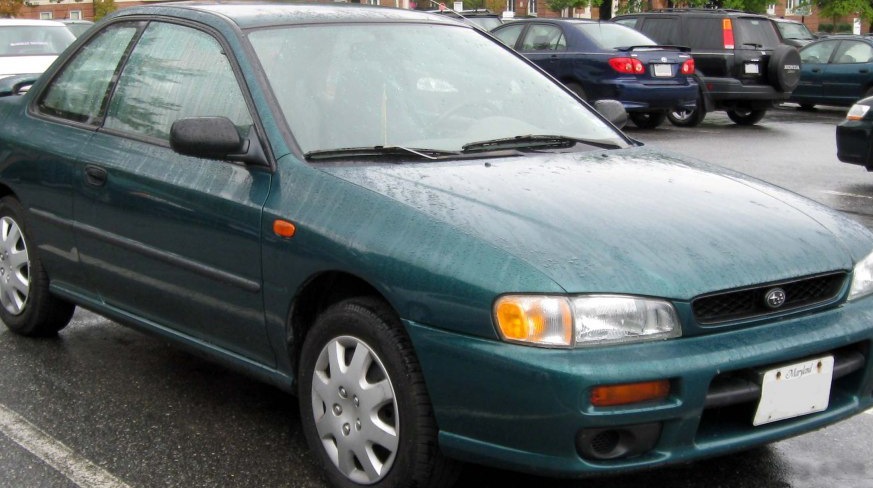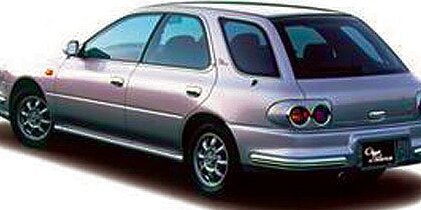
The Subaru Impreza I Station Wagon (GF), specifically the 2.0-liter 115 horsepower, all-wheel-drive variant, was produced between 1995 and 2000. This model represented Subaru’s entry into the increasingly popular compact station wagon segment, offering a blend of practicality, all-weather capability, and the distinctive engineering hallmarks of the Impreza line. Positioned as a versatile family vehicle, it sat within the first generation (GF/GM) Impreza range, which was based on Subaru’s new ‘C’ platform. The station wagon body style, or ‘estate’ as it was often referred to in European markets, broadened the Impreza’s appeal beyond the hatchback and sedan models.
Technical Specifications
| Brand | Subaru |
| Model | Impreza |
| Generation | Impreza I Station Wagon (GF) |
| Type (Engine) | 2.0 (115 Hp) 4WD |
| Start of production | 1995 |
| End of production | 2000 |
| Powertrain Architecture | Internal Combustion engine |
| Body type | Station wagon (estate) |
| Seats | 5 |
| Doors | 5 |
| Fuel consumption (combined) | 9 l/100 km (26.1 US mpg, 31.4 UK mpg, 11.1 km/l) |
| Fuel Type | Petrol (Gasoline) |
| Acceleration 0 – 100 km/h | 10 sec |
| Acceleration 0 – 62 mph | 10 sec |
| Acceleration 0 – 60 mph | 9.5 sec |
| Maximum speed | 185 km/h (114.95 mph) |
| Weight-to-power ratio | 10.1 kg/Hp, 98.7 Hp/tonne |
| Weight-to-torque ratio | 6.9 kg/Nm, 145.9 Nm/tonne |
| Power | 115 Hp @ 5600 rpm |
| Power per litre | 57.7 Hp/l |
| Torque | 170 Nm @ 4400 rpm (125.39 lb.-ft. @ 4400 rpm) |
| Engine layout | Front, Longitudinal |
| Engine Model/Code | EJ20G |
| Engine displacement | 1994 cm3 (121.68 cu. in.) |
| Number of cylinders | 4 |
| Engine configuration | Boxer |
| Cylinder Bore | 92 mm (3.62 in.) |
| Piston Stroke | 75 mm (2.95 in.) |
| Compression ratio | 9.5:1 |
| Number of valves per cylinder | 4 |
| Fuel injection system | Multi-port manifold injection |
| Engine aspiration | Naturally aspirated engine |
| Valvetrain | OHC |
| Engine oil capacity | 4 l (4.23 US qt | 3.52 UK qt) |
| Kerb Weight | 1165 kg (2568.39 lbs.) |
| Max. weight | 1720 kg (3791.95 lbs.) |
| Max load | 555 kg (1223.57 lbs.) |
| Trunk (boot) space – minimum | 356 l (12.57 cu. ft.) |
| Trunk (boot) space – maximum | 1275 l (45.03 cu. ft.) |
| Fuel tank capacity | 50 l (13.21 US gal | 11 UK gal) |
| Length | 4350 mm (171.26 in.) |
| Width | 1690 mm (66.54 in.) |
| Height | 1420 mm (55.91 in.) |
| Wheelbase | 2520 mm (99.21 in.) |
| Front track | 1460 mm (57.48 in.) |
| Rear (Back) track | 1450 mm (57.09 in.) |
| Drive wheel | All wheel drive (4×4) |
| Number of gears and type of gearbox | 5 gears, manual transmission |
| Front suspension | Wishbone |
| Rear suspension | Several levers and rods |
| Front brakes | Ventilated discs |
| Rear brakes | Drum |
| Assisting systems | ABS (Anti-lock braking system) |
| Steering type | Steering rack and pinion |
| Power steering | Hydraulic Steering |
| Tires size | 185/70 R14 |
| Wheel rims size | 14 |
Powertrain & Engine Architecture
The heart of this Impreza variant was the EJ20G 2.0-liter naturally aspirated, horizontally-opposed (boxer) four-cylinder engine. This engine was a key component of Subaru’s engineering identity, known for its smooth operation and inherent balance. The EJ20G featured a single overhead camshaft (OHC) design and multi-point fuel injection. The 9.5:1 compression ratio was a compromise between performance and fuel efficiency. Paired with the engine was a five-speed manual transmission, delivering power to all four wheels via Subaru’s symmetrical all-wheel-drive system. This system utilized a viscous limited-slip center differential, providing automatic torque distribution between the front and rear axles. The engine code ‘EJ20G’ signifies a specific iteration of the EJ20 series, commonly found in non-turbo Impreza models of this era.
Driving Characteristics
The 115 horsepower output and 170 Nm (125 lb-ft) of torque provided adequate, though not exhilarating, performance. Acceleration from 0-60 mph took around 9.5 seconds, and top speed was approximately 115 mph. Compared to the more potent turbocharged Impreza variants (like the WRX), this version prioritized fuel economy and ease of driving. The five-speed manual transmission offered a reasonable spread of gears, but the engine lacked the low-end grunt of the turbo models, requiring more frequent downshifts during spirited driving. The all-wheel-drive system provided excellent traction in various conditions, making it a capable and sure-footed vehicle, particularly in inclement weather. The power delivery was linear, making it predictable and easy to control.
Equipment & Trim Levels
The 2.0-liter Impreza Station Wagon typically came with a fairly basic level of equipment, reflecting its position as a more affordable option within the range. Standard features generally included power steering, central locking, and an AM/FM radio. Interior upholstery was typically cloth, and the dashboard featured a functional, if somewhat utilitarian, design. Optional extras could include air conditioning, power windows, and upgraded audio systems. Trim levels varied depending on the market, but generally, this engine/transmission combination represented a mid-range offering, sitting above the base models but below the more luxurious or performance-oriented trims.
Chassis & Braking
The Impreza I Station Wagon utilized a MacPherson strut front suspension and a multi-link rear suspension, providing a comfortable ride and decent handling characteristics. The front brakes were ventilated discs, offering good stopping power, while the rear brakes were drums, a cost-saving measure common in this class of vehicle. Anti-lock braking system (ABS) was often included as standard equipment, enhancing safety. The chassis was relatively lightweight, contributing to the car’s agility. Stabilizer bars were fitted to both the front and rear axles to reduce body roll during cornering.
Market Reception & Comparison
The 1.8L automatic Impreza wagon was generally well-received as a practical and reliable family vehicle. Critics praised its all-wheel-drive system and spacious interior, but noted that its performance was not particularly exciting. Compared to other compact station wagons of the time, such as the Ford Escort Estate or the Vauxhall Astra Estate, the Impreza offered a unique combination of all-wheel-drive capability and Subaru’s distinctive engineering. Fuel economy was respectable, averaging around 26 mpg in combined driving. Reliability was generally good, although routine maintenance was essential to ensure the longevity of the engine and drivetrain.
Legacy
The Subaru Impreza I Station Wagon 2.0 (115 Hp) 4WD has become a relatively sought-after classic among Subaru enthusiasts. The EJ20G engine, while not as powerful as the turbocharged variants, is known for its durability and relative simplicity. Well-maintained examples are still relatively common on the used car market, and they offer a unique blend of practicality, reliability, and all-weather capability. The car’s enduring appeal lies in its ability to provide a comfortable and capable driving experience, even by modern standards. Parts availability remains reasonably good, making it a viable option for those seeking a classic Subaru with a practical body style.