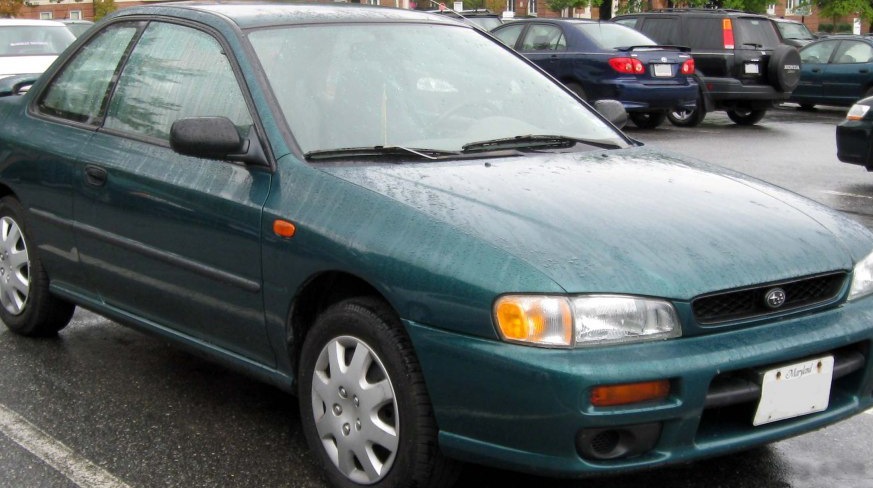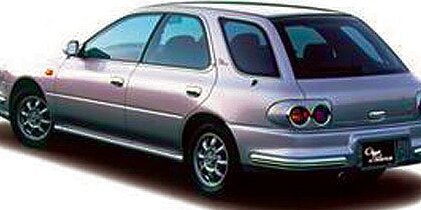
The Subaru Impreza I Station Wagon (GF) 2.0 16V, produced between 1998 and 2000, represented Subaru’s entry into the compact estate car market with a focus on all-wheel drive capability. This variant, powered by the EJ20G engine producing 125 horsepower, occupied a middle ground within the first-generation Impreza lineup, offering a balance between practicality, affordability, and Subaru’s signature symmetrical all-wheel drive system. It was primarily sold in European and Asian markets, where the demand for compact wagons was strong. The GF chassis code designates this specific body style within the Impreza range.
Technical Specifications
| Brand | Subaru |
| Model | Impreza |
| Generation | Impreza I Station Wagon (GF) |
| Type | 2.0 16V (125 Hp) 4WD |
| Start of production | 1998 |
| End of production | 2000 |
| Powertrain Architecture | Internal Combustion engine |
| Body type | Station wagon (estate) |
| Seats | 5 |
| Doors | 5 |
| Fuel consumption (urban) | 12.1 l/100 km (19.4 US mpg) |
| Fuel consumption (extra urban) | 7.2 l/100 km (32.7 US mpg) |
| Fuel Type | Petrol (Gasoline) |
| Acceleration 0 – 100 km/h | 9.7 sec |
| Acceleration 0 – 62 mph | 9.7 sec |
| Acceleration 0 – 60 mph | 9.2 sec |
| Maximum speed | 190 km/h (118.06 mph) |
| Weight-to-power ratio | 9.5 kg/Hp |
| Weight-to-torque ratio | 6.4 kg/Nm |
| Power | 125 Hp @ 5600 rpm |
| Torque | 184 Nm @ 3600 rpm (135.71 lb.-ft. @ 3600 rpm) |
| Engine layout | Front, Longitudinal |
| Engine Model/Code | EJ20G |
| Engine displacement | 1994 cm3 (121.68 cu. in.) |
| Number of cylinders | 4 |
| Engine configuration | Boxer |
| Cylinder Bore | 92 mm (3.62 in.) |
| Piston Stroke | 75 mm (2.95 in.) |
| Compression ratio | 10:1 |
| Number of valves per cylinder | 4 |
| Fuel injection system | Multi-port manifold injection |
| Engine aspiration | Naturally aspirated engine |
| Valvetrain | OHC |
| Engine oil capacity | 4 l (4.23 US qt | 3.52 UK qt) |
| Kerb Weight | 1185 kg (2612.48 lbs.) |
| Max. weight | 1720 kg (3791.95 lbs.) |
| Max load | 535 kg (1179.47 lbs.) |
| Trunk (boot) space – minimum | 356 l (12.57 cu. ft.) |
| Trunk (boot) space – maximum | 1275 l (45.03 cu. ft.) |
| Fuel tank capacity | 50 l (13.21 US gal | 11 UK gal) |
| Length | 4350 mm (171.26 in.) |
| Width | 1690 mm (66.54 in.) |
| Height | 1420 mm (55.91 in.) |
| Wheelbase | 2520 mm (99.21 in.) |
| Front track | 1460 mm (57.48 in.) |
| Rear track | 1450 mm (57.09 in.) |
| Drive wheel | All wheel drive (4×4) |
| Number of gears | 5 gears, manual transmission |
| Front suspension | Wishbone |
| Rear suspension | Several levers and rods |
| Front brakes | Ventilated discs |
| Rear brakes | Disc |
| Assisting systems | ABS (Anti-lock braking system) |
| Steering type | Steering rack and pinion |
| Power steering | Hydraulic Steering |
| Tires size | 185/70 R14 |
| Wheel rims size | 5.5J x 14 |
Powertrain & Engine Architecture
The heart of the Impreza I Station Wagon 2.0 16V is the EJ20G engine, a 1994cc naturally aspirated, horizontally-opposed (boxer) four-cylinder. This engine design, a Subaru hallmark, provides a low center of gravity, contributing to improved handling. The EJ20G featured a single overhead camshaft (SOHC) design operating four valves per cylinder. Fuel delivery was managed by a multi-point fuel injection system. The engine’s 125 horsepower and 135.71 lb-ft of torque were respectable for its time, but not exceptional compared to some of its competitors. The engine was paired with a five-speed manual transmission, delivering power to all four wheels via Subaru’s symmetrical all-wheel drive system. This system utilized a viscous limited-slip center differential, providing automatic torque distribution between the front and rear axles.
Driving Characteristics
The 2.0-liter engine, coupled with the manual transmission, provided adequate performance for everyday driving. Acceleration to 60 mph took approximately 9.2 seconds, and top speed was around 118 mph. While not a sports car, the Impreza Wagon offered a responsive driving experience, particularly on slippery surfaces where the all-wheel drive system provided enhanced traction. The gear ratios were tuned for a balance of fuel efficiency and usability, rather than outright performance. Compared to the higher-output turbocharged Impreza variants (like the WRX), this 2.0L model felt less powerful, but it offered a smoother, more predictable power delivery. The manual transmission was generally well-regarded for its light action and precise shifts.
Equipment & Trim Levels
The Impreza I Station Wagon 2.0 16V typically came with a fairly basic level of equipment, reflecting its position as a mainstream model. Standard features generally included power steering, central locking, electric windows, and an AM/FM radio. Interior upholstery was typically cloth, and the dashboard featured a functional, if somewhat utilitarian, design. Optional extras could include air conditioning, a sunroof, and upgraded audio systems. Trim levels varied depending on the market, but generally offered incremental upgrades in terms of interior comfort and exterior styling.
Chassis & Braking
The Impreza Wagon featured a MacPherson strut front suspension and a multi-link rear suspension, providing a comfortable ride and competent handling. The chassis was relatively lightweight, contributing to the car’s agility. Braking duties were handled by ventilated discs at the front and solid discs at the rear. An anti-lock braking system (ABS) was standard, enhancing safety. The suspension was tuned for a balance between ride comfort and handling, making it suitable for both urban driving and longer journeys.
Market Reception & Comparison
The Impreza I Station Wagon 2.0 16V was generally well-received by automotive critics as a practical and capable family car. It was praised for its all-wheel drive system, spacious interior, and reasonable fuel economy. However, some critics noted that the engine lacked the punch of its turbocharged counterparts. Compared to other compact wagons of the time, such as the Ford Focus Estate or the Volkswagen Golf Variant, the Impreza offered a unique combination of all-wheel drive capability and Subaru’s reputation for reliability. Fuel economy was average for the class, with combined figures around 25 mpg. Reliability was generally good, although regular maintenance was essential to ensure the longevity of the engine and drivetrain.
Legacy
The Subaru Impreza I Station Wagon 2.0 16V, while not the most powerful or glamorous variant of the Impreza range, remains a popular choice among enthusiasts and used car buyers. The EJ20G engine is known for its durability, and the all-wheel drive system continues to provide excellent traction in all weather conditions. Today, well-maintained examples are sought after by those looking for a practical, reliable, and capable estate car with a unique character. Parts availability is generally good, although some specific components may be becoming increasingly difficult to find. The Impreza Wagon 2.0 16V represents a significant chapter in Subaru’s history, demonstrating the brand’s commitment to all-wheel drive technology and practical, well-engineered vehicles.