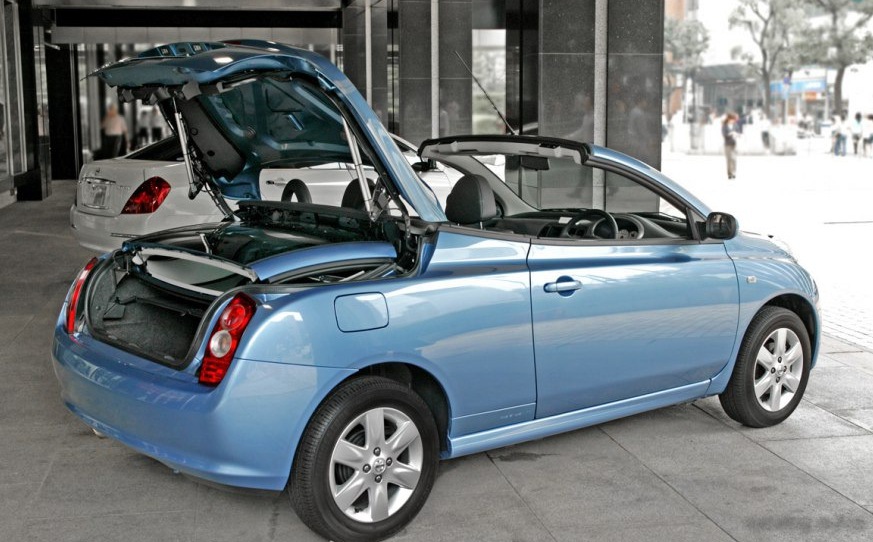
The Nissan Micra C+C (K12) 1.6 16V, produced from 2005 to 2009, represented Nissan’s foray into the compact roadster segment. Based on the K12 Micra supermini platform, the C+C – standing for “Compact Coupe” – distinguished itself with a folding hardtop convertible roof, offering open-air driving enjoyment with added security and weather protection. This variant, powered by the 1.6-liter HR16DE engine producing 110 horsepower, occupied a mid-range position within the C+C lineup, offering a balance between affordability and performance. It aimed to appeal to buyers seeking a stylish and practical convertible without the premium price tag of larger roadsters.
Technical Specifications
| Brand | Nissan |
| Model | Micra |
| Generation | Micra C+C (K12) |
| Type (Engine) | 1.6 16V (110 Hp) |
| Start of production | 2005 |
| End of production | 2009 |
| Powertrain Architecture | Internal Combustion engine |
| Body type | Cabriolet |
| Seats | 4 |
| Doors | 2 |
| Fuel consumption (urban) | 8.7 l/100 km (27 US mpg, 32.5 UK mpg, 11.5 km/l) |
| Fuel consumption (extra urban) | 5.6 l/100 km (42 US mpg, 50.4 UK mpg, 17.9 km/l) |
| Fuel Type | Petrol (Gasoline) |
| Acceleration 0 – 100 km/h | 10.6 sec |
| Acceleration 0 – 62 mph | 10.6 sec |
| Acceleration 0 – 60 mph | 10.1 sec |
| Maximum speed | 191 km/h (118.68 mph) |
| Weight-to-power ratio | 10.5 kg/Hp, 95.7 Hp/tonne |
| Weight-to-torque ratio | 7.5 kg/Nm, 133 Nm/tonne |
| Power | 110 Hp @ 6000 rpm |
| Power per litre | 68.8 Hp/l |
| Torque | 153 Nm @ 4400 rpm (112.85 lb.-ft. @ 4400 rpm) |
| Engine layout | Front, Transverse |
| Engine Model/Code | HR16DE |
| Engine displacement | 1598 cm3 (97.52 cu. in.) |
| Number of cylinders | 4 |
| Engine configuration | Inline |
| Cylinder Bore | 78 mm (3.07 in.) |
| Piston Stroke | 83.6 mm (3.29 in.) |
| Compression ratio | 10.7:1 |
| Number of valves per cylinder | 4 |
| Fuel injection system | Multi-port manifold injection |
| Engine aspiration | Naturally aspirated engine |
| Valvetrain | DOHC |
| Engine oil capacity | 4.5 l (4.76 US qt | 3.96 UK qt) |
| Coolant | 5.3 l (5.6 US qt | 4.66 UK qt) |
| Kerb Weight | 1150 kg (2535.32 lbs.) |
| Max. weight | 1540 kg (3395.12 lbs.) |
| Max load | 390 kg (859.8 lbs.) |
| Trunk (boot) space – minimum | 255 l (9.01 cu. ft.) |
| Trunk (boot) space – maximum | 457 l (16.14 cu. ft.) |
| Fuel tank capacity | 46 l (12.15 US gal | 10.12 UK gal) |
| Length | 3808 mm (149.92 in.) |
| Width | 1668 mm (65.67 in.) |
| Height | 1441 mm (56.73 in.) |
| Wheelbase | 2432 mm (95.75 in.) |
| Front track | 1460 mm (57.48 in.) |
| Rear (Back) track | 1448 mm (57.01 in.) |
| Drivetrain Architecture | The Internal combustion engine (ICE) drives the front wheels of the vehicle. |
| Drive wheel | Front wheel drive |
| Number of gears and type of gearbox | 5 gears, manual transmission |
| Front suspension | Independent coil spring |
| Rear suspension | Independent coil spring |
| Front brakes | Disc |
| Rear brakes | Drum |
| Assisting systems | ABS (Anti-lock braking system) |
| Tires size | 185/50R16 |
Powertrain & Engine Architecture
The heart of the Micra C+C 1.6 16V is the HR16DE engine, a 1.6-liter inline-four cylinder gasoline engine. This engine, part of Nissan’s HR series, featured a lightweight aluminum block and cylinder head, contributing to the car’s relatively low weight. The HR16DE utilizes multi-point fuel injection and a double overhead camshaft (DOHC) valvetrain with four valves per cylinder, optimizing airflow for improved performance. The engine’s 10.7:1 compression ratio further enhanced efficiency. The 110 horsepower and 153 Nm (113 lb-ft) of torque were delivered through a five-speed manual transmission, the only transmission option available for this specific variant. The engine’s design prioritized smooth operation and fuel economy over outright power, aligning with the C+C’s intended role as a stylish and accessible convertible.
Driving Characteristics
The 1.6-liter engine in the Micra C+C provided adequate, though not exhilarating, performance. Acceleration from 0 to 60 mph took around 10.1 seconds, and the top speed was approximately 118.68 mph. The five-speed manual transmission offered a reasonably engaging driving experience, but the relatively low power output meant that frequent downshifts were necessary for overtaking or climbing hills. Compared to the base 1.4-liter engine, the 1.6 offered a noticeable improvement in responsiveness. However, it lacked the punch of more powerful convertibles in the market. The C+C’s light weight helped to mitigate the engine’s limitations, providing a nimble feel in corners. The suspension, tuned for comfort, offered a compliant ride, although it wasn’t particularly sporty.
Equipment & Trim Levels
The Micra C+C 1.6 16V typically came equipped with features such as air conditioning, power steering, electric front windows, and a basic audio system. Safety features included ABS brakes and front airbags. Higher trim levels offered options like alloy wheels, leather upholstery, a more sophisticated audio system, and automatic climate control. The interior design was functional and modern for its time, with a focus on usability. The folding hardtop roof was the standout feature, providing a secure and weatherproof cabin when closed, and an open-air experience when retracted. Interior space was somewhat limited, particularly in the rear seats, reflecting the car’s compact dimensions.
Chassis & Braking
The Micra C+C utilized a front-wheel-drive layout with independent coil spring suspension at all four corners. The front suspension featured MacPherson struts, while the rear employed a torsion beam setup. This configuration provided a good balance between ride comfort and handling. Braking duties were handled by disc brakes at the front and drum brakes at the rear. ABS (Anti-lock Braking System) was standard, enhancing safety during emergency braking situations. The chassis was reinforced to compensate for the loss of structural rigidity resulting from the removal of the fixed roof, ensuring a safe and stable driving experience.
Market Reception & Comparison
The Nissan Micra C+C was generally well-received by critics as an affordable and stylish convertible. It was praised for its folding hardtop roof, which offered a practical alternative to traditional soft-top convertibles. However, some reviewers noted the engine’s lack of power and the car’s limited interior space. Compared to other small convertibles of the time, such as the Mazda MX-5, the Micra C+C offered a more comfortable ride and a more practical interior, but it lacked the MX-5’s sporty handling. Fuel economy was a strong point, with the 1.6-liter engine achieving around 42 mpg on the highway. Reliability was generally good, although some owners reported minor issues with the electrical system.
Legacy
The Nissan Micra C+C 1.6 16V remains a relatively affordable and accessible entry point into the world of convertible motoring. The HR16DE engine is known for its durability and relatively low maintenance costs. While not a performance car, the C+C offers a unique combination of style, practicality, and affordability. On the used car market, these models are generally well-maintained and can provide years of reliable service. The folding hardtop roof continues to be a desirable feature, offering the convenience of a coupe with the freedom of a convertible. The Micra C+C represents a significant chapter in Nissan’s history, demonstrating the company’s ability to innovate and offer compelling products in niche market segments.