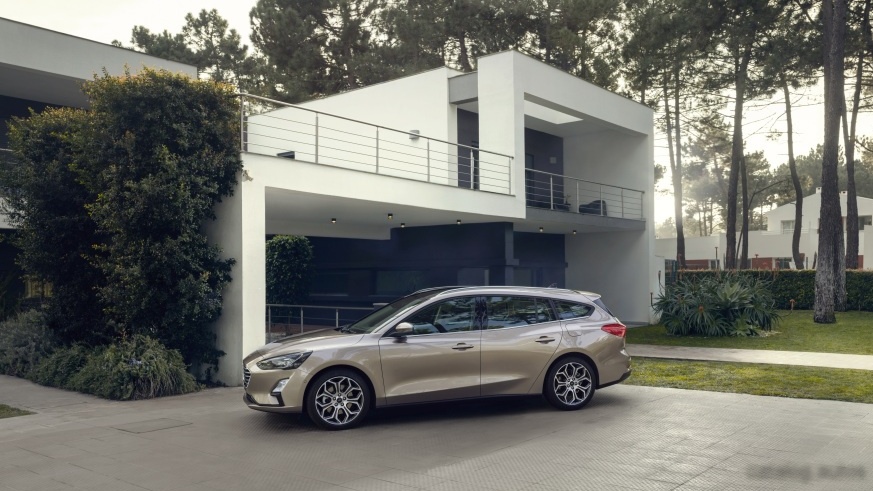
The Ford Focus IV Wagon 1.0 EcoBoost (125 hp) Automatic, produced from September 2018 to 2021, represented an entry-level powertrain option within the fourth generation of the globally successful Focus compact wagon. Positioned as a fuel-efficient and accessible variant, it catered to buyers prioritizing practicality and lower running costs over outright performance. This model was primarily sold in the European market, where wagons remain a popular body style, and to a lesser extent in other regions where the Focus was offered. It built upon the foundation of the Mk4 Focus (internally designated as the 55 platform), which aimed to improve upon its predecessor with increased refinement, technology, and driving dynamics.
Technical Specifications
| Brand | Ford |
| Model | Focus |
| Generation | Focus IV Wagon |
| Type (Engine) | 1.0 EcoBoost (125 Hp) Automatic |
| Start of production | September, 2018 |
| End of production | 2021 |
| Powertrain Architecture | Internal Combustion engine |
| Body type | Station wagon (estate) |
| Seats | 5 |
| Doors | 5 |
| Fuel consumption (urban) | 7.3-7.5 l/100 km (32.2 – 31.4 US mpg) |
| Fuel consumption (extra urban) | 4.9-5.1 l/100 km (48 – 46.1 US mpg) |
| Fuel consumption (combined) | 5.8-6.0 l/100 km (40.6 – 39.2 US mpg) |
| CO2 emissions | 130-135 g/km |
| Fuel Type | Petrol (Gasoline) |
| Acceleration 0 – 100 km/h | 11.4 sec |
| Acceleration 0 – 62 mph | 11.4 sec |
| Acceleration 0 – 60 mph | 10.8 sec |
| Maximum speed | 193 km/h (119.92 mph) |
| Emission standard | Euro 6 d |
| Weight-to-power ratio | 10.8 kg/Hp |
| Weight-to-torque ratio | 8 kg/Nm |
| Power | 125 Hp @ 6000 rpm |
| Torque | 170 Nm @ 1400-4500 rpm (125.39 lb.-ft. @ 1400-4500 rpm) |
| Engine layout | Front, Transverse |
| Engine Model/Code | B7DA |
| Engine displacement | 999 cm3 (60.96 cu. in.) |
| Number of cylinders | 3 |
| Engine configuration | Inline |
| Cylinder Bore | 71.9 mm (2.83 in.) |
| Piston Stroke | 82 mm (3.23 in.) |
| Compression ratio | 10.5:1 |
| Number of valves per cylinder | 4 |
| Fuel injection system | Direct injection |
| Engine aspiration | Turbocharger, Intercooler |
| Valvetrain | DOHC |
| Engine oil capacity | 4.5 l (4.76 US qt | 3.96 UK qt) |
| Coolant | 5.8 l (6.13 US qt | 5.1 UK qt) |
| Kerb Weight | 1356 kg (2989.47 lbs.) |
| Max. weight | 1970 kg (4343.11 lbs.) |
| Max load | 614 kg (1353.64 lbs.) |
| Trunk (boot) space – minimum | 608 l (21.47 cu. ft.) |
| Trunk (boot) space – maximum | 1653 l (58.38 cu. ft.) |
| Fuel tank capacity | 52 l (13.74 US gal | 11.44 UK gal) |
| Max. roof load | 75 kg (165.35 lbs.) |
| Permitted trailer load with brakes (12%) | 1300 kg (2866.01 lbs.) |
| Permitted trailer load without brakes | 715 kg (1576.31 lbs.) |
| Permitted towbar download | 90 kg (198.42 lbs.) |
| Length | 4667-4672 mm (183.74 – 183.94 in.) |
| Width | 1825 mm (71.85 in.) |
| Width with mirrors folded | 1848 mm (72.76 in.) |
| Width including mirrors | 1979 mm (77.91 in.) |
| Height | 1459-1469 mm (57.44 – 57.83 in.) |
| Wheelbase | 2700 mm (106.3 in.) |
| Front track | 1572 mm (61.89 in.) |
| Rear (Back) track | 1566 mm (61.65 in.) |
| Front overhang | 909 mm (35.79 in.) |
| Rear overhang | 1059 mm (41.69 in.) |
| Ride height (ground clearance) | 115-134 mm (4.53 – 5.28 in.) |
| Drag coefficient (Cd) | 0.28 |
| Minimum turning circle (turning diameter) | 11.0 m (36.09 ft.) |
| Drivetrain Architecture | Front wheel drive |
| Number of gears and type of gearbox | 8 gears, automatic transmission |
| Front brakes | Ventilated discs |
| Rear brakes | Disc |
| Assisting systems | ABS (Anti-lock braking system) |
| Steering type | Steering rack and pinion |
| Power steering | Electric Steering |
| Tires size | 195/65 R16; 205/60 R16; 215/50 R17; 235/40 R18 |
| Wheel rims size | 6.5J x 16; 7J x 17; 8J x 18 |
Powertrain & Engine Architecture
The heart of this Focus variant is the Ford 1.0 EcoBoost engine, specifically the B7DA iteration. This is a three-cylinder, 1.0-liter (999cc) turbocharged gasoline engine. It utilizes direct fuel injection and a double overhead camshaft (DOHC) valvetrain with four valves per cylinder. The engine’s compact size and lightweight construction contribute to the vehicle’s overall efficiency. The turbocharger, coupled with an intercooler, helps to boost power output despite the small displacement. The engine produces 125 horsepower at 6000 rpm and 170 Nm (125 lb-ft) of torque between 1400 and 4500 rpm. This torque curve provides reasonable responsiveness in everyday driving situations. Paired with this engine is an eight-speed automatic transmission, which was a relatively new offering for Ford at the time. This transmission aimed to provide smooth shifts and contribute to improved fuel economy compared to a traditional six-speed automatic.
Driving Characteristics
The 1.0 EcoBoost 125 hp automatic Focus Wagon delivers adequate, but not exhilarating, performance. Acceleration from 0-60 mph takes around 10.8 seconds, and top speed is approximately 119.92 mph. The automatic transmission, while smooth, can sometimes feel hesitant during quick acceleration or overtaking maneuvers. The gear ratios are tuned for fuel efficiency rather than outright performance. Compared to higher-output versions of the Focus, such as those equipped with the 1.5 EcoBoost engine, this variant feels noticeably slower. However, it offers a more relaxed driving experience, particularly in urban environments. The relatively low weight of the engine contributes to good front-end balance, but the three-cylinder engine can exhibit some vibration, particularly at idle.
Equipment & Trim Levels
The 1.0 EcoBoost Automatic typically came as a mid-range trim level, often designated as ‘Trend’ or ‘Titanium’ depending on the specific market. Standard equipment generally included air conditioning, power windows, power mirrors, a basic infotainment system with Bluetooth connectivity, and alloy wheels. Higher trim levels offered additional features such as a larger touchscreen display, navigation system, parking sensors, automatic headlights and wipers, and upgraded interior upholstery. Optional extras included a panoramic sunroof, heated seats, and advanced driver-assistance systems like adaptive cruise control and lane-keeping assist.
Chassis & Braking
The Focus IV Wagon utilizes a MacPherson strut front suspension and a multi-link rear suspension. The suspension setup is tuned to provide a balance between comfort and handling. The 1.0 EcoBoost variant typically featured smaller brake discs compared to higher-performance models. Front brakes were ventilated discs, while rear brakes were solid discs. Anti-lock Braking System (ABS) was standard. The steering is electric power-assisted, providing a light and responsive feel. Stabilizer bars were fitted to both the front and rear axles to reduce body roll during cornering.
Market Reception & Comparison
The 1.0 EcoBoost Automatic Focus Wagon was generally well-received by critics as a practical and fuel-efficient option. It was praised for its low running costs and comfortable ride. However, some reviewers noted the engine’s lack of outright power and the occasional hesitation of the automatic transmission. Compared to the 1.5 EcoBoost variants, the 1.0 EcoBoost offered significantly better fuel economy but at the expense of performance. The 1.0 EcoBoost also proved to be more reliable than some of the more complex engine options in the Focus lineup, particularly the diesel variants.
Legacy
The 1.0 EcoBoost engine has proven to be a relatively durable and reliable powertrain, although some early models experienced issues with timing belt failures. The eight-speed automatic transmission has also generally proven to be reliable, provided it receives regular maintenance. In the used car market, the 1.0 EcoBoost Automatic Focus Wagon represents a good value proposition for buyers seeking a practical and fuel-efficient family car. Its lower purchase price and running costs make it an attractive alternative to higher-performance or diesel-powered variants. The engine’s small displacement and turbocharging technology continue to be relevant in the automotive industry, as manufacturers strive to improve fuel efficiency and reduce emissions.