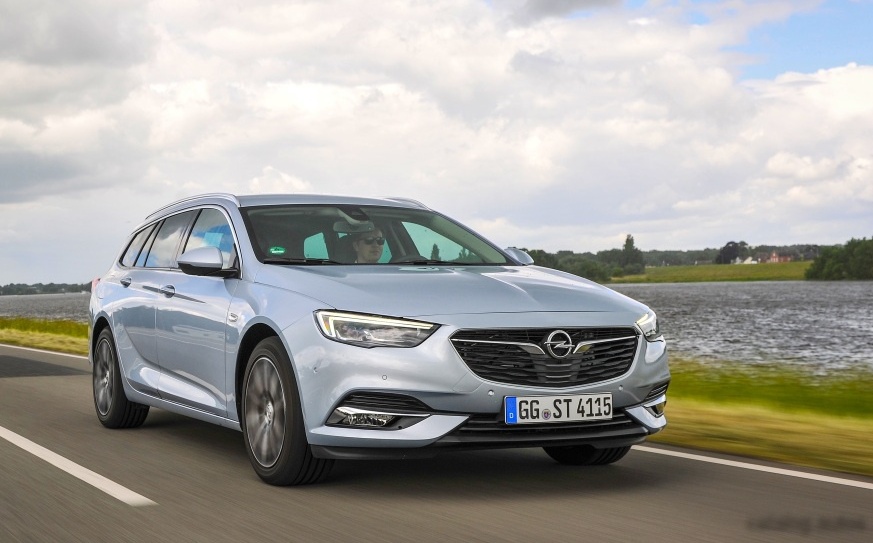
The Opel Insignia Sports Tourer (B) 1.5 Turbo, producing 165 horsepower, was a key variant within the second generation of Opel’s flagship D-segment vehicle. Introduced in June 2017 and remaining in production until June 2018, this model offered a balance between fuel efficiency and respectable performance within the Insignia range. Positioned as a mid-range option, it catered to buyers seeking a practical and comfortable estate car without the higher costs associated with the more powerful engine options. The Insignia B series, built on the GM’s E2 platform (also known as the 936 platform), aimed to compete with established rivals like the Ford Mondeo, Volkswagen Passat, and Peugeot 508.
Technical Specifications
| Brand | Opel |
| Model | Insignia |
| Generation | Insignia Sports Tourer (B) |
| Type (Engine) | 1.5 Turbo (165 Hp) |
| Start of production | June, 2017 |
| End of production | June, 2018 |
| Powertrain Architecture | Internal Combustion engine |
| Body type | Station wagon (estate) |
| Seats | 5 |
| Doors | 5 |
| Fuel consumption (urban) | 7.6 l/100 km (30.9 US mpg) |
| Fuel consumption (extra urban) | 5.2 l/100 km (45.2 US mpg) |
| Fuel consumption (combined) | 6.1 l/100 km (38.6 US mpg) |
| CO2 emissions | 139 g/km |
| Fuel Type | Petrol (Gasoline) |
| Acceleration 0 – 100 km/h | 9.2 sec |
| Acceleration 0 – 62 mph | 9.2 sec |
| Acceleration 0 – 60 mph | 8.7 sec |
| Maximum speed | 218 km/h (135.46 mph) |
| Emission standard | Euro 6 |
| Weight-to-power ratio | 8.6 kg/Hp |
| Weight-to-torque ratio | 5.6 kg/Nm |
| Power | 165 Hp @ 5600 rpm |
| Torque | 250 Nm @ 2000-4500 rpm (184.39 lb.-ft.) |
| Engine layout | Front, Transverse |
| Engine Model/Code | B15XFT |
| Engine displacement | 1490 cm3 (90.93 cu. in.) |
| Number of cylinders | 4 |
| Engine configuration | Inline |
| Cylinder Bore | 74 mm (2.91 in.) |
| Piston Stroke | 86.6 mm (3.41 in.) |
| Compression ratio | 10.1:1 |
| Number of valves per cylinder | 4 |
| Fuel injection system | Direct injection |
| Engine aspiration | Turbocharger, Intercooler |
| Valvetrain | DOHC |
| Engine oil capacity | 4 l (4.23 US qt | 3.52 UK qt) |
| Coolant | 5.4 l (5.71 US qt | 4.75 UK qt) |
| Kerb Weight | 1412 kg (3112.93 lbs.) |
| Max. weight | 2085 kg (4596.64 lbs.) |
| Max load | 673 kg (1483.71 lbs.) |
| Trunk (boot) space – minimum | 560 l (19.78 cu. ft.) |
| Trunk (boot) space – maximum | 1665 l (58.8 cu. ft.) |
| Fuel tank capacity | 62 l (16.38 US gal | 13.64 UK gal) |
| Max. roof load | 100 kg (220.46 lbs.) |
| Permitted trailer load with brakes (12%) | 1405 kg (3097.49 lbs.) |
| Permitted trailer load without brakes | 730 kg (1609.37 lbs.) |
| Length | 4986 mm (196.3 in.) |
| Width | 1863 mm (73.35 in.) |
| Width with mirrors folded | 1941 mm (76.42 in.) |
| Width including mirrors | 2093 mm (82.4 in.) |
| Height | 1500 mm (59.06 in.) |
| Wheelbase | 2829 mm (111.38 in.) |
| Front track | 1607 mm (63.27 in.) |
| Rear (Back) track | 1610 mm (63.39 in.) |
| Front overhang | 990 mm (38.98 in.) |
| Rear overhang | 1167 mm (45.94 in.) |
| Minimum turning circle | 11.74 m (38.52 ft.) |
| Drivetrain Architecture | Front wheel drive |
| Drive wheel | Front wheel drive |
| Number of gears and type of gearbox | 6 gears, manual transmission |
| Front suspension | Independent type McPherson |
| Front brakes | Ventilated discs |
| Rear brakes | Disc |
| Assisting systems | ABS (Anti-lock braking system) |
| Steering type | Steering rack and pinion |
| Power steering | Electric Steering |
| Tires size | 215/60 R16 |
| Wheel rims size | 6.5 J x 16 |
INTRODUCTION
The Opel Insignia Sports Tourer (B) 1.5 Turbo, launched in 2017, represented a significant step forward for Opel in the competitive mid-size estate car segment. This variant, powered by the B15XFT engine, was designed to appeal to families and individuals needing a spacious and practical vehicle with reasonable running costs. The ‘B’ designation signifies the second generation of the Insignia, which brought with it a lighter chassis, improved aerodynamics, and a more refined interior compared to its predecessor. The Sports Tourer body style, Opel’s term for a station wagon, offered increased cargo capacity and versatility, making it a popular choice for those with active lifestyles. This 165 hp version was a key part of the lineup, offering a balance between performance and economy.
Powertrain & Engine Architecture
At the heart of the Insignia Sports Tourer 1.5 Turbo lies the B15XFT engine, a 1.5-liter turbocharged four-cylinder petrol engine. This engine is part of Opel’s Small Displacement Gasoline (SDG) family, designed for efficiency and reduced emissions. The B15XFT utilizes direct injection technology, injecting fuel directly into the combustion chamber for improved fuel atomization and combustion efficiency. It also features a turbocharger with an intercooler, which forces more air into the engine, boosting power output. The engine produces 165 horsepower at 5600 rpm and 250 Nm (184 lb-ft) of torque between 2000 and 4500 rpm. The engine employs a Dual Overhead Camshaft (DOHC) valvetrain with four valves per cylinder. The engine is transversely mounted at the front of the vehicle. The 1.5 Turbo was typically paired with a six-speed manual transmission, although an optional six-speed automatic transmission was also available. The automatic transmission offered smoother gear changes and enhanced convenience, but at the expense of slightly reduced fuel economy.
Driving Characteristics
The 1.5 Turbo engine, while not the most powerful option in the Insignia range, provided adequate performance for everyday driving. Acceleration from 0 to 62 mph (0-100 km/h) took around 9.2 seconds. The engine felt responsive at lower revs, thanks to the turbocharger, and offered sufficient power for overtaking maneuvers on the highway. Compared to the higher-output 2.0-liter turbocharged engine, the 1.5 Turbo felt less eager to rev and lacked the same level of outright acceleration. However, it offered a more relaxed and fuel-efficient driving experience. The six-speed manual transmission provided precise gear changes, while the optional automatic transmission offered smooth and seamless shifts. The Insignia’s suspension provided a comfortable ride, absorbing bumps and imperfections in the road surface effectively. The steering was light and precise, making it easy to maneuver in urban environments.
Equipment & Trim Levels
The Insignia Sports Tourer 1.5 Turbo typically came equipped with a generous amount of standard features. These included air conditioning, a touchscreen infotainment system with Bluetooth connectivity, USB ports, and a multi-function steering wheel. Safety features such as ABS, electronic stability control, and multiple airbags were also standard. Higher trim levels offered additional features such as leather upholstery, heated front seats, a panoramic sunroof, and advanced driver-assistance systems like adaptive cruise control and lane departure warning. Interior upholstery was typically cloth on the base models, with leather options available on higher trims. The dashboard layout was modern and ergonomic, with a focus on user-friendliness.
Chassis & Braking
The Insignia Sports Tourer featured a McPherson strut front suspension and a multi-link rear suspension, providing a good balance between ride comfort and handling. The front brakes were ventilated discs, while the rear brakes were solid discs. ABS (Anti-lock Braking System) was standard, ensuring safe and controlled braking in emergency situations. The chassis was designed to be lightweight yet rigid, contributing to the car’s overall handling and stability. Stabilizer bars were fitted to both the front and rear axles to reduce body roll during cornering.
Market Reception & Comparison
The Opel Insignia Sports Tourer 1.5 Turbo was generally well-received by automotive critics. It was praised for its spacious interior, comfortable ride, and fuel efficiency. However, some critics noted that the 1.5 Turbo engine lacked the punch of the more powerful engine options. Compared to the 2.0-liter turbocharged models, the 1.5 Turbo offered better fuel economy but less performance. The 1.5 Turbo was also a more affordable option, making it an attractive choice for budget-conscious buyers. In terms of reliability, the B15XFT engine proved to be generally reliable, although some owners reported minor issues with the turbocharger and fuel injectors.
Legacy
The Opel Insignia Sports Tourer 1.5 Turbo remains a popular choice in the used car market today. Its combination of practicality, comfort, and fuel efficiency makes it a compelling option for families and individuals seeking a versatile estate car. The B15XFT engine has proven to be relatively durable, and parts availability is generally good. While not as sought-after as the higher-performance models, the 1.5 Turbo offers a good value proposition for those seeking a reliable and affordable estate car. Its legacy lies in providing a well-rounded and practical option within the Insignia range, appealing to a broad spectrum of buyers.