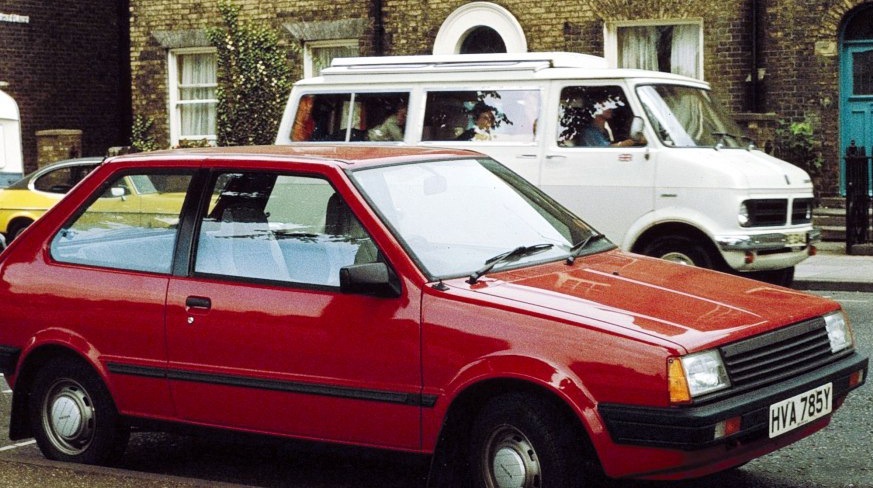
The Nissan Micra K10, produced from 1986 to 1992, represented a significant step forward for Nissan’s small car offerings in Europe and other international markets. The 1.2-liter (54 horsepower) variant, powered by the MA12 engine, served as the entry point to the K10 range, offering affordable and economical transportation. Positioned as the base model, it was designed for buyers prioritizing fuel efficiency and low running costs over outright performance. This generation Micra was a key player in Nissan’s expansion beyond its traditional Japanese market, establishing a foothold in the competitive European supermini segment.
Technical Specifications
| Brand | Nissan |
| Model | Micra |
| Generation | Micra (K10) |
| Type (Engine) | 1.2 (54 Hp) |
| Start of production | 1986 |
| End of production | 1992 |
| Powertrain Architecture | Internal Combustion engine |
| Body type | Hatchback |
| Fuel Type | Petrol (Gasoline) |
| Power | 54 Hp |
| Engine Model/Code | MA12 |
| Engine aspiration | Naturally aspirated engine |
| Engine oil capacity | 2.8 l (2.96 US qt | 2.46 UK qt) |
| Coolant capacity | 4.3 l (4.54 US qt | 3.78 UK qt) |
Powertrain & Engine Architecture
The heart of the K10 1.2 was the MA12 engine, a 1.2-liter (1189cc) inline-four cylinder petrol engine. This engine was a relatively simple design, featuring a single overhead camshaft (SOHC) operating two valves per cylinder. Fuel delivery was managed by a carburetor, a common feature for vehicles of this era and price point. The MA12 engine was known for its reliability and ease of maintenance, though it lacked the sophistication of more modern fuel injection systems. The engine’s modest output of 54 horsepower at 6000 rpm and 76 lb-ft of torque at 4000 rpm was geared towards maximizing fuel economy rather than providing spirited acceleration. The transmission was typically a four-speed manual, though a three-speed automatic transmission was also available, albeit less common. The automatic version further reduced performance but offered increased convenience for urban driving.
Driving Characteristics
The 1.2-liter Micra K10 offered a decidedly unhurried driving experience. Acceleration was modest, with a 0-60 mph time estimated around 16-18 seconds. The focus was on smooth, economical cruising rather than sporty handling. The four-speed manual transmission allowed drivers to make the most of the engine’s limited power, while the three-speed automatic, while convenient, resulted in noticeable performance degradation. Gear ratios were optimized for fuel efficiency, with taller gearing in the upper ranges. The suspension, consisting of MacPherson struts at the front and a twist-beam rear axle, provided a comfortable ride, absorbing bumps and imperfections in the road reasonably well. Steering was light and easy, making the Micra well-suited for navigating crowded city streets. Compared to the later 1.4 and 1.6-liter versions of the K10, the 1.2 felt noticeably slower, particularly when fully loaded or climbing hills.
Equipment & Trim Levels
The K10 1.2, as the entry-level model, was typically equipped with basic amenities. Standard features generally included cloth upholstery, a simple dashboard layout with analog gauges, and manual windows and door locks. Power steering was not standard on the base model, though it was often available as an optional extra. Radio fitment was also typically an optional item. Interior trim was functional and durable, prioritizing practicality over luxury. Higher trim levels, such as the LX and S, added features like upgraded upholstery, a more comprehensive instrument cluster, and optional extras like alloy wheels and a sunroof. The base 1.2 model was often seen as a blank canvas for buyers who wanted to add their own personal touches.
Chassis & Braking
The K10 Micra featured a relatively lightweight chassis, contributing to its fuel efficiency. Front suspension utilized MacPherson struts, providing a comfortable ride and predictable handling. The rear suspension employed a simple twist-beam axle, which was cost-effective and space-efficient. Braking on the base 1.2 model typically consisted of disc brakes at the front and drum brakes at the rear. This configuration was adequate for the car’s weight and performance, but lacked the stopping power of all-disc setups found on higher-spec models. Stabilizer bars were often omitted on the base model to further reduce cost, resulting in slightly more body roll during cornering. The steering system was a rack-and-pinion setup, providing reasonably precise steering feel.
Market Reception & Comparison
The Nissan Micra K10 1.2 was generally well-received as an affordable and reliable city car. Critics praised its fuel economy and ease of driving, but noted its lack of performance. Compared to rivals like the Ford Fiesta, Volkswagen Polo, and Peugeot 205, the Micra 1.2 offered a competitive price point and a reputation for dependability. However, it lagged behind some competitors in terms of refinement and driving dynamics. The 1.4 and 1.6-liter versions of the K10 offered significantly improved performance, but at a higher price. Fuel economy for the 1.2-liter model was typically in the range of 45-55 mpg, making it an attractive option for budget-conscious buyers. Reliability was generally good, with the MA12 engine proving to be a durable and long-lasting unit.
Legacy
The Nissan Micra K10 1.2 remains a popular choice among classic car enthusiasts and those seeking an affordable and reliable runabout. The MA12 engine, while simple, is known for its robustness and relatively low maintenance costs. Parts availability is generally good, although some components may be becoming increasingly difficult to find. The K10’s simple construction makes it relatively easy to repair and maintain for those with basic mechanical skills. In the used car market, well-maintained examples of the 1.2-liter Micra K10 can still command reasonable prices, particularly those with low mileage and a complete service history. The K10 1.2 represents a significant chapter in Nissan’s history, demonstrating the company’s ability to produce a competitive and affordable small car for the European market.