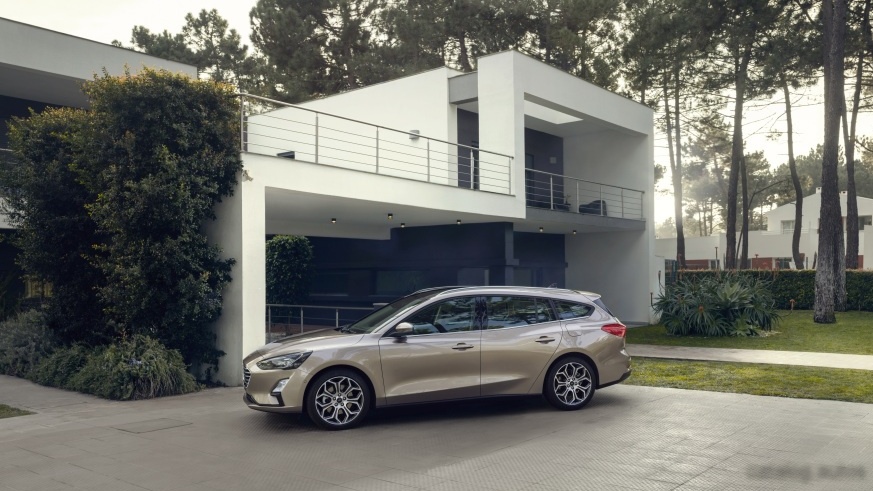
The Ford Focus IV Wagon 1.5 EcoBlue (95 hp) represents a fuel-efficient and practical offering within the fourth generation of the globally successful Focus compact wagon. Introduced in September 2018 and remaining in production through 2021, this variant was primarily aimed at the European market, where diesel-powered wagons continue to hold significant appeal. It occupied the entry-level position in the Focus IV Wagon lineup, offering a balance of affordability, economy, and practicality for families and individuals seeking a versatile vehicle. This model is part of the larger Focus IV series, built on the C2 platform (also known as the 1HX0/A3 platform), which brought improvements in interior space, driving dynamics, and technology compared to its predecessor.
Technical Specifications
| Brand | Ford |
| Model | Focus |
| Generation | Focus IV Wagon |
| Type (Engine) | 1.5 EcoBlue (95 Hp) |
| Start of production | September, 2018 |
| End of production | 2021 |
| Powertrain Architecture | Internal Combustion engine |
| Body type | Station wagon (estate) |
| Seats | 5 |
| Doors | 5 |
| Fuel consumption (urban) | 4.0-4.1 l/100 km (58.8 – 57.4 US mpg) |
| Fuel consumption (extra urban) | 3.5-3.7 l/100 km (67.2 – 63.6 US mpg) |
| Fuel consumption (combined) | 3.6-3.8 l/100 km (65.3 – 61.9 US mpg) |
| CO2 emissions | 96-100 g/km |
| Fuel Type | Diesel |
| Acceleration 0 – 100 km/h | 11.8 sec |
| Acceleration 0 – 62 mph | 11.8 sec |
| Acceleration 0 – 60 mph | 11.2 sec |
| Maximum speed | 181 km/h (112.47 mph) |
| Emission standard | Euro 6 d |
| Weight-to-power ratio | 14.1 kg/Hp |
| Weight-to-torque ratio | 4.5 kg/Nm |
| Power | 95 Hp @ 3600 rpm |
| Torque | 300 Nm @ 1750-2000 rpm (221.27 lb.-ft. @ 1750-2000 rpm) |
| Engine layout | Front, Transverse |
| Engine Model/Code | ZTDB |
| Engine displacement | 1500 cm3 (91.54 cu. in.) |
| Number of cylinders | 4 |
| Engine configuration | Inline |
| Cylinder Bore | 75 mm (2.95 in.) |
| Piston Stroke | 84.8 mm (3.34 in.) |
| Compression ratio | 16.4:1 |
| Number of valves per cylinder | 4 |
| Fuel injection system | Diesel Commonrail |
| Engine aspiration | Turbocharger, Intercooler |
| Valvetrain | DOHC |
| Engine oil capacity | 6.2 l (6.55 US qt | 5.46 UK qt) |
| Coolant | 6.7 l (7.08 US qt | 5.9 UK qt) |
| Kerb Weight | 1338 kg (2949.79 lbs.) |
| Max. weight | 1955 kg (4310.04 lbs.) |
| Max load | 617 kg (1360.25 lbs.) |
| Trunk (boot) space – minimum | 608 l (21.47 cu. ft.) |
| Trunk (boot) space – maximum | 1653 l (58.38 cu. ft.) |
| Fuel tank capacity | 47 l (12.42 US gal | 10.34 UK gal) |
| Max. roof load | 75 kg (165.35 lbs.) |
| Permitted trailer load with brakes (12%) | 1200 kg (2645.55 lbs.) |
| Permitted trailer load without brakes | 705 kg (1554.26 lbs.) |
| Permitted towbar download | 80 kg (176.37 lbs.) |
| Length | 4668 mm (183.78 in.) |
| Width | 1825 mm (71.85 in.) |
| Width with mirrors folded | 1848 mm (72.76 in.) |
| Width including mirrors | 1979 mm (77.91 in.) |
| Height | 1481 mm (58.31 in.) |
| Wheelbase | 2700 mm (106.3 in.) |
| Front track | 1572 mm (61.89 in.) |
| Rear (Back) track | 1566 mm (61.65 in.) |
| Front overhang | 909 mm (35.79 in.) |
| Rear overhang | 1059 mm (41.69 in.) |
| Ride height (ground clearance) | 115-134 mm (4.53 – 5.28 in.) |
| Drag coefficient (Cd) | 0.28 |
| Minimum turning circle (turning diameter) | 11.0 m (36.09 ft.) |
| Drivetrain Architecture | The Internal combustion engine (ICE) drives the front wheels of the vehicle. |
| Drive wheel | Front wheel drive |
| Number of gears and type of gearbox | 6 gears, manual transmission |
| Front brakes | Ventilated discs |
| Rear brakes | Disc |
| Assisting systems | ABS (Anti-lock braking system) |
| Steering type | Steering rack and pinion |
| Power steering | Electric Steering |
| Tires size | 195/65 R16; 205/60 R16; 215/50 R17; 235/40 R18 |
| Wheel rims size | 6.5J x 16; 7J x 17; 8J x 18 |
Powertrain & Engine Architecture
The heart of this Focus variant is the 1.5-liter EcoBlue turbocharged diesel engine, designated with the code ZTDB. This engine is part of Ford’s EcoBlue family, known for its focus on efficiency and reduced emissions. The 1.5L EcoBlue utilizes a common-rail direct fuel injection system, delivering fuel directly into the cylinders at extremely high pressure for optimized combustion. The engine features a single turbocharger with an intercooler to increase air density and improve power output. The valvetrain employs a double overhead camshaft (DOHC) configuration with four valves per cylinder, enhancing breathing and contributing to the engine’s torque characteristics. The engine produces 95 horsepower at 3600 rpm and 300 Nm (221 lb-ft) of torque between 1750 and 2000 rpm. This torque band provides good low-end responsiveness, suitable for everyday driving and hauling loads. The engine’s high compression ratio of 16.4:1 is typical for modern diesel engines, contributing to thermal efficiency.
Driving Characteristics
The 95 hp EcoBlue engine, paired with a 6-speed manual transmission, delivers adequate performance for typical driving scenarios. Acceleration from 0 to 62 mph (0-100 km/h) takes approximately 11.8 seconds, and the top speed is 181 km/h (112.47 mph). While not a performance-oriented setup, the engine’s strong low-end torque makes it feel more responsive than the figures suggest. Compared to higher-output versions of the 1.5 EcoBlue or the 1.0 EcoBoost petrol engine, this variant prioritizes fuel economy over outright speed. The gear ratios are tuned for efficiency, with taller gearing in higher gears to reduce engine speed at cruising speeds. The manual transmission provides a direct connection to the engine, allowing for precise control, but it lacks the convenience of an automatic.
Equipment & Trim Levels
The 1.5 EcoBlue (95 hp) variant typically served as the entry point to the Focus IV Wagon range. Standard equipment generally included air conditioning, power windows, power mirrors, a basic audio system with Bluetooth connectivity, and a suite of safety features such as ABS, ESP (Electronic Stability Program), and multiple airbags. Interior upholstery was typically cloth, and the dashboard featured a functional but relatively basic design. Optional extras included alloy wheels, a touchscreen infotainment system with navigation, parking sensors, and a panoramic sunroof. Trim levels varied slightly depending on the specific market, but this engine was generally offered in lower to mid-range trims.
Chassis & Braking
The Focus IV Wagon features a fully independent front suspension with MacPherson struts and a multi-link rear suspension. This setup provides a good balance of ride comfort and handling. The 1.5 EcoBlue variant typically used ventilated front disc brakes and solid rear disc brakes. The braking system is assisted by ABS and ESP, enhancing stability and control during emergency braking. Steering is provided by an electric power steering system, offering light and precise control. The suspension tuning is geared towards comfort, but the Focus IV Wagon still offers a reasonably engaging driving experience.
Market Reception & Comparison
The 1.5 EcoBlue (95 hp) variant was well-received in markets where diesel wagons are popular, particularly in Europe. Critics praised its fuel efficiency and practicality, but some noted its relatively modest performance. Compared to the 1.0 EcoBoost petrol engine, the diesel offered superior fuel economy and torque, but at the expense of refinement and responsiveness. Compared to higher-output diesel variants, such as the 1.5 EcoBlue 120 hp, this version offered a more affordable entry point but lacked the extra power for more demanding driving situations. Its fuel economy figures of 3.6-3.8 l/100 km (65.3 – 61.9 US mpg) were a key selling point.
Legacy
The 1.5 EcoBlue engine has proven to be a relatively reliable powertrain, although, like all diesel engines, it requires regular maintenance, including oil changes and diesel particulate filter (DPF) regeneration. On the used car market, the Focus IV Wagon 1.5 EcoBlue (95 hp) represents a sensible and economical choice for buyers seeking a practical and fuel-efficient wagon. Its affordability and low running costs make it an attractive option for families and individuals who prioritize value and efficiency over outright performance. The engine’s durability and the Focus’s overall build quality contribute to its continued appeal in the used car market.