Technical Specifications
| Brand | Nissan |
| Model | Micra |
| Generation | Micra (K11) |
| Type (Engine) | 1.0i 16V (54 Hp) CVT |
| Start of production | 1992 |
| End of production | 2000 |
| Powertrain Architecture | Internal Combustion engine |
| Body type | Hatchback |
| Seats | 5 |
| Doors | 3/5 |
| Fuel consumption (urban) | 7.1 l/100 km (33.1 US mpg, 39.8 UK mpg, 14.1 km/l) |
| Fuel consumption (extra urban) | 5.2 l/100 km (45.2 US mpg, 54.3 UK mpg, 19.2 km/l) |
| Fuel consumption (combined) | 6.1 l/100 km (38.6 US mpg, 46.3 UK mpg, 16.4 km/l) |
| Fuel Type | Petrol (Gasoline) |
| Acceleration 0 – 100 km/h | 19.7 sec |
| Acceleration 0 – 62 mph | 19.7 sec |
| Acceleration 0 – 60 mph | 18.7 sec |
| Maximum speed | 145 km/h (90.1 mph) |
| Weight-to-power ratio | 14.4 kg/Hp, 69.7 Hp/tonne |
| Weight-to-torque ratio | 9.8 kg/Nm, 101.9 Nm/tonne |
| Power | 54 Hp @ 6000 rpm |
| Power per litre | 54.1 Hp/l |
| Torque | 79 Nm @ 4000 rpm (58.27 lb.-ft. @ 4000 rpm) |
| Engine layout | Front, Transverse |
| Engine Model/Code | CG10DE |
| Engine displacement | 998 cm3 (60.9 cu. in.) |
| Number of cylinders | 4 |
| Engine configuration | Inline |
| Cylinder Bore | 71 mm (2.8 in.) |
| Piston Stroke | 63 mm (2.48 in.) |
| Compression ratio | 9.5:1 |
| Number of valves per cylinder | 4 |
| Fuel injection system | Multi-port manifold injection |
| Engine aspiration | Naturally aspirated engine |
| Valvetrain | DOHC |
| Engine oil capacity | 3.1 l (3.28 US qt | 2.73 UK qt) |
| Coolant capacity | 4 l (4.23 US qt | 3.52 UK qt) |
| Kerb Weight | 775 kg (1708.58 lbs.) |
| Max. weight | 1290 kg (2843.96 lbs.) |
| Max load | 515 kg (1135.38 lbs.) |
| Trunk (boot) space – minimum | 206 l (7.27 cu. ft.) |
| Trunk (boot) space – maximum | 960 l (33.9 cu. ft.) |
| Fuel tank capacity | 42 l (11.1 US gal | 9.24 UK gal) |
| Length | 3695 mm (145.47 in.) |
| Width | 1585 mm (62.4 in.) |
| Height | 1430 mm (56.3 in.) |
| Wheelbase | 2360 mm (92.91 in.) |
| Front track | 1360 mm (53.54 in.) |
| Rear track | 1325 mm (52.17 in.) |
| Drivetrain Architecture | Front wheel drive |
| Number of gears and type of gearbox | 1 gears, automatic transmission CVT |
| Front suspension | Wishbone |
| Rear suspension | Spring Strut |
| Front brakes | Disc |
| Rear brakes | Drum |
| Assisting systems | ABS (Anti-lock braking system) |
| Steering type | Steering rack and pinion |
| Tires size | 155/70 R13 |
| Wheel rims size | 13 |
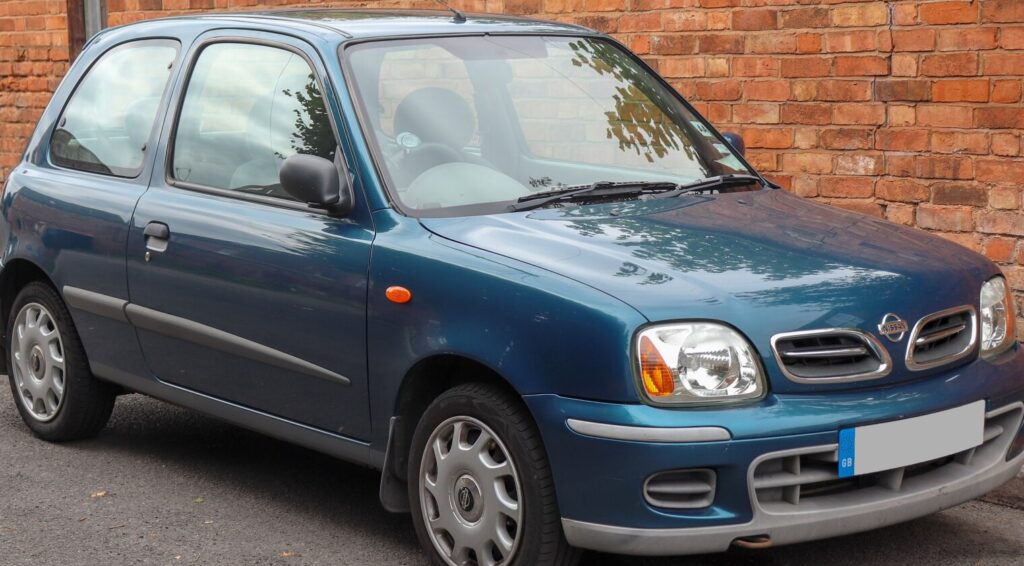
The Nissan Micra K11, produced from 1992 to 2000, marked a significant evolution in Nissan’s supermini lineup. The 1.0i 16V variant, paired with a Continuously Variable Transmission (CVT), was introduced as an entry-level option specifically targeting buyers who valued fuel efficiency and ease of operation. This model occupied the lower end of the K11 range, which also included 1.3 and 1.4 liter engine choices, and was primarily sold in European and Japanese markets, where compact, economical cars were in high demand. The K11 generation was recognized for its surprisingly spacious interior and relatively modern styling for its time, and the 1.0i CVT version offered a particularly accessible price point.
Powertrain & Engine Architecture
The powertrain of the K11 1.0i CVT centers around the CG10DE engine, a 998cc inline-four cylinder gasoline engine. This engine incorporates a multi-port fuel injection system and a double overhead camshaft (DOHC) valvetrain, contributing to its efficient operation. The 16 valves (four per cylinder) enhance airflow and help achieve the engine’s 54 horsepower output at 6000 rpm and 79 Nm (58.27 lb-ft) of torque at 4000 rpm. The engine’s small displacement and modest power were typical for this vehicle class in 1990s Europe, where fuel economy and low running costs were paramount. The CVT transmission, a relatively new technology at the time, provided smooth, stepless gear changes, offering a more refined acceleration experience compared to a traditional manual gearbox. Unlike conventional automatic transmissions with fixed gear ratios, a CVT utilizes a belt or chain system to deliver a virtually infinite number of gear ratios within its operating range.
Driving Characteristics
The 1.0i CVT Micra wasn’t designed for performance. Acceleration was deliberate, taking approximately 18.7 seconds to reach 60 mph. The CVT transmission, while smooth, created a unique driving sensation compared to a manual or traditional automatic. The engine frequently revved to its peak power output and remained there during acceleration, resulting in a noticeable ‘rubber band’ effect. This meant engine speed didn’t always directly correspond to vehicle speed. However, for city driving and commuting, the CVT proved comfortable and convenient. The gear ratios were optimized for fuel efficiency, making it an economical choice for urban environments. Compared to the 1.3 and 1.4 liter models, the 1.0i offered significantly less power, but also lower running costs and insurance premiums.
Equipment & Trim Levels
The 1.0i CVT Micra generally came with a basic equipment level, reflecting its position as the entry-level model. Standard features typically included power steering, central locking, and a basic stereo system. Interior upholstery was usually cloth, and the dashboard featured a simple, functional layout. Optional extras, depending on the market, could include air conditioning, electric windows, and alloy wheels. The trim level was often indicated by a badge on the rear of the vehicle. The emphasis was on providing a practical and affordable vehicle, rather than luxury or extensive features.
Chassis & Braking
The K11 Micra employed a front-wheel-drive layout with a relatively straightforward suspension setup. The front suspension featured independent wishbones, while the rear suspension utilized a spring strut arrangement. Braking was typically disc brakes on the front wheels and drum brakes on the rear, a common configuration for vehicles in this price bracket at the time. Anti-lock Braking System (ABS) was often included as standard equipment, enhancing safety. The chassis was engineered to provide a comfortable ride, prioritizing compliance over sporty handling. Stabilizer bars were used to minimize body roll during cornering, but the overall driving experience was geared towards everyday usability.
Market Reception & Comparison
The 1.0i CVT Micra was generally well-received as an affordable and fuel-efficient city car. Critics praised its fuel economy and ease of driving, particularly the smooth operation of the CVT transmission. However, the limited power output was often noted, and some reviewers found the ‘rubber band’ effect of the CVT to be unusual. Compared to other superminis of the era, such as the Ford Fiesta and Peugeot 205, the Micra offered a competitive package in terms of price and fuel economy. The 1.3 and 1.4 liter Micra models provided more performance, but at a higher cost. The 1.0i CVT appealed to buyers who prioritized low running costs and ease of use over outright performance.
Legacy
The Nissan Micra K11, and specifically the 1.0i CVT variant, has proven to be a relatively reliable vehicle. The CG10DE engine is known for its durability, and the CVT transmission, with regular fluid maintenance, can provide years of service. Today, these cars are relatively inexpensive to purchase and maintain, making them popular choices for first-time drivers or those seeking an economical vehicle. While not a highly collectible model, well-maintained examples are becoming increasingly scarce, and the K11 generation is fondly remembered for its practicality and affordability.