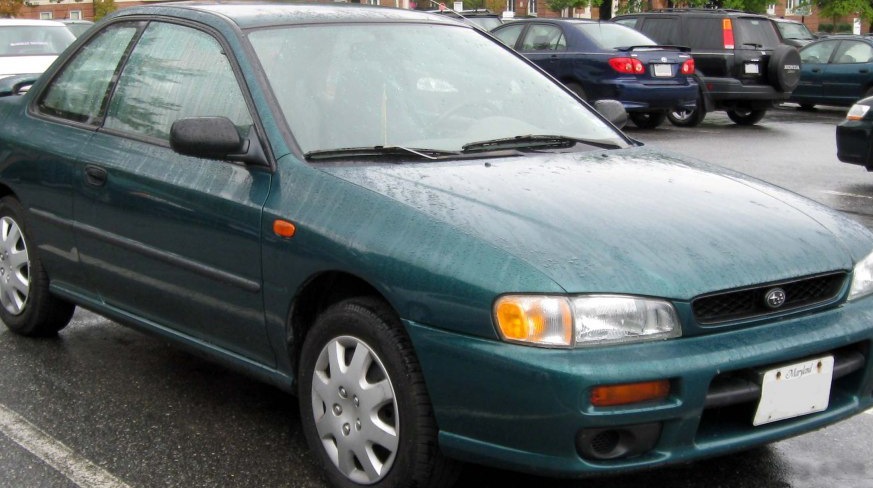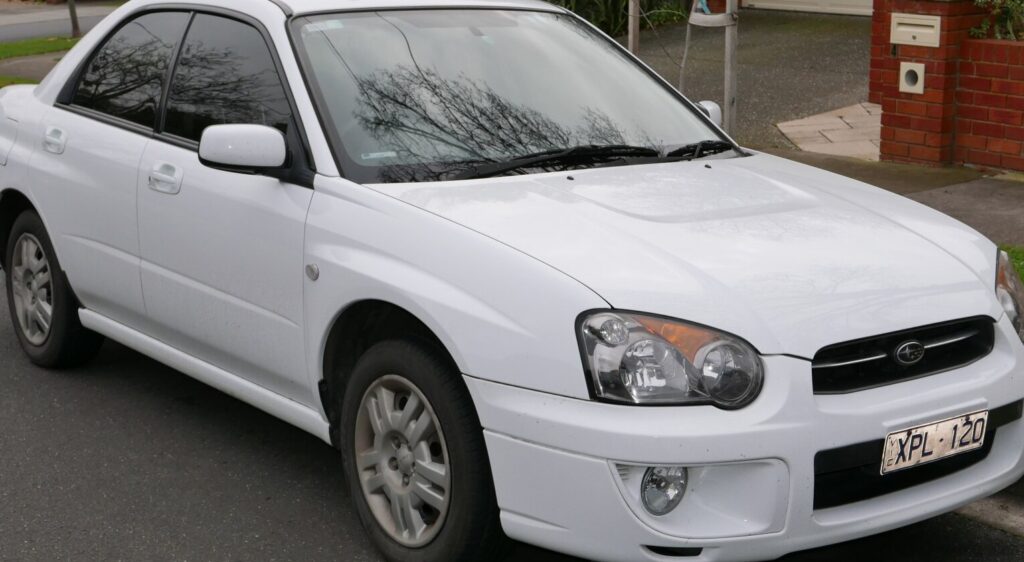
The Subaru Impreza II, specifically the facelifted version introduced in 2002, represented a significant evolution of Subaru’s popular compact car. Produced between 2002 and 2005, this generation continued the Impreza’s reputation for standard all-wheel drive and a focus on practicality. The 2.0-liter (125 hp) AWD variant occupied a middle ground in the Impreza lineup, offering a balance between affordability, fuel efficiency, and the renowned Subaru symmetrical all-wheel drive system. It served as a more accessible entry point into the Impreza range compared to the higher-performance WRX models, appealing to buyers prioritizing everyday usability and all-weather capability.
Technical Specifications
| Brand | Subaru |
| Model | Impreza |
| Generation | Impreza II (facelift 2002) |
| Type (Engine) | 2.0 (125 Hp) AWD |
| Start of production | 2002 |
| End of production | 2005 |
| Powertrain Architecture | Internal Combustion engine |
| Body type | Sedan |
| Seats | 5 |
| Doors | 4 |
| Fuel consumption (economy) – urban (NEDC) | 12.4 l/100 km (19 US mpg, 22.8 UK mpg, 8.1 km/l) |
| Fuel consumption (economy) – extra urban (NEDC) | 6.6 l/100 km (35.6 US mpg, 42.8 UK mpg, 15.2 km/l) |
| Fuel consumption (economy) – combined (NEDC) | 8.9 l/100 km (26.4 US mpg, 31.7 UK mpg, 11.2 km/l) |
| CO2 emissions (NEDC) | 212 g/km |
| Fuel Type | Petrol (Gasoline) |
| Acceleration 0 – 100 km/h | 10.2 sec |
| Acceleration 0 – 62 mph | 10.2 sec |
| Acceleration 0 – 60 mph | 9.7 sec |
| Maximum speed | 191 km/h (118.68 mph) |
| Emission standard | Euro 3 |
| Weight-to-power ratio | 10.6 kg/Hp, 94 Hp/tonne |
| Weight-to-torque ratio | 7.2 kg/Nm, 138.3 Nm/tonne |
| Power | 125 Hp @ 5600 rpm |
| Power per litre | 62.7 Hp/l |
| Torque | 184 Nm @ 3600 rpm (135.71 lb.-ft. @ 3600 rpm) |
| Engine layout | Front, Longitudinal |
| Engine Model/Code | EJ201 |
| Engine displacement | 1994 cm3 (121.68 cu. in.) |
| Number of cylinders | 4 |
| Engine configuration | Boxer |
| Cylinder Bore | 92 mm (3.62 in.) |
| Piston Stroke | 75 mm (2.95 in.) |
| Compression ratio | 10:1 |
| Number of valves per cylinder | 4 |
| Fuel injection system | Multi-port manifold injection |
| Engine aspiration | Naturally aspirated engine |
| Valvetrain | SOHC |
| Engine oil capacity | 4.5 l (4.76 US qt, 3.96 UK qt) |
| Coolant | 7 l (7.4 US qt, 6.16 UK qt) |
| Kerb Weight | 1330 kg (2932.15 lbs.) |
| Max. weight | 1760 kg (3880.14 lbs.) |
| Max load | 430 kg (947.99 lbs.) |
| Trunk (boot) space – minimum | 401 l (14.16 cu. ft.) |
| Fuel tank capacity | 50 l (13.21 US gal, 11 UK gal) |
| Max. roof load | 80 kg (176.37 lbs.) |
| Permitted trailer load with brakes (12%) | 1200 kg (2645.55 lbs.) |
| Permitted trailer load without brakes | 500 kg (1102.31 lbs.) |
| Length | 4415 mm (173.82 in.) |
| Width | 1740 mm (68.5 in.) |
| Height | 1440 mm (56.69 in.) |
| Wheelbase | 2525 mm (99.41 in.) |
| Front track | 1485 mm (58.46 in.) |
| Rear (Back) track | 1475 mm (58.07 in.) |
| Ride height (ground clearance) | 150 mm (5.91 in.) |
| Drivetrain Architecture | The Internal combustion engine (ICE) drives permanently the four wheels of the vehicle. |
| Drive wheel | All wheel drive (4×4) |
| Number of gears and type of gearbox | 5 gears, manual transmission |
| Front suspension | Spring Strut, Transverse stabilizer |
| Rear suspension | Spring Strut, Transverse stabilizer |
| Front brakes | Ventilated discs |
| Rear brakes | Disc |
| Assisting systems | ABS (Anti-lock braking system) |
| Steering type | Steering rack and pinion |
| Power steering | Hydraulic Steering |
| Tires size | 195/60 R15 |
| Wheel rims size | 6J x 15 |
Powertrain & Engine Architecture
The heart of the 2002-2005 Subaru Impreza 2.0 AWD was the EJ201 engine, a 1994cc naturally aspirated, horizontally-opposed (boxer) four-cylinder. This engine design, a Subaru hallmark, contributes to a lower center of gravity, enhancing stability and handling. The EJ201 featured a single overhead camshaft (SOHC) valvetrain and multi-port fuel injection. The 125 horsepower output at 5600 rpm and 184 Nm (135.71 lb-ft) of torque at 3600 rpm were respectable for its time, but not particularly high-performance figures. The engine’s longitudinal mounting, coupled with Subaru’s symmetrical all-wheel drive system, required a more complex drivetrain layout than typical front-wheel drive cars. The standard transmission for this variant was a 5-speed manual, although a 4-speed automatic transmission was also available. The automatic transmission, while offering convenience, did impact acceleration and fuel economy compared to the manual.
Driving Characteristics
The Impreza 2.0 AWD with the manual transmission offered a reasonably engaging driving experience. Acceleration to 60 mph took around 9.7 seconds, and the car could reach a top speed of 118.68 mph. The automatic transmission version saw a slight decrease in performance. The boxer engine provided a unique engine note and smooth power delivery, but lacked the punch of the turbocharged WRX models. The all-wheel drive system provided excellent traction in various conditions, making it a capable and confident vehicle in rain, snow, or on gravel roads. The suspension, while comfortable for everyday driving, wasn’t particularly sporty, resulting in some body roll during cornering. The steering was precise and well-weighted, contributing to a secure feel behind the wheel.
Equipment & Trim Levels
The 2.0 AWD Impreza typically came with a fairly standard equipment list. This included power windows, power locks, and air conditioning. Interior upholstery was typically cloth, and the dashboard featured a straightforward layout with easy-to-use controls. Optional extras included a sunroof, upgraded audio systems, and alloy wheels. The trim level for this engine/transmission combination generally sat in the mid-range of the Impreza lineup, offering more features than the base models but lacking the performance-oriented upgrades found in the WRX.
Chassis & Braking
The Impreza II utilized a MacPherson strut suspension setup at both the front and rear, with a transverse stabilizer bar to reduce body roll. The braking system consisted of ventilated discs at the front and solid discs at the rear. Anti-lock brakes (ABS) were standard, enhancing safety and control during emergency braking. The chassis was designed to provide a balance between rigidity and comfort, contributing to the car’s overall stability and ride quality.
Market Reception & Comparison
The 2002-2005 Subaru Impreza 2.0 AWD was generally well-received by automotive critics. It was praised for its standard all-wheel drive, practicality, and reliability. However, some reviewers noted that the engine lacked the power and refinement of some competitors. Compared to the higher-performance WRX models, the 2.0 AWD offered significantly lower running costs and a more comfortable ride. Fuel economy was reasonable for its class, averaging around 26.4 US mpg in combined driving. The 1.8L automatic versions of competing vehicles like the Honda Civic or Toyota Corolla offered better fuel economy, but lacked the all-wheel drive capability of the Impreza.
Legacy
The EJ201 engine, while not known for being exceptionally powerful, proved to be a durable and reliable unit when properly maintained. The Impreza 2.0 AWD remains a popular choice in the used car market, particularly in regions with harsh winters. Its all-wheel drive system and reputation for reliability make it a practical and dependable vehicle for everyday use. While not a sports car, the Impreza 2.0 AWD offers a unique combination of capability, practicality, and affordability that continues to appeal to a wide range of buyers.