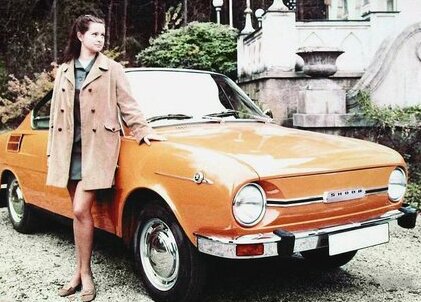
The Škoda 110 Coupe 1.1 R, producing 52 horsepower, was a distinctive and relatively affordable sports coupe manufactured by the Czechoslovakian automaker Škoda between September 1970 and December 1980. Positioned as the more stylish and performance-oriented derivative of the standard Škoda 110, the Coupe aimed to offer a taste of sporting flair to Eastern European drivers. It was built upon the rear-engine, rear-wheel-drive platform (designated the 110/110L series) and represented a significant step forward in Škoda’s design language, moving away from the more utilitarian aesthetics of earlier models. The 1.1 R variant, with its 1107cc engine, served as the entry point to the Coupe range, offering a balance between cost and usability.
Technical Specifications
| Brand | Škoda |
| Model | 110 |
| Generation | 110 Coupe |
| Type (Engine) | 1.1 R (52 Hp) |
| Start of production | September, 1970 |
| End of production | December, 1980 |
| Powertrain Architecture | Internal Combustion engine |
| Body type | Coupe |
| Seats | 4 |
| Doors | 2 |
| Fuel consumption (combined) | 8.5-9.5 l/100 km (27.7 – 24.8 US mpg, 33.2 – 29.7 UK mpg, 11.8 – 10.5 km/l) |
| Fuel Type | Petrol (Gasoline) |
| Acceleration 0 – 100 km/h | 18.5 sec |
| Acceleration 0 – 62 mph | 18.5 sec |
| Acceleration 0 – 60 mph | 17.6 sec |
| Maximum speed | 145 km/h (90.1 mph) |
| Weight-to-power ratio | 16.9 kg/Hp, 59.1 Hp/tonne |
| Weight-to-torque ratio | 10.2 kg/Nm, 97.7 Nm/tonne |
| Power | 52 Hp @ 4650 rpm |
| Power per litre | 47 Hp/l |
| Torque | 86 Nm @ 3500 rpm (63.43 lb.-ft. @ 3500 rpm) |
| Engine layout | Rear, Longitudinal |
| Engine displacement | 1107 cm3 (67.55 cu. in.) |
| Number of cylinders | 4 |
| Engine configuration | Inline |
| Cylinder Bore | 72 mm (2.83 in.) |
| Piston Stroke | 68 mm (2.68 in.) |
| Compression ratio | 9.5:1 |
| Number of valves per cylinder | 2 |
| Fuel injection system | Carburettor |
| Engine aspiration | Naturally aspirated engine |
| Valvetrain | OHV |
| Engine oil capacity | 4.6 l (4.86 US qt | 4.05 UK qt) |
| Coolant | 6.8 l (7.19 US qt | 5.98 UK qt) |
| Kerb Weight | 880 kg (1940.07 lbs.) |
| Max. weight | 1200 kg (2645.55 lbs.) |
| Max load | 320 kg (705.48 lbs.) |
| Trunk (boot) space – minimum | 370 l (13.07 cu. ft.) |
| Length | 4155 mm (163.58 in.) |
| Width | 1620 mm (63.78 in.) |
| Height | 1340 mm (52.76 in.) |
| Wheelbase | 2400 mm (94.49 in.) |
| Front track | 1280 mm (50.39 in.) |
| Rear (Back) track | 1250 mm (49.21 in.) |
| Ride height (ground clearance) | 175 mm (6.89 in.) |
| Minimum turning circle | 10.2 m (33.46 ft.) |
| Drivetrain Architecture | The Internal combustion engine (ICE) drives the rear wheels of the vehicle. |
| Drive wheel | Rear wheel drive |
| Number of gears and type of gearbox | 4 gears, manual transmission |
| Front suspension | Independent coil spring, Transverse stabilizer |
| Rear suspension | Independent coil spring |
| Front brakes | Disc, 252.5 mm |
| Rear brakes | Drum |
| Steering type | Worm-reduction unit |
| Tires size | 155/80 R14 |
| Wheel rims size | 4.5J x 14 |
Powertrain & Engine Architecture
The Škoda 110 Coupe 1.1 R was powered by a 1107cc, inline-four cylinder engine. This engine, designated as the 721.113, was a development of Škoda’s long-running OHV (Overhead Valve) engine family. It featured a cast iron block and cylinder head, and utilized a single Solex C32 PA carburetor for fuel delivery. The engine produced 52 horsepower at 4650 rpm and 86 Nm (63.43 lb-ft) of torque at 3500 rpm. The engine was mounted longitudinally in the rear of the vehicle, driving the rear wheels. The four-speed manual transmission was a conventional setup, providing relatively long gearing to suit the engine’s characteristics. The engine’s design, while robust, was relatively simple and relied on proven technology, prioritizing reliability over outright performance.
Driving Characteristics
The 1.1 R variant of the Škoda 110 Coupe offered modest performance. Acceleration from 0 to 100 km/h (0-62 mph) took approximately 18.5 seconds, and the top speed was around 145 km/h (90 mph). The long gearing of the four-speed manual transmission meant that the engine lacked significant punch at higher speeds, but it provided reasonable fuel economy. Compared to the later 1.3 and 1.6-liter versions of the Coupe, the 1.1 R felt noticeably slower, particularly when carrying passengers or luggage. However, the rear-engine layout provided a unique driving experience, with a distinct feel to the handling. The car was known for its predictable, if somewhat understeery, handling characteristics. The relatively light weight of the vehicle helped to mitigate the engine’s lack of power.
Equipment & Trim Levels
The 110 Coupe 1.1 R was generally equipped with basic, but functional, features. Standard equipment included cloth upholstery, a basic instrument panel with speedometer, fuel gauge, and warning lights, and manually operated windows. The interior was relatively spartan, reflecting the car’s price point and the prevailing market conditions in Eastern Europe. Optional extras included a radio, upgraded upholstery, and a sunroof. The exterior trim was minimal, with chrome bumpers and relatively simple steel wheels. The 1.1 R represented the entry-level trim, and lacked some of the more luxurious features found on the higher-specification models.
Chassis & Braking
The Škoda 110 Coupe utilized an independent coil spring suspension at all four wheels, with a transverse stabilizer bar at the front to reduce body roll. The rear suspension featured a unique arrangement designed to accommodate the rear-mounted engine and transmission. Braking was provided by disc brakes at the front and drum brakes at the rear. The braking system was adequate for the car’s performance, but lacked the stopping power of more modern vehicles. The steering was a worm-reduction type, which provided relatively heavy, but precise, steering feel. The car’s relatively narrow tires (155/80 R14) contributed to its predictable handling characteristics.
Market Reception & Comparison
The Škoda 110 Coupe 1.1 R was generally well-received in its primary markets of Czechoslovakia and other Eastern European countries. It offered a stylish and relatively affordable alternative to more expensive Western European sports coupes. Critics praised the car’s design and handling, but noted its modest performance. Compared to the higher-specification 1.3 and 1.6-liter versions, the 1.1 R was seen as a more practical and economical choice, appealing to a wider range of buyers. Fuel economy was a key selling point, and the 1.1 R offered competitive fuel consumption figures for its time. Reliability was also a strong suit, thanks to the engine’s simple and robust design.
Legacy
The Škoda 110 Coupe 1.1 R remains a popular classic car among enthusiasts. Its distinctive styling and unique rear-engine layout have earned it a dedicated following. The 1.1 R engine, while not particularly powerful, is known for its reliability and ease of maintenance. Parts availability can be a challenge, but a thriving aftermarket exists to support owners. Today, well-maintained examples of the 110 Coupe 1.1 R are sought after by collectors and represent a tangible link to Czechoslovakia’s automotive heritage. The car’s enduring appeal lies in its combination of style, affordability, and unique driving experience.