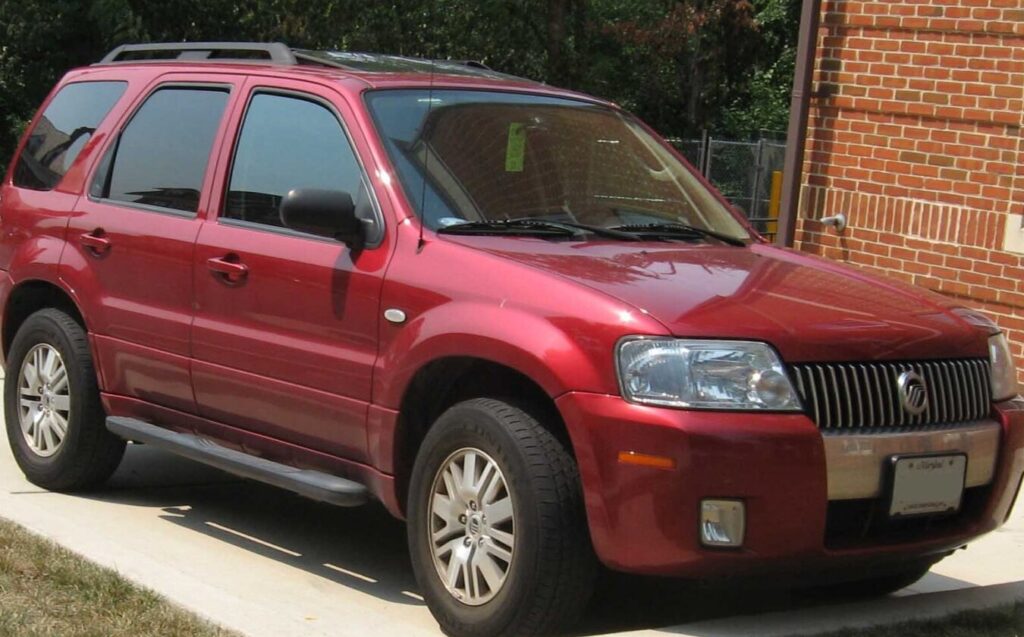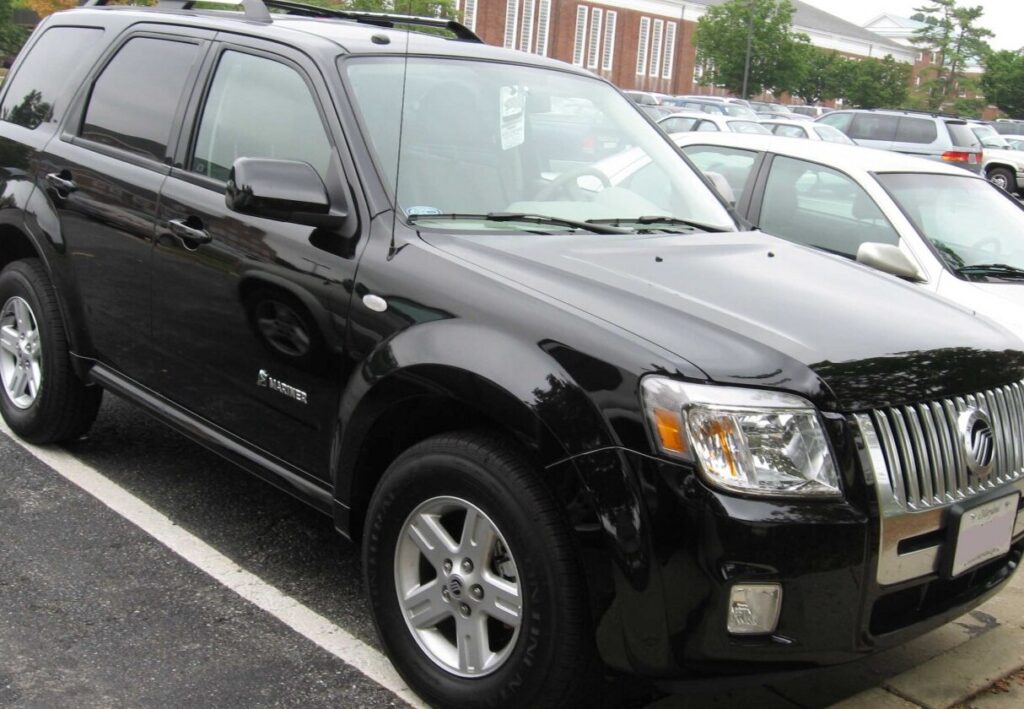
The Mercury Mariner II 2.3 Hybrid, produced for the 2007 and 2008 model years, represented Mercury’s entry into the burgeoning hybrid SUV market. Built on the Ford Escape Hybrid platform (sharing the 5H platform code), the Mariner II aimed to offer fuel efficiency without sacrificing the practicality and space expected of a compact crossover. This particular variant, equipped with the 2.3-liter four-cylinder engine paired with an eCVT (electronically controlled continuously variable transmission), occupied a mid-range position within the Mariner II lineup, offering a balance between cost and fuel economy. It was positioned below the more conventionally powered Mariner models, but above a base trim if one existed.
Technical Specifications
| Brand | Mercury |
| Model | Mariner |
| Generation | Mariner II |
| Type (Engine) | 2.3 (155 Hp) Hybrid eCVT |
| Start of production | 2007 |
| End of production | 2008 |
| Powertrain Architecture | FHEV (Full Hybrid Electric Vehicle) |
| Body type | SUV, Crossover |
| Seats | 5 |
| Doors | 5 |
| Fuel consumption (urban) | 6.9 l/100 km (34.1 US mpg) |
| Fuel consumption (extra urban) | 7.8 l/100 km (30.2 US mpg) |
| Fuel Type | Petrol (Gasoline) |
| Emission standard | PZEV |
| Weight-to-power ratio | 10.7 kg/Hp |
| Weight-to-torque ratio | 9.9 kg/Nm |
| Battery voltage | 330 V |
| Battery technology | Nickel-metal hydride (NiMH) |
| Electric motor power | 94 Hp @ 5000 rpm |
| Electric motor location | Integrated into the transmission |
| Electric motor type | Synchronous |
| System power | 155 Hp |
| Engine power | 133 Hp @ 6000 rpm |
| Power per litre | 58.8 Hp/l |
| Torque | 168 Nm @ 4250 rpm (123.91 lb.-ft. @ 4250 rpm) |
| Engine layout | Front, Transverse |
| Engine Model/Code | Duratec 23 |
| Engine displacement | 2261 cm3 (137.97 cu. in.) |
| Number of cylinders | 4 |
| Engine configuration | Inline |
| Cylinder Bore | 87.5 mm (3.44 in.) |
| Piston Stroke | 94 mm (3.7 in.) |
| Compression ratio | 12.3:1 |
| Number of valves per cylinder | 4 |
| Fuel injection system | Multi-port manifold injection |
| Engine aspiration | Naturally aspirated |
| Valvetrain | DOHC |
| Engine oil capacity | 4.25 l (4.49 US qt | 3.74 UK qt) |
| Coolant capacity | 11 l (11.62 US qt | 9.68 UK qt) |
| Kerb Weight | 1660 kg (3659.67 lbs.) |
| Max. weight | 2104 kg (4638.53 lbs.) |
| Max load | 444 kg (978.85 lbs.) |
| Fuel tank capacity | 57 l (15.06 US gal | 12.54 UK gal) |
| Length | 4450 mm (175.2 in.) |
| Width | 1806 mm (71.1 in.) |
| Width with mirrors folded | 1979 mm (77.91 in.) |
| Width including mirrors | 2065 mm (81.3 in.) |
| Height | 1727 mm (67.99 in.) |
| Wheelbase | 2619 mm (103.11 in.) |
| Front track | 1552 mm (61.1 in.) |
| Rear track | 1534 mm (60.39 in.) |
| Front overhang | 864 mm (34.02 in.) |
| Rear overhang | 968 mm (38.11 in.) |
| Ride height (ground clearance) | 218 mm (8.58 in.) |
| Minimum turning circle | 11.2 m (36.75 ft.) |
| Approach angle | 24.5° |
| Departure angle | 27.7° |
| Ramp-over angle | 21.3° |
| Drivetrain Architecture | Front wheel drive. FHEV. ICE and electric motor drive front wheels. |
| Number of gears | automatic transmission eCVT |
| Front suspension | Independent, McPherson with coil spring and anti-roll bar |
| Rear suspension | Independent multi-link with stabilizer |
| Front brakes | Ventilated discs, 303 mm |
| Rear brakes | Disc, 302 mm |
| Assisting systems | ABS |
| Steering type | Steering rack and pinion |
| Power steering | Electric |
| Tires size | 235/70 R16 |
| Wheel rims size | 16 |
Powertrain & Engine Architecture
The heart of the Mariner II Hybrid is the Duratec 23 2.3-liter inline-four engine. This engine, part of Ford’s Duratec family, utilizes a cast iron block with an aluminum cylinder head. It features dual overhead camshafts (DOHC) and four valves per cylinder, contributing to its relatively efficient operation. Multi-port fuel injection delivers fuel to the cylinders. The engine produces 133 horsepower at 6000 rpm and 168 Nm (123.91 lb-ft) of torque at 4250 rpm. Crucially, this engine is paired with an electric motor, drawing power from a 330-volt nickel-metal hydride (NiMH) battery pack. The electric motor contributes an additional 94 horsepower at 5000 rpm. The combined system output is 155 horsepower.
The transmission is a key component of the hybrid system – an eCVT (electronically controlled continuously variable transmission). Unlike traditional CVTs with belts and pulleys, the eCVT uses a planetary gearset to seamlessly blend power from the gasoline engine and the electric motor. This allows for smooth acceleration and optimized fuel efficiency. The eCVT doesn’t have fixed gear ratios; instead, it continuously adjusts the gear ratio to keep the engine operating at its most efficient point.
Driving Characteristics
The 2.3-liter hybrid powertrain in the Mariner II delivers adequate, though not exhilarating, performance. Acceleration is smooth and linear, thanks to the eCVT. The electric motor provides instant torque, which helps with initial acceleration and city driving. However, the combined 155 horsepower doesn’t translate into particularly quick speeds. Compared to the standard 2.4-liter four-cylinder or the optional 3.0-liter V6 Mariner models, the hybrid feels noticeably slower, especially when merging onto highways or climbing hills. The eCVT, while smooth, can sometimes feel disconnected from the engine, resulting in a slight “rubber band” effect during acceleration. The focus of this powertrain was clearly on fuel economy rather than outright performance.
Equipment & Trim Levels
The Mariner II 2.3 Hybrid typically came reasonably well-equipped, reflecting its position as a more technologically advanced (and slightly more expensive) variant. Standard features generally included air conditioning, power windows and locks, a CD player with an auxiliary input jack, and keyless entry. Safety features such as anti-lock brakes (ABS) were also standard. Higher trim levels offered options like leather upholstery, a sunroof, upgraded audio systems, and alloy wheels. The interior design was functional and relatively spacious, though the materials used were generally of average quality.
Chassis & Braking
The Mariner II utilizes an independent front suspension with McPherson struts and a multi-link independent rear suspension. This setup provides a comfortable ride, absorbing bumps and irregularities in the road surface effectively. A stabilizer bar is included at both the front and rear to reduce body roll during cornering. The braking system consists of ventilated discs at the front and solid discs at the rear. ABS is standard, providing enhanced braking control in emergency situations. The steering is rack-and-pinion with electric power assist, offering a reasonably responsive feel.
Market Reception & Comparison
The Mercury Mariner II Hybrid was generally well-received by critics, who praised its fuel efficiency and smooth ride. However, some reviewers noted its lack of power compared to other Mariner models. Fuel economy was a significant selling point, with the hybrid achieving EPA ratings of 34.1 mpg in the city and 30.2 mpg on the highway. Compared to the standard 2.4-liter Mariner, the hybrid offered a substantial improvement in fuel economy, but at the cost of performance. Reliability reports suggest that the hybrid system is generally reliable, though the NiMH battery pack may require replacement after several years of use.
Legacy
The Mercury Mariner II Hybrid represents an early attempt by Mercury to offer a fuel-efficient alternative in the popular compact SUV segment. While the Mariner II itself was short-lived (discontinued after 2008), it paved the way for future hybrid offerings from Ford and Mercury. Today, used Mariner II Hybrids are relatively uncommon, but they can be a good value for buyers seeking a fuel-efficient and practical SUV. The longevity of the hybrid powertrain is a key consideration for potential buyers, as the NiMH battery pack may be nearing the end of its lifespan. However, with proper maintenance, these vehicles can still provide reliable transportation.