
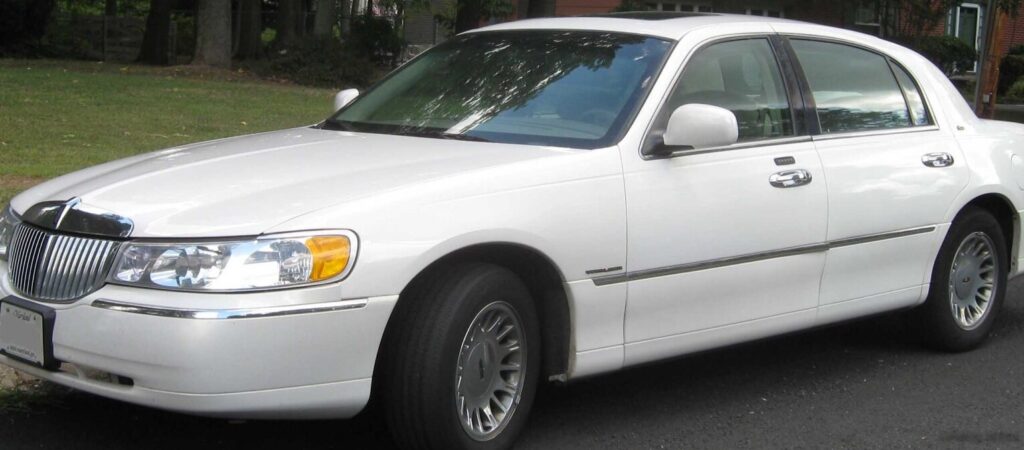
The Lincoln Town Car III (FN145), specifically equipped with the 4.6-liter V8 engine producing 238 horsepower, represented a continuation of Lincoln’s long-standing tradition of full-size luxury sedans. Produced for the 2001 and 2002 model years, this generation Town Car built upon the foundation laid by its predecessors, offering a blend of traditional American styling, spaciousness, and a comfortable ride. It occupied the top tier of Lincoln’s sedan lineup, positioned above the smaller LS model and aimed at buyers seeking a large, domestically-produced luxury vehicle. The FN145 Town Car was the last of its kind before a significant redesign in 2003, marking the end of an era for the body-on-frame full-size luxury sedan.
Technical Specifications
| Brand | Lincoln |
| Model | Town Car |
| Generation | Town Car III (FN145) |
| Type (Engine) | 4.6 V8 (238 Hp) |
| Start of production | 2001 |
| End of production | 2002 |
| Powertrain Architecture | Internal Combustion engine |
| Body type | Sedan |
| Seats | 5 |
| Doors | 4 |
| Fuel consumption (urban) | 13.8 l/100 km (17 US mpg, 20.5 UK mpg) |
| Fuel consumption (extra urban) | 9.8 l/100 km (24 US mpg, 28.8 UK mpg) |
| Fuel Type | Petrol (Gasoline) |
| Maximum speed | 180 km/h (111.85 mph) |
| Weight-to-power ratio | 7.7 kg/Hp, 129.7 Hp/tonne |
| Weight-to-torque ratio | 4.9 kg/Nm, 203.3 Nm/tonne |
| Power | 238 Hp @ 4750 rpm |
| Power per litre | 51.7 Hp/l |
| Torque | 373 Nm @ 3000 rpm (275.11 lb.-ft. @ 3000 rpm) |
| Engine layout | Front, Longitudinal |
| Engine Model/Code | Modular / C46RSEM |
| Engine displacement | 4601 cm3 (280.77 cu. in.) |
| Number of cylinders | 8 |
| Engine configuration | V-engine |
| Cylinder Bore | 90.2 mm (3.55 in.) |
| Piston Stroke | 90 mm (3.54 in.) |
| Compression ratio | 9.4:1 |
| Number of valves per cylinder | 2 |
| Fuel injection system | Multi-port manifold injection |
| Engine aspiration | Naturally aspirated engine |
| Valvetrain | OHC |
| Engine oil capacity | 4.7 l (4.97 US qt | 4.14 UK qt) |
| Coolant | 15 l (15.85 US qt | 13.2 UK qt) |
| Kerb Weight | 1835 kg (4045.48 lbs.) |
| Trunk (boot) space – minimum | 585 l (20.66 cu. ft.) |
| Fuel tank capacity | 72 l (19.02 US gal | 15.84 UK gal) |
| Length | 5470 mm (215.35 in.) |
| Width | 1985 mm (78.15 in.) |
| Height | 1470 mm (57.87 in.) |
| Wheelbase | 2990 mm (117.72 in.) |
| Front track | 1610 mm (63.39 in.) |
| Rear (Back) track | 1660 mm (65.35 in.) |
| Drivetrain Architecture | Rear wheel drive |
| Number of gears and type of gearbox | 4 gears, automatic transmission |
| Front suspension | Coil spring |
| Rear suspension | Coil spring |
| Front brakes | Ventilated discs |
| Rear brakes | Disc |
| Assisting systems | ABS (Anti-lock braking system) |
| Steering type | Steering rack and pinion |
| Power steering | Hydraulic Steering |
| Tires size | 225/60 R16 |
| Wheel rims size | 16 |
Powertrain & Engine Architecture
The heart of the 2001-2002 Town Car was the 4.6-liter Modular V8 engine, specifically the C46RSEM variant. This engine, a staple of Ford’s lineup for years, featured a single overhead camshaft (OHC) design with two valves per cylinder. Multi-port fuel injection delivered fuel to each cylinder, optimizing combustion and contributing to the engine’s smooth power delivery. The 4.6L engine was known for its durability and relatively simple maintenance requirements. The engine’s longitudinal mounting and rear-wheel-drive configuration were traditional for a large American sedan. Paired with the engine was a four-speed automatic transmission, designed for comfortable cruising rather than sporty performance. This transmission was electronically controlled, offering smooth shifts and adapting to driving conditions.
Driving Characteristics
The 238-horsepower 4.6-liter V8, coupled with the four-speed automatic, provided adequate, but not exhilarating, performance. Acceleration was sufficient for highway merging and passing, but the Town Car was never intended to be a sports sedan. The automatic transmission’s gear ratios were optimized for relaxed cruising and fuel efficiency, prioritizing comfort over aggressive acceleration. Compared to the higher-output versions of the 4.6L found in other Ford and Lincoln models, or the potential for a manual transmission, this configuration offered a more refined and less demanding driving experience. The focus was on providing a smooth, quiet ride, and the powertrain delivered on that promise.
Equipment & Trim Levels
The 2001-2002 Town Car, even in its base configuration, came well-equipped. Standard features included air conditioning, power windows and locks, cruise control, and an AM/FM stereo with a cassette player. Upholstery was typically cloth, with optional leather available. The dashboard featured woodgrain accents and a straightforward layout. Higher trim levels, such as the Signature and Cartier editions, added features like leather upholstery, upgraded sound systems, and additional chrome trim. Optional extras included a sunroof, heated seats, and a navigation system.
Chassis & Braking
The Town Car III utilized a traditional body-on-frame construction, providing a comfortable ride but also contributing to its substantial weight. The suspension consisted of coil springs all around, tuned for a soft and forgiving ride quality. Front brakes were ventilated discs, providing adequate stopping power, while rear brakes were discs. Anti-lock braking system (ABS) was standard, enhancing safety. The steering system was a hydraulic rack-and-pinion setup, offering relatively light and easy steering. The relatively heavy curb weight of the vehicle necessitated a robust braking system and suspension setup to maintain control and stability.
Market Reception & Comparison
The 2001-2002 Lincoln Town Car was generally well-received by critics as a comfortable and spacious luxury sedan. However, it was often criticized for its lack of sporty handling and its relatively dated design compared to newer, more modern competitors. Fuel economy, at 17 mpg city and 24 mpg highway, was typical for a full-size luxury sedan of the era, but not particularly impressive. Compared to other trims in the Town Car lineup, the 4.6L automatic offered a balance between performance and affordability. It was a popular choice for buyers who prioritized comfort and space over outright speed.
Legacy
The 4.6-liter Modular V8 engine, in its various iterations, proved to be a remarkably durable and reliable powertrain. The Town Car’s automatic transmission also enjoyed a good reputation for longevity. Today, well-maintained examples of the 2001-2002 Town Car can still be found on the used car market, often at very affordable prices. While not a collector’s item, the FN145 Town Car represents a significant chapter in American automotive history, embodying the traditional values of size, comfort, and luxury that defined the full-size sedan segment for decades. Its simplicity and robust construction make it a relatively easy vehicle to maintain, appealing to those seeking a classic American cruiser.
