Technical Specifications
| Brand | Opel |
| Model | Insignia |
| Generation | Insignia Sports Tourer (B) |
| Type (Engine) | 2.0d BiTurbo (210 Hp) 4×4 Automatic |
| Start of production | April, 2019 |
| End of production | February, 2020 |
| Powertrain Architecture | Internal Combustion engine |
| Body type | Station wagon (estate) |
| Seats | 5 |
| Doors | 5 |
| Fuel consumption (urban) | 9.2-9.4 l/100 km (25.6 – 25 US mpg, 30.7 – 30.1 UK mpg, 10.9 – 10.6 km/l) |
| Fuel consumption (extra urban) | 5.5-5.8 l/100 km (42.8 – 40.6 US mpg, 51.4 – 48.7 UK mpg, 18.2 – 17.2 km/l) |
| Fuel consumption (combined) | 6.9-7.1 l/100 km (34.1 – 33.1 US mpg, 40.9 – 39.8 UK mpg, 14.5 – 14.1 km/l) |
| CO2 emissions | 181-187 g/km |
| Fuel Type | Diesel |
| Acceleration 0 – 100 km/h | 8 sec |
| Acceleration 0 – 62 mph | 8 sec |
| Acceleration 0 – 60 mph | 7.6 sec |
| Maximum speed | 231 km/h (143.54 mph) |
| Emission standard | Euro 6c |
| Weight-to-power ratio | 7.8 kg/Hp, 127.5 Hp/tonne |
| Weight-to-torque ratio | 3.4 kg/Nm, 291.4 Nm/tonne |
| Power | 210 Hp @ 4000 rpm |
| Power per litre | 107.4 Hp/l |
| Torque | 480 Nm @ 1500 rpm (354.03 lb.-ft. @ 1500 rpm) |
| Engine layout | Front, Transverse |
| Engine Model/Code | D20DTR |
| Engine displacement | 1956 cm3 (119.36 cu. in.) |
| Number of cylinders | 4 |
| Engine configuration | Inline |
| Cylinder Bore | 83 mm (3.27 in.) |
| Piston Stroke | 90.4 mm (3.56 in.) |
| Compression ratio | 16.5:1 |
| Number of valves per cylinder | 4 |
| Fuel injection system | Diesel Commonrail |
| Engine aspiration | BiTurbo, Intercooler |
| Engine oil capacity | 4.9 l (5.18 US qt | 4.31 UK qt) |
| Coolant | 5.9 l (6.23 US qt | 5.19 UK qt) |
| Kerb Weight | 1647 kg (3631.01 lbs.) |
| Max. weight | 2390 kg (5269.05 lbs.) |
| Max load | 743 kg (1638.03 lbs.) |
| Trunk (boot) space – minimum | 560 l (19.78 cu. ft.) |
| Trunk (boot) space – maximum | 1660 l (58.62 cu. ft.) |
| Fuel tank capacity | 62 l (16.38 US gal | 13.64 UK gal) |
| AdBlue tank | 15 l (3.96 US gal | 3.3 UK gal) |
| Max. roof load | 100 kg (220.46 lbs.) |
| Permitted trailer load with brakes (12%) | 1805 kg (3979.34 lbs.) |
| Permitted trailer load without brakes | 750 kg (1653.47 lbs.) |
| Permitted towbar download | 90 kg (198.42 lbs.) |
| Length | 4986 mm (196.3 in.) |
| Width | 1863 mm (73.35 in.) |
| Width with mirrors folded | 1941 mm (76.42 in.) |
| Width including mirrors | 2093 mm (82.4 in.) |
| Height | 1500 mm (59.06 in.) |
| Wheelbase | 2829 mm (111.38 in.) |
| Front track | 1607 mm (63.27 in.) |
| Rear (Back) track | 1610 mm (63.39 in.) |
| Front overhang | 990 mm (38.98 in.) |
| Rear overhang | 1167 mm (45.94 in.) |
| Minimum turning circle | 11.74 m (38.52 ft.) |
| Drive wheel | All wheel drive (4×4) |
| Number of gears and type of gearbox | 8 gears, automatic transmission |
| Front brakes | Disc |
| Rear brakes | Disc |
| Assisting systems | ABS (Anti-lock braking system) |
| Steering type | Steering rack and pinion |
| Power steering | Electric Steering |
| Tires size | 215/60 R16; 215/55 R17; 225/55 R17; 245/45 R18 |
| Wheel rims size | 6.5J x 16; 7J x 17; 7.5J x 17; 8.5J x 18 |
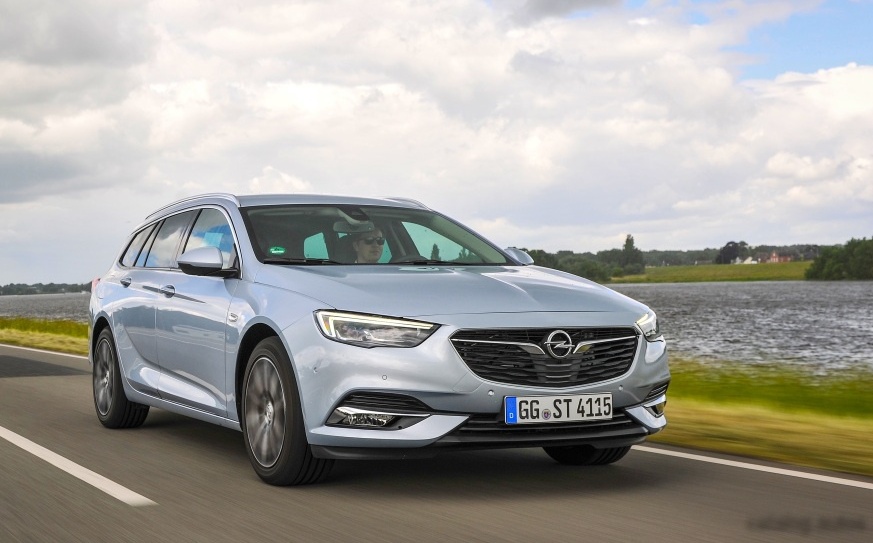
The Opel Insignia Sports Tourer (B) 2.0d BiTurbo 4×4 Automatic, launched in 2019 as part of the B generation Insignia, offered a compelling blend of practicality, performance, and technology. Built on the GM’s Epsilon II platform (also known as the 1HX0/A3 platform), the Sports Tourer body style provided a spacious and versatile alternative to traditional saloons. This particular variant, equipped with the D20DTR engine and an eight-speed automatic transmission, aimed to deliver a refined driving experience with strong acceleration and all-weather capability. It represented a significant step up in performance from the base diesel models, targeting drivers who frequently cover long distances or require a vehicle capable of handling varied road conditions.
Powertrain & Engine Architecture
At the heart of the Insignia 2.0d BiTurbo 4×4 Automatic lies the D20DTR engine, a 1956cc inline-four cylinder diesel. This engine utilizes a sophisticated bi-turbocharger setup, employing two turbochargers – a smaller, low-inertia turbo for quick response at low engine speeds, and a larger turbo for increased power at higher RPMs. This configuration effectively minimizes turbo lag and delivers a broad torque curve. The engine features a common-rail direct fuel injection system, operating at extremely high pressures to ensure efficient combustion and reduced emissions. The D20DTR also incorporates an intercooler to cool the compressed intake air, further enhancing performance. The eight-speed automatic transmission, sourced from Aisin, provides smooth and efficient gear changes, contributing to both performance and fuel economy. It’s programmed for both comfort and sport modes, allowing the driver to tailor the transmission’s behavior to their preferences.
Driving Characteristics
The 210 horsepower and 480 Nm (354 lb-ft) of torque produced by the 2.0d BiTurbo engine translate into brisk acceleration. The 0-60 mph sprint takes approximately 7.6 seconds, and the car feels confident during overtaking maneuvers. The all-wheel-drive system provides excellent traction, particularly in wet or slippery conditions. The eight-speed automatic transmission is generally responsive, although some drivers may find it occasionally hesitant during kickdown. Compared to the lower-powered 1.6-liter diesel versions, the 2.0d BiTurbo offers a significantly more engaging driving experience, with noticeably stronger acceleration and a more relaxed feel at highway speeds. While not as overtly sporty as some of its rivals, the Insignia Sports Tourer 2.0d BiTurbo 4×4 Automatic strikes a good balance between performance and comfort.
Equipment & Trim Levels
The 2.0d BiTurbo 4×4 Automatic typically came well-equipped, often representing a mid-to-high trim level within the Insignia range. Standard features generally included automatic climate control, a touchscreen infotainment system with Apple CarPlay and Android Auto compatibility, heated front seats, and a suite of safety features such as lane departure warning, automatic emergency braking, and adaptive cruise control. Higher trim levels offered options like leather upholstery, a panoramic sunroof, and a premium sound system. The interior design was modern and functional, with a focus on ergonomics and user-friendliness.
Chassis & Braking
The Insignia Sports Tourer’s chassis is tuned for a comfortable ride, while still providing decent handling. The suspension utilizes MacPherson struts at the front and a multi-link setup at the rear. The all-wheel-drive system employs a multi-plate clutch to distribute torque between the front and rear axles, optimizing traction and stability. Braking duties are handled by disc brakes on all four wheels, providing ample stopping power. ABS (Anti-lock Braking System) and electronic stability control are standard features, enhancing safety and control.
Market Reception & Comparison
The Opel Insignia Sports Tourer 2.0d BiTurbo 4×4 Automatic was generally well-received by automotive critics. It was praised for its spacious interior, comfortable ride, and strong performance. However, some reviewers noted that the infotainment system could be occasionally laggy and that the styling was somewhat conservative. Compared to rivals like the Volkswagen Passat Variant, the Insignia offered a more affordable price point with comparable levels of equipment and performance. Fuel economy was competitive, averaging around 34-39 mpg in combined driving, and reliability reports were generally positive.
Legacy
The Opel Insignia Sports Tourer 2.0d BiTurbo 4×4 Automatic represents a capable and well-rounded family wagon. The D20DTR engine, while not without its complexities due to the bi-turbo setup, has proven to be relatively reliable when properly maintained. On the used car market, these models offer good value for money, providing a spacious, comfortable, and well-equipped vehicle at a reasonable price. Regular servicing, including oil changes and filter replacements, is crucial to ensure the longevity of the engine and transmission. The all-wheel-drive system adds to the vehicle’s appeal in regions with harsh winters or challenging road conditions, making it a practical and versatile choice for a wide range of drivers.