
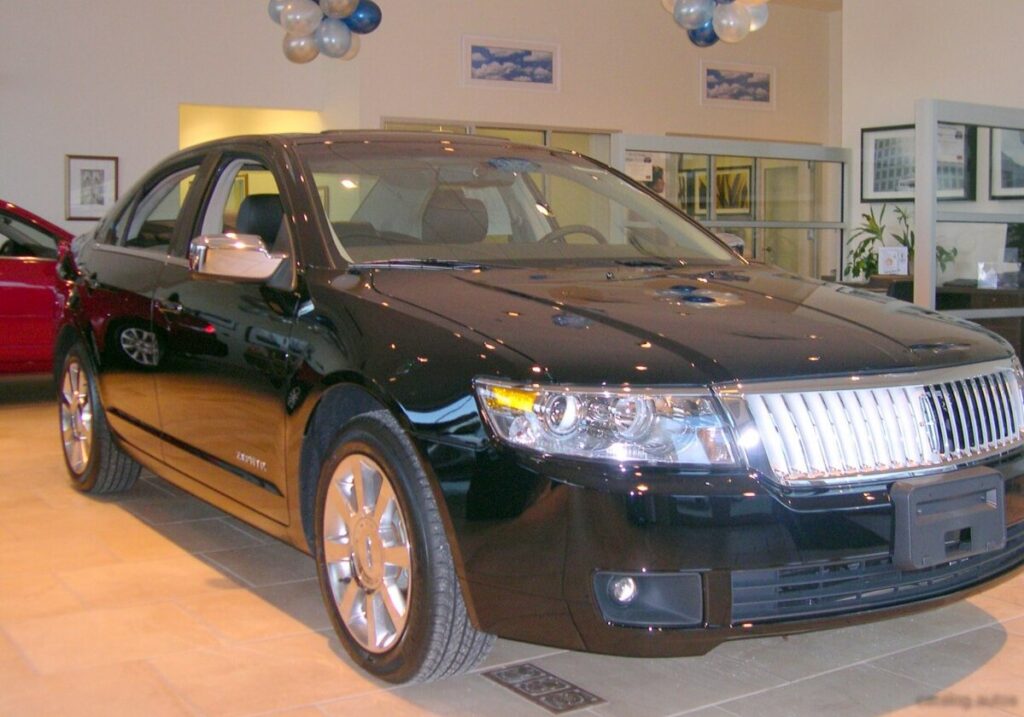
The Lincoln Zephyr 3.0 i V6 24V (212 Hp) was a mid-size luxury sedan produced by Lincoln from 2006 to 2012. Positioned as the entry-level model in Lincoln’s lineup during its production run, it aimed to attract buyers seeking a more affordable alternative to larger, more established luxury vehicles. The Zephyr represented Lincoln’s attempt to modernize its image and appeal to a younger demographic. It was based on the Ford Fusion platform, sharing many components but offering a more refined interior and a more powerful engine option in the 3.0L V6 configuration. The Zephyr was later replaced by the MKZ in 2013.
Technical Specifications
| Brand | Lincoln |
| Model | Zephyr |
| Generation | Zephyr |
| Type (Engine) | 3.0 i V6 24V (212 Hp) |
| Start of production | 2006 |
| End of production | 2012 |
| Powertrain Architecture | Internal Combustion engine |
| Body type | Sedan |
| Seats | 5 |
| Doors | 4 |
| Fuel consumption (urban) | 13.8 l/100 km (17 US mpg) |
| Fuel consumption (extra urban) | 9 l/100 km (26.1 US mpg) |
| Fuel consumption (combined) | 11.8 l/100 km (19.9 US mpg) |
| Fuel Type | Petrol (Gasoline) |
| Acceleration 0 – 60 mph | 7.5 sec |
| Weight-to-power ratio | 7.4 kg/Hp |
| Weight-to-torque ratio | 5.8 kg/Nm |
| Power | 212 Hp @ 6250 rpm |
| Power per litre | 71.5 Hp/l |
| Torque | 271 Nm @ 4750 rpm (199.88 lb.-ft. @ 4750 rpm) |
| Engine layout | Front, Longitudinal |
| Engine Model/Code | Duratec 30 |
| Engine displacement | 2967 cm3 (181.06 cu. in.) |
| Number of cylinders | 6 |
| Engine configuration | V-engine |
| Cylinder Bore | 89 mm (3.5 in.) |
| Piston Stroke | 79.5 mm (3.13 in.) |
| Compression ratio | 10:1 |
| Number of valves per cylinder | 4 |
| Fuel injection system | Multi-port manifold injection |
| Engine aspiration | Naturally aspirated engine |
| Engine oil capacity | 5.7 l (6.02 US qt | 5.02 UK qt) |
| Coolant capacity | 9.2 l (9.72 US qt | 8.09 UK qt) |
| Kerb Weight | 1575 kg (3472.28 lbs.) |
| Trunk (boot) space – minimum | 448 l (15.82 cu. ft.) |
| Fuel tank capacity | 68 l (17.96 US gal | 14.96 UK gal) |
| Length | 4840 mm (190.55 in.) |
| Width | 1834 mm (72.2 in.) |
| Height | 1420 mm (55.91 in.) |
| Wheelbase | 2728 mm (107.4 in.) |
| Front track | 1565 mm (61.61 in.) |
| Rear track | 1557 mm (61.3 in.) |
| Drivetrain Architecture | Front wheel drive |
| Number of gears and type of gearbox | 6 gears, automatic transmission |
| Front suspension | Spring Strut |
| Rear suspension | Spring Strut |
| Front brakes | Disc |
| Rear brakes | Disc |
| Assisting systems | ABS (Anti-lock braking system) |
| Steering type | Steering rack and pinion |
| Tires size | 225/50 R17 |
| Wheel rims size | 17 |
Powertrain & Engine Architecture
The Lincoln Zephyr 3.0 i V6 was powered by Ford’s Duratec 30 engine, a 3.0-liter, naturally aspirated V6. This engine, part of the Duratec family, featured a 60-degree V-angle and a double overhead camshaft (DOHC) design with four valves per cylinder. The engine utilized multi-port fuel injection, delivering fuel directly into the intake ports. The Duratec 30 was known for its relatively smooth operation and decent power output for its size. The engine code for this variant is often associated with the Duratec 30, and while specific variations existed, the core architecture remained consistent. The 6-speed automatic transmission, sourced from Aisin, was the sole transmission option for this trim. This transmission was chosen for its smooth shifting characteristics and its ability to complement the engine’s power delivery.
Driving Characteristics
The 3.0L V6 paired with the 6-speed automatic provided a comfortable and refined driving experience. Acceleration from 0 to 60 mph took approximately 7.5 seconds, which was competitive for its class. The automatic transmission offered smooth gear changes, although it wasn’t particularly sporty or quick to downshift. The gear ratios were tuned for fuel efficiency and comfortable cruising rather than aggressive performance. Compared to the base 2.0L four-cylinder engine, the 3.0L V6 offered a significant boost in power and torque, making it more suitable for highway driving and passing maneuvers. However, it wasn’t as engaging to drive as some of its European rivals with manual transmissions.
Equipment & Trim Levels
The Zephyr 3.0 i V6 typically came standard with features such as leather upholstery, power-adjustable front seats, a premium audio system, and automatic climate control. Optional extras included a navigation system, a sunroof, and upgraded interior trim. The Zephyr offered a relatively well-equipped interior for its price point, focusing on comfort and convenience. Trim levels varied slightly depending on the model year, but generally, the 3.0L V6 was offered in a single, well-equipped trim.
Chassis & Braking
The Zephyr utilized a front-wheel-drive layout with independent front suspension and a multi-link rear suspension. The suspension was tuned for a comfortable ride, prioritizing smoothness over sporty handling. The Zephyr featured disc brakes on all four wheels, providing adequate stopping power. Anti-lock braking system (ABS) was standard. The Zephyr’s chassis was derived from the Ford Fusion, and while it provided a stable platform, it wasn’t particularly lightweight. The steering was a rack-and-pinion system, offering reasonable precision but lacking the feedback of some competitors.
Market Reception & Comparison
The Lincoln Zephyr 3.0 i V6 was generally well-received by critics, who praised its comfortable ride, spacious interior, and powerful engine. However, some reviewers criticized its somewhat bland styling and lack of sporty handling. Compared to other mid-size luxury sedans, such as the Acura TL and Lexus ES, the Zephyr offered a more affordable price point but lacked the brand prestige and refinement of its Japanese rivals. Fuel economy was average for its class, with combined fuel consumption around 19.9 US mpg. Reliability was generally good, although some owners reported minor issues with the electronic systems.
Legacy
The Lincoln Zephyr 3.0 i V6 represents an interesting chapter in Lincoln’s history. While it didn’t achieve the sales success of some of its competitors, it offered a compelling combination of luxury, comfort, and value. The Duratec 30 engine proved to be a reliable and durable powerplant, and many Zephyrs are still on the road today. In the used car market, the Zephyr 3.0 i V6 is often seen as a good value proposition for buyers seeking an affordable and comfortable luxury sedan. Its relatively simple mechanical design and readily available parts make it a relatively easy vehicle to maintain.
