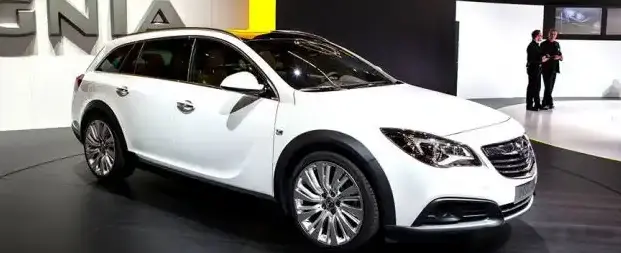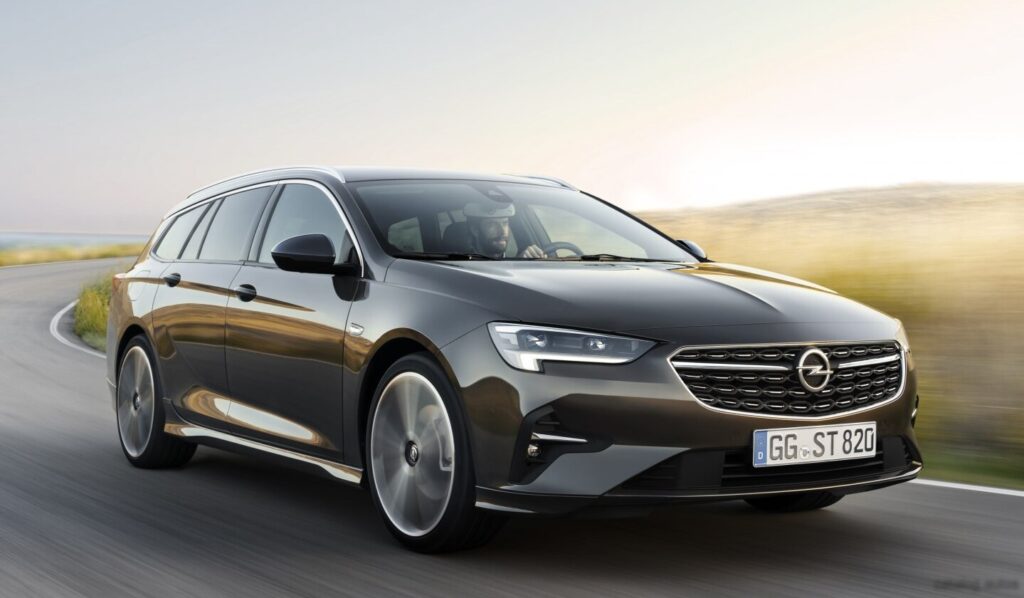
The Opel Insignia Sports Tourer (B, facelift 2020) 2.0 Turbo (170 hp) Automatic represents a mid-range offering within the second generation of Opel’s flagship wagon. Introduced in September 2020 as part of a comprehensive facelift for the B-series Insignia, this variant aimed to balance performance, fuel efficiency, and practicality for European buyers. Positioned between the lower-powered diesel options and the more potent GSi models, the 2.0 Turbo Automatic catered to drivers seeking a comfortable and capable family vehicle with a gasoline engine. It builds upon the foundation of the A3/1HX0 platform shared with other Stellantis (then PSA Group) vehicles.
| Brand | Opel |
| Model | Insignia |
| Generation | Insignia Sports Tourer (B, facelift 2020) |
| Type (Engine) | 2.0 Turbo (170 Hp) Automatic |
| Start of production | September, 2020 |
| Powertrain Architecture | Internal Combustion engine |
| Body type | Station wagon (estate) |
| Seats | 5 |
| Doors | 5 |
| Fuel consumption at Low speed (WLTP) | 11.2-12.1 l/100 km (21 – 19.4 US mpg, 25.2 – 23.3 UK mpg, 8.9 – 8.3 km/l) |
| Fuel consumption at Medium speed (WLTP) | 7.6-8.2 l/100 km (30.9 – 28.7 US mpg, 37.2 – 34.4 UK mpg, 13.2 – 12.2 km/l) |
| Fuel consumption at high speed (WLTP) | 6-6.9 l/100 km (39.2 – 34.1 US mpg, 47.1 – 40.9 UK mpg, 16.7 – 14.5 km/l) |
| Fuel consumption at very high speed (WLTP) | 6.9-8.1 l/100 km (34.1 – 29 US mpg, 40.9 – 34.9 UK mpg, 14.5 – 12.3 km/l) |
| Combined fuel consumption (WLTP) | 7.4-8.3 l/100 km (31.8 – 28.3 US mpg, 38.2 – 34 UK mpg, 13.5 – 12 km/l) |
| CO2 emissions (WLTP) | 167-188 g/km |
| Fuel Type | Petrol (Gasoline) |
| Acceleration 0 – 100 km/h | 8.9 sec |
| Acceleration 0 – 62 mph | 8.9 sec |
| Acceleration 0 – 60 mph | 8.5 sec |
| Maximum speed | 225 km/h (139.81 mph) |
| Emission standard | Euro 6d |
| Weight-to-power ratio | 9.1 kg/Hp, 110.4 Hp/tonne |
| Weight-to-torque ratio | 4.4 kg/Nm, 227.3 Nm/tonne |
| Power | 170 Hp @ 4250-6000 rpm |
| Power per litre | 85.1 Hp/l |
| Torque | 350 Nm @ 1500-4000 rpm (258.15 lb.-ft. @ 1500-4000 rpm) |
| Engine layout | Front, Transverse |
| Engine Model/Code | F20SHT |
| Engine displacement | 1998 cm3 (121.93 cu. in.) |
| Number of cylinders | 4 |
| Engine configuration | Inline |
| Number of valves per cylinder | 4 |
| Fuel injection system | Direct injection |
| Engine aspiration | Turbocharger, Intercooler |
| Engine oil capacity | 4.9 l (5.18 US qt | 4.31 UK qt) |
| Kerb Weight | 1540 kg (3395.12 lbs.) |
| Max. weight | 2215 kg (4883.24 lbs.) |
| Max load | 675 kg (1488.12 lbs.) |
| Trunk (boot) space – minimum | 560 l (19.78 cu. ft.) |
| Trunk (boot) space – maximum | 1665 l (58.8 cu. ft.) |
| Fuel tank capacity | 62 l (16.38 US gal | 13.64 UK gal) |
| Max. roof load | 75 kg (165.35 lbs.) |
| Permitted trailer load with brakes (12%) | 2000 kg (4409.25 lbs.) |
| Permitted trailer load without brakes | 750 kg (1653.47 lbs.) |
| Permitted towbar download | 90 kg (198.42 lbs.) |
| Length | 4986 mm (196.3 in.) |
| Width | 1863 mm (73.35 in.) |
| Width with mirrors folded | 1941 mm (76.42 in.) |
| Width including mirrors | 2093 mm (82.4 in.) |
| Height | 1500 mm (59.06 in.) |
| Wheelbase | 2829 mm (111.38 in.) |
| Front track | 1607 mm (63.27 in.) |
| Rear (Back) track | 1610 mm (63.39 in.) |
| Front overhang | 990 mm (38.98 in.) |
| Rear overhang | 1167 mm (45.94 in.) |
| Minimum turning circle (turning diameter) | 11.74 m (38.52 ft.) |
| Drivetrain Architecture | The Internal combustion engine (ICE) drives the front wheels of the vehicle. |
| Drive wheel | Front wheel drive |
| Number of gears and type of gearbox | 9 gears, automatic transmission |
| Front brakes | Ventilated discs |
| Rear brakes | Disc |
| Tires size | 215/55 R17; 245/45 R18; 245/35 R20 |
| Wheel rims size | 7J x 17; 8.5J x 18; 8.5J x 20 |
Powertrain & Engine Architecture
At the heart of the Insignia Sports Tourer 2.0 Turbo Automatic lies the F20SHT engine, a 1.998-liter (121.93 cubic inches) turbocharged inline-four cylinder gasoline engine. This engine is part of Opel’s family of small displacement, direct-injected turbocharged engines. Direct injection is crucial for optimizing combustion efficiency and reducing emissions. The engine utilizes a single-scroll turbocharger with an intercooler to enhance power output and mitigate turbo lag. The engine’s variable valve timing system contributes to a broad torque curve. The engine is transversely mounted in the front of the vehicle. The engine is paired with a sophisticated 9-speed automatic transmission, providing smooth and efficient gear changes. This transmission, sourced from a joint venture between General Motors and Hyundai, offers a wide range of gear ratios to optimize fuel economy and performance.
Driving Characteristics
The 170 hp and 350 Nm (258 lb-ft) of torque delivered by the 2.0 Turbo engine provide adequate performance for everyday driving. Acceleration from 0 to 60 mph takes approximately 8.5 seconds, and the car has a top speed of 139.81 mph. While not a sports car, the Insignia Sports Tourer offers sufficient power for overtaking maneuvers and maintaining comfortable cruising speeds on the highway. The 9-speed automatic transmission contributes to a relaxed driving experience, particularly on long journeys. Compared to the lower-powered diesel variants, the 2.0 Turbo offers a more responsive and engaging driving experience. However, it lacks the outright punch of the GSi models with their more powerful engines. The automatic transmission, while smooth, can sometimes feel hesitant during quick downshifts.
Equipment & Trim Levels
The 2.0 Turbo Automatic trim typically included a generous level of standard equipment. This often included features such as automatic climate control, a touchscreen infotainment system with Apple CarPlay and Android Auto compatibility, and a suite of safety features including lane departure warning, automatic emergency braking, and adaptive cruise control. Interior upholstery was typically cloth or a combination of cloth and leatherette. Higher trim levels offered options such as leather seats, a panoramic sunroof, and a premium sound system. The dashboard layout was modern and functional, with a focus on ease of use.
Chassis & Braking
The Insignia Sports Tourer features a front-wheel-drive layout with a MacPherson strut front suspension and a multi-link rear suspension. This suspension setup provides a good balance between ride comfort and handling. The steering is electrically assisted, offering a light and precise feel. Braking duties are handled by ventilated discs at the front and solid discs at the rear. Anti-lock braking system (ABS) and electronic stability control (ESC) are standard features, enhancing safety and control. Stabilizer bars are fitted to both the front and rear axles to reduce body roll during cornering.
Market Reception & Comparison
The Opel Insignia Sports Tourer 2.0 Turbo Automatic was generally well-received by automotive critics. It was praised for its spacious interior, comfortable ride, and good fuel economy. However, some critics noted that the engine could feel strained when fully loaded or driving uphill. Compared to the 1.6-liter diesel variants, the 2.0 Turbo offered better performance but at the cost of slightly higher fuel consumption. The 2.0 Turbo also provided a more refined driving experience than the base-level engines. Against competitors like the Ford Mondeo and Volkswagen Passat, the Insignia Sports Tourer offered a compelling combination of value, practicality, and style.
Legacy
The F20SHT engine, while generally reliable, is known to require regular maintenance, particularly regarding oil changes and timing chain inspections. The 9-speed automatic transmission has also been reported to experience occasional issues, although these are not widespread. In the used car market, the Insignia Sports Tourer 2.0 Turbo Automatic represents a good value proposition for buyers seeking a spacious and comfortable family wagon. Its combination of performance, fuel efficiency, and equipment levels makes it a competitive choice in its segment. The Insignia, in general, has established a reputation as a practical and well-equipped vehicle, and the 2.0 Turbo Automatic variant continues to be a popular choice among used car buyers.