Technical Specifications
| Brand | Skoda |
| Model | Citigo |
| Generation | Citigo (5-door) |
| Type (Engine) | 1.0 (60 Hp) |
| Start of production | October, 2011 |
| End of production | 2017 |
| Powertrain Architecture | Internal Combustion engine |
| Body type | Hatchback |
| Seats | 4 |
| Doors | 5 |
| Fuel consumption (urban) | 5.6 l/100 km (42 US mpg, 50.4 UK mpg, 17.9 km/l) |
| Fuel consumption (extra urban) | 3.9 l/100 km (60.3 US mpg, 72.4 UK mpg, 25.6 km/l) |
| Fuel consumption (combined) | 4.5 l/100 km (52.3 US mpg, 62.8 UK mpg, 22.2 km/l) |
| CO2 emissions | 105 g/km |
| Fuel Type | Petrol (Gasoline) |
| Acceleration 0 – 100 km/h | 14.4 sec |
| Acceleration 0 – 62 mph | 14.4 sec |
| Acceleration 0 – 60 mph | 13.7 sec |
| Maximum speed | 160 km/h (99.42 mph) |
| Emission standard | Euro 5 |
| Weight-to-power ratio | 15.5 kg/Hp, 64.6 Hp/tonne |
| Weight-to-torque ratio | 9.8 kg/Nm, 102.3 Nm/tonne |
| Power | 60 Hp @ 5000-6000 rpm |
| Power per litre | 60.1 Hp/l |
| Torque | 95 Nm @ 3000-4300 rpm (70.07 lb.-ft. @ 3000-4300 rpm) |
| Engine layout | Front, Transverse |
| Engine Model/Code | CHYA |
| Engine displacement | 999 cm3 (60.96 cu. in.) |
| Number of cylinders | 3 |
| Engine configuration | Inline |
| Fuel injection system | Multi-port manifold injection |
| Engine aspiration | Naturally aspirated engine |
| Engine oil capacity | 3.4 l (3.59 US qt | 2.99 UK qt) |
| Coolant capacity | 4.2 l (4.44 US qt | 3.7 UK qt) |
| Kerb Weight | 929 kg (2048.09 lbs.) |
| Max. weight | 1290 kg (2843.96 lbs.) |
| Max load | 361 kg (795.87 lbs.) |
| Trunk (boot) space – minimum | 251 l (8.86 cu. ft.) |
| Trunk (boot) space – maximum | 959 l (33.87 cu. ft.) |
| Fuel tank capacity | 35 l (9.25 US gal | 7.7 UK gal) |
| Length | 3563 mm (140.28 in.) |
| Width | 1645 mm (64.76 in.) |
| Height | 1478 mm (58.19 in.) |
| Wheelbase | 2420 mm (95.28 in.) |
| Front track | 1428 mm (56.22 in.) |
| Rear track | 1424 mm (56.06 in.) |
| Minimum turning circle | 9.8 m (32.15 ft.) |
| Drivetrain Architecture | Front wheel drive |
| Number of gears | 5 gears, manual transmission |
| Front suspension | Independent, type McPherson with coil spring and anti-roll bar |
| Rear suspension | Semi-dependent beam with stabilizer lateral stability |
| Front brakes | Ventilated discs |
| Rear brakes | Drum |
| Assisting systems | ABS (Anti-lock braking system) |
| Steering type | Steering rack and pinion |
| Power steering | Electric Steering |
| Tires size | 165/70 R14 |
| Wheel rims size | 5.0J x 14 |
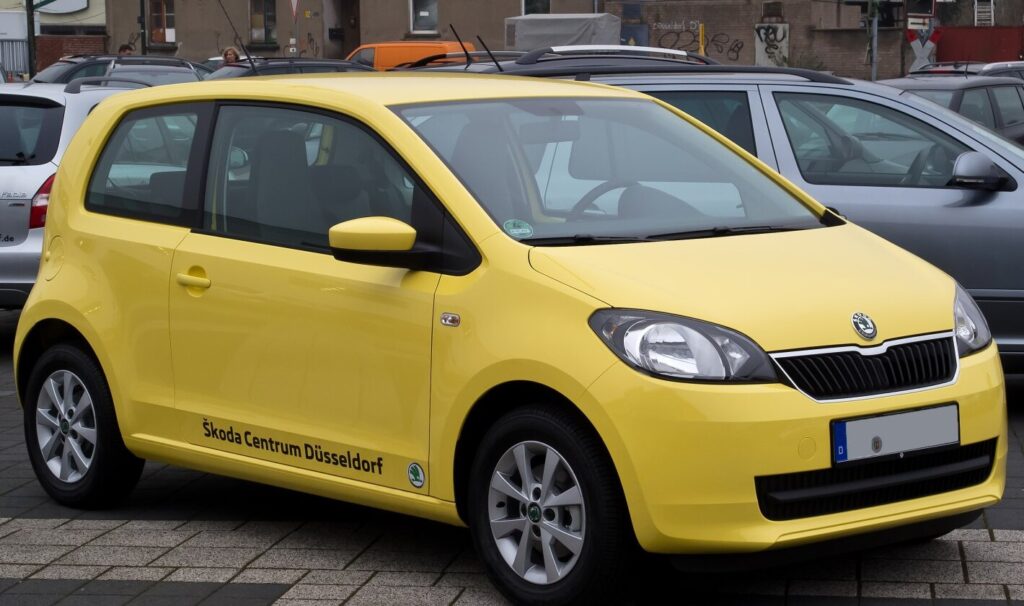
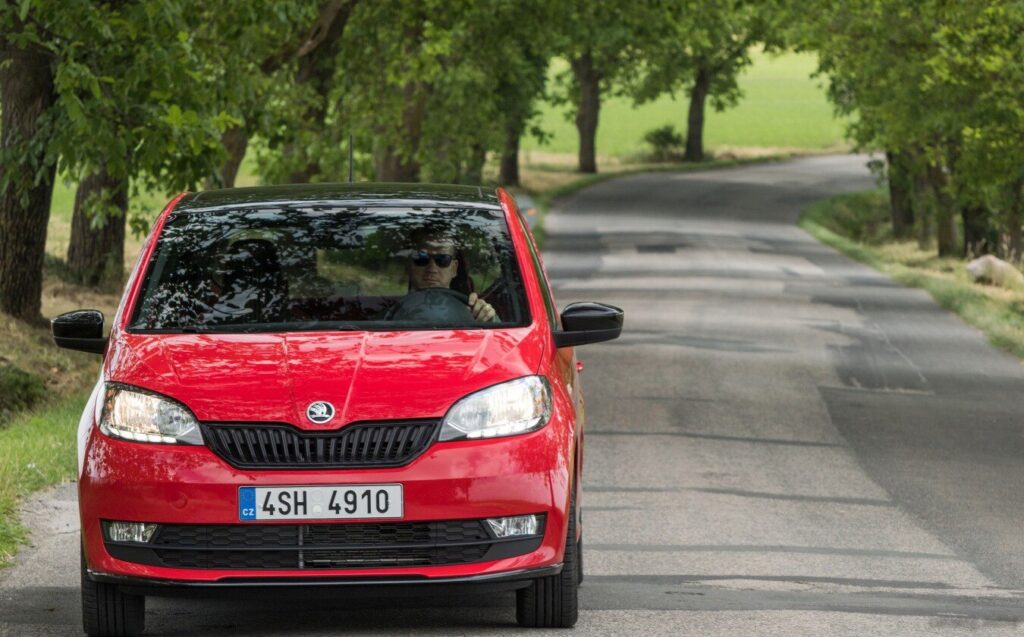
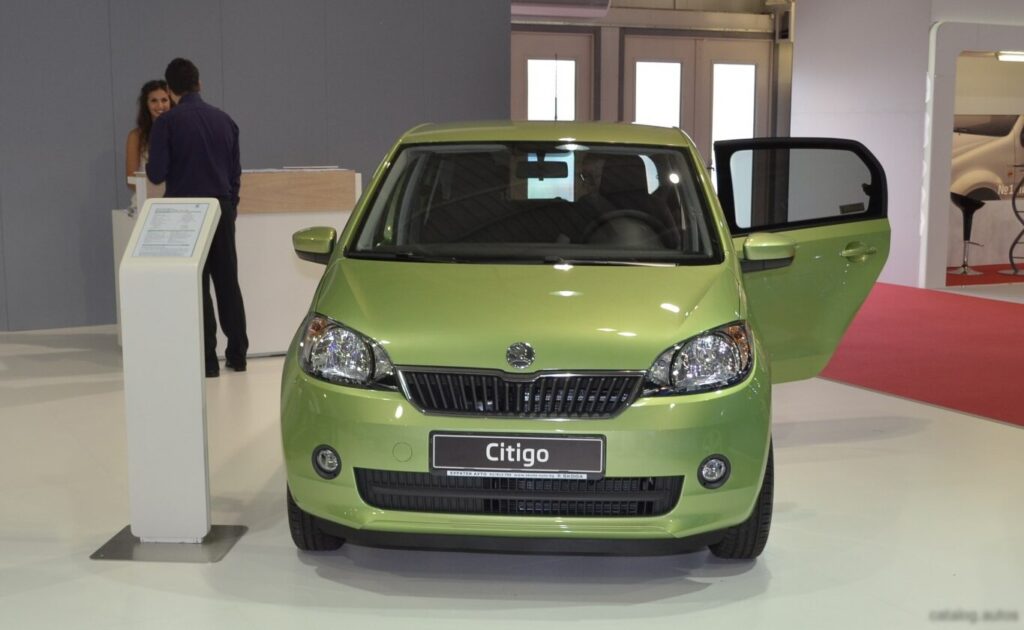
The Skoda Citigo, specifically the five-door 1.0-liter 60 horsepower variant, was a city car produced by the Czech manufacturer Skoda Auto between October 2011 and 2017. Part of the Volkswagen Group’s New Small Family (NSF) project, the Citigo shared its platform – the 1HX0/A3 – and many components with the Volkswagen up! and SEAT Mii. Designed as an affordable and economical vehicle for urban environments, the 1.0 60 hp model represented the entry point into the Citigo range, prioritizing fuel efficiency and low running costs over outright performance. It was primarily sold in European markets, where demand for small, practical hatchbacks remained strong.
Powertrain & Engine Architecture
The heart of the Citigo 1.0 60 hp is the CHYA engine code, a naturally aspirated, three-cylinder petrol engine displacing 999 cubic centimeters. This engine is a member of Volkswagen Group’s EA111 family, known for its compact size and relatively simple design. It utilizes a multi-point fuel injection system, delivering fuel directly into the intake ports. The engine features a single overhead camshaft (SOHC) operating four valves per cylinder. The 60 horsepower output is achieved at 5000-6000 rpm, with peak torque of 95 Nm (70 lb-ft) available between 3000 and 4300 rpm. The engine is paired with a five-speed manual transmission, chosen for its affordability and efficiency. An automated manual transmission (ASG) was also offered as an option, but the standard manual was more common in this base trim.
Driving Characteristics
The 1.0-liter 60 hp Citigo is not a performance-oriented vehicle. Acceleration is modest, taking approximately 14.4 seconds to reach 62 mph (100 km/h). The focus is on usability and fuel economy. The engine feels strained at higher speeds, and overtaking requires careful planning. The five-speed gearbox is well-matched to the engine’s characteristics, with relatively short ratios to keep the engine in its optimal power band. Compared to the more powerful 1.2-liter four-cylinder engine offered in higher Citigo trims, the 1.0-liter feels significantly less responsive. However, the lighter engine weight contributes to nimble handling in city driving. The ASG transmission, while offering some convenience, was often criticized for its jerky shifts and slow response compared to a traditional automatic or the manual gearbox.
Equipment & Trim Levels
The 1.0 60 hp Citigo typically came with a basic level of equipment, reflecting its position as the entry-level model. Standard features generally included central locking, power steering, ABS brakes, front airbags, and a basic audio system. Interior upholstery was typically cloth, and the dashboard featured a simple, functional design. Optional extras included air conditioning, electric front windows, and alloy wheels. Higher trim levels, such as the Elegance and Sport, added features like alloy wheels, a multi-function steering wheel, and upgraded interior trim. The five-door body style was a practical addition, offering easier access to the rear seats compared to the three-door version.
Chassis & Braking
The Citigo utilizes a McPherson strut front suspension and a semi-independent torsion beam rear suspension. This setup provides a comfortable ride quality, particularly on smooth urban roads. The front brakes are ventilated discs, while the rear brakes are drums – a cost-saving measure common in this segment. ABS (Anti-lock Braking System) is standard, enhancing safety during emergency braking. The steering is electrically assisted, providing light and easy steering feel, ideal for maneuvering in tight spaces. Stabilizer bars are present on both axles, helping to reduce body roll during cornering.
Market Reception & Comparison
The Skoda Citigo 1.0 60 hp was generally well-received by automotive critics as a practical and affordable city car. Its fuel economy was a major selling point, with combined fuel consumption figures around 4.5 l/100 km (52.3 US mpg). However, the engine’s lack of power was often noted. Compared to the Volkswagen up! and SEAT Mii, which shared the same platform and powertrain, the Citigo offered a slightly more affordable price point, making it an attractive option for budget-conscious buyers. The 1.2-liter engine offered in higher trims provided a noticeable performance improvement, but at the cost of increased fuel consumption and a higher purchase price. The 1.6 TDI diesel variant offered even better fuel economy, but was more expensive and subject to diesel emissions concerns.
Legacy
The Skoda Citigo, including the 1.0 60 hp variant, proved to be a reliable and economical city car. The CHYA engine, while not particularly powerful, is generally considered durable and relatively easy to maintain. On the used car market, Citigos are often sought after for their low running costs and practicality. Common issues are generally minor, such as wear and tear on suspension components and occasional problems with the ASG transmission (if equipped). The Citigo’s simple design and readily available parts contribute to its affordability and ease of repair, making it a popular choice for first-time car buyers and those seeking a dependable urban runabout.