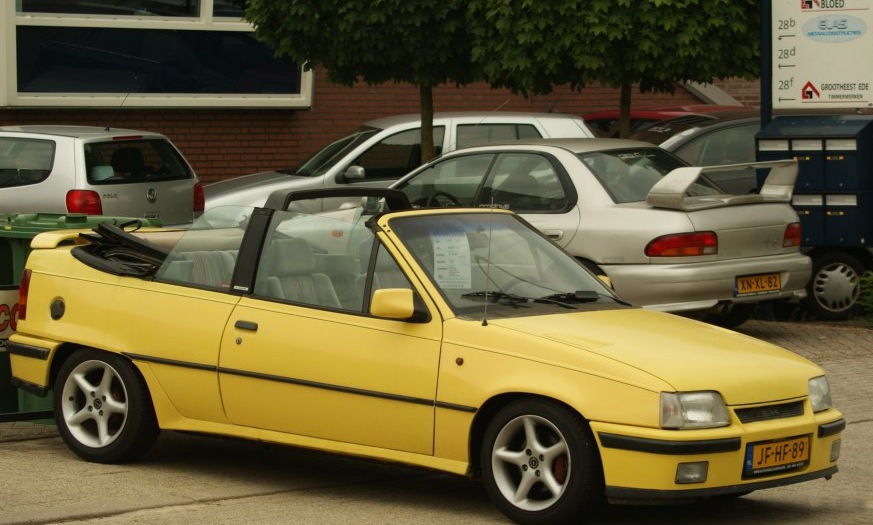
The Vauxhall Astra Mk II Convertible 2.0i CAT, produced between 1986 and 1993, represented a significant offering in the British market for affordable, open-top motoring. Positioned as a more premium variant within the Mk II Astra Convertible range, the 2.0i CAT (Catalytic Converter) distinguished itself with a larger engine and improved performance compared to the 1.6-liter models. This generation Astra Convertible, based on the Astra GTE chassis, aimed to provide a stylish and practical alternative to more expensive convertibles available at the time. It was a key model in Vauxhall’s lineup, appealing to buyers seeking a blend of sporty aesthetics and everyday usability.
Technical Specifications
| Brand | Vauxhall |
| Model | Astra |
| Generation | Astra Mk II Convertible |
| Type (Engine) | 2.0i CAT (115 Hp) |
| Start of production | 1986 |
| End of production | 1993 |
| Powertrain Architecture | Internal Combustion engine |
| Body type | Cabriolet |
| Seats | 4 |
| Doors | 2 |
| Fuel Type | Petrol (Gasoline) |
| Acceleration 0 – 100 km/h | 10 sec |
| Acceleration 0 – 62 mph | 10 sec |
| Acceleration 0 – 60 mph | 9.5 sec |
| Maximum speed | 195 km/h (121.17 mph) |
| Weight-to-power ratio | 9.2 kg/Hp, 109 Hp/tonne |
| Weight-to-torque ratio | 6.2 kg/Nm, 161.1 Nm/tonne |
| Power | 115 Hp @ 5400 rpm |
| Power per litre | 57.6 Hp/l |
| Torque | 170 Nm @ 3000 rpm (125.39 lb.-ft. @ 3000 rpm) |
| Engine layout | Front, Transverse |
| Engine Model/Code | C20NE |
| Engine displacement | 1998 cm3 (121.93 cu. in.) |
| Number of cylinders | 4 |
| Engine configuration | Inline |
| Cylinder Bore | 86 mm (3.39 in.) |
| Piston Stroke | 86 mm (3.39 in.) |
| Compression ratio | 9.2:1 |
| Number of valves per cylinder | 2 |
| Fuel injection system | Multi-port manifold injection |
| Engine aspiration | Naturally aspirated engine |
| Valvetrain | SOHC |
| Engine oil capacity | 4 l (4.23 US qt | 3.52 UK qt) |
| Coolant | 6.9 l (7.29 US qt | 6.07 UK qt) |
| Kerb Weight | 1055 kg (2325.88 lbs.) |
| Max. weight | 1460 kg (3218.75 lbs.) |
| Max load | 405 kg (892.87 lbs.) |
| Trunk (boot) space – minimum | 290 l (10.24 cu. ft.) |
| Trunk (boot) space – maximum | 620 l (21.9 cu. ft.) |
| Fuel tank capacity | 52 l (13.74 US gal | 11.44 UK gal) |
| Length | 3998 mm (157.4 in.) |
| Width | 1663 mm (65.47 in.) |
| Height | 1380 mm (54.33 in.) |
| Wheelbase | 2520 mm (99.21 in.) |
| Front track | 1406 mm (55.35 in.) |
| Rear (Back) track | 1406 mm (55.35 in.) |
| Minimum turning circle | 10.5 m (34.45 ft.) |
Powertrain & Engine Architecture
The heart of the Astra Mk II Convertible 2.0i CAT was the C20NE engine, a 1998cc inline-four cylinder unit. This engine was a mainstay of Vauxhall and Opel vehicles throughout the late 1980s and early 1990s. It featured a single overhead camshaft (SOHC) valvetrain operating two valves per cylinder. The ‘CAT’ designation indicated the presence of a catalytic converter, mandated by increasingly stringent emissions regulations. Fuel delivery was handled by Bosch multi-port fuel injection, contributing to improved fuel efficiency and smoother power delivery compared to earlier carbureted engines. The C20NE was known for its relative simplicity and robustness, making it a reasonably reliable unit. The engine was transversely mounted, driving the front wheels. The transmission was a four-speed automatic gearbox, offering convenience but at the expense of some performance and fuel economy compared to the available five-speed manual.
Driving Characteristics
The 2.0i CAT automatic offered a comfortable, if not particularly sporty, driving experience. The automatic transmission, while providing ease of use, resulted in a noticeable reduction in acceleration compared to the manual transmission equipped models. The 0-60 mph time of around 9.5 seconds was respectable for the era, but the engine felt somewhat strained when pushed hard. Gear ratios were optimized for cruising rather than outright performance. The power delivery was relatively linear, with peak torque arriving at 3000 rpm. Compared to the more nimble and engaging manual versions, the automatic felt heavier and less responsive. However, it catered to a different audience – those prioritizing comfort and convenience over outright driving thrills.
Equipment & Trim Levels
The 2.0i CAT typically came with a reasonably comprehensive equipment list for its time. Standard features included central locking, electric front windows, and a basic stereo system. Interior upholstery was typically cloth, with options for upgraded velour or leather available. Dashboard design was functional and straightforward, reflecting the car’s practical nature. Optional extras included alloy wheels, a sunroof (in addition to the convertible top), and upgraded sound systems. The trim level generally sat in the mid-range of the Astra Convertible lineup, offering a step up in terms of engine performance and features compared to the base 1.6-liter models, but lacking the full luxury appointments of any potential limited-edition variants.
Chassis & Braking
The Astra Mk II Convertible utilized a MacPherson strut front suspension and a twist-beam rear axle. The suspension was tuned for comfort, providing a relatively smooth ride, although body roll was noticeable during cornering. Braking was initially specified with front disc brakes and rear drum brakes, although later models often featured rear disc brakes as standard. Stabilizer bars were fitted to both the front and rear axles to help reduce body roll. The chassis was reinforced compared to the standard Astra hatchback to compensate for the loss of structural rigidity inherent in a convertible design.
Market Reception & Comparison
The Astra Mk II Convertible 2.0i CAT was generally well-received by motoring journalists as a capable and affordable convertible. Critics praised its stylish design and practicality, but noted that the automatic transmission dulled the driving experience. Compared to the 1.6-liter models, the 2.0i CAT offered a significant performance boost, but at a higher price point. Fuel economy was reasonable for the time, but lower than that of the smaller-engined variants. Reliability was generally good, although the automatic transmission could be prone to issues if not properly maintained. It competed with other affordable convertibles such as the Ford Escort Convertible and the Peugeot 205 Convertible.
Legacy
The Astra Mk II Convertible 2.0i CAT remains a popular choice among classic car enthusiasts today. The C20NE engine is known for its durability and relative ease of maintenance, making it a relatively affordable classic to own. Parts availability is generally good, although some trim-specific components can be difficult to find. The automatic transmission, while not as desirable as the manual, is still serviceable with regular maintenance. Values for well-maintained examples have been steadily increasing in recent years, reflecting the growing demand for affordable classic convertibles. The car represents a significant era in British motoring, offering a taste of open-top freedom at a reasonable price.