Technical Specifications
| Brand | Land Rover |
| Model | Discovery Sport |
| Generation | Discovery Sport |
| Type (Engine) | 2.0 (180 Hp) AWD Ingenium engine |
| Start of production | 2016 |
| End of production | 2018 |
| Powertrain Architecture | Internal Combustion engine |
| Body type | SUV |
| Seats | 5 |
| Doors | 5 |
| Fuel consumption (combined) | 4.9 l/100 km (48 US mpg, 57.6 UK mpg, 20.4 km/l) |
| CO2 emissions | 129 g/km |
| Fuel Type | Diesel |
| Acceleration 0 – 100 km/h | 9.9 sec |
| Acceleration 0 – 62 mph | 9.9 sec |
| Acceleration 0 – 60 mph | 9.4 sec |
| Maximum speed | 200 km/h (124.27 mph) |
| Emission standard | Euro 6 |
| Weight-to-power ratio | 9.9 kg/Hp, 101.4 Hp/tonne |
| Weight-to-torque ratio | 4.1 kg/Nm, 242.3 Nm/tonne |
| Power | 180 Hp @ 4000 rpm |
| Power per litre | 90 Hp/l |
| Torque | 430 Nm @ 1750 rpm (317.15 lb.-ft. @ 1750 rpm) |
| Engine layout | Front, Transverse |
| Engine Model/Code | Ingenium / 204DTD |
| Engine displacement | 1999 cm3 (121.99 cu. in.) |
| Number of cylinders | 4 |
| Engine configuration | Inline |
| Cylinder Bore | 83 mm (3.27 in.) |
| Piston Stroke | 92.35 mm (3.64 in.) |
| Compression ratio | 15.5:1 |
| Number of valves per cylinder | 4 |
| Fuel injection system | Diesel Commonrail |
| Engine aspiration | Turbocharger, Intercooler |
| Engine oil capacity | 6.5 l (6.87 US qt | 5.72 UK qt) |
| Coolant | 7.4 l (7.82 US qt | 6.51 UK qt) |
| Kerb Weight | 1775 kg (3913.21 lbs.) |
| Max. weight | 2505 kg (5522.58 lbs.) |
| Max load | 730 kg (1609.37 lbs.) |
| Trunk (boot) space – maximum | 1698 l (59.96 cu. ft.) |
| Fuel tank capacity | 54 l (14.27 US gal | 11.88 UK gal) |
| AdBlue tank | 13.7 l (3.62 US gal | 3.01 UK gal) |
| Permitted trailer load with brakes (12%) | 2000 kg (4409.25 lbs.) |
| Permitted trailer load without brakes | 750 kg (1653.47 lbs.) |
| Permitted towbar download | 150 kg (330.69 lbs.) |
| Length | 4599 mm (181.06 in.) |
| Width with mirrors folded | 2069 mm (81.46 in.) |
| Width including mirrors | 2173 mm (85.55 in.) |
| Height | 1724 mm (67.87 in.) |
| Wheelbase | 2741 mm (107.91 in.) |
| Front track | 1621 mm (63.82 in.) |
| Rear (Back) track | 1630 mm (64.17 in.) |
| Ride height (ground clearance) | 212 mm (8.35 in.) |
| Drag coefficient (Cd) | 0.36 |
| Minimum turning circle (turning diameter) | 11.6 m (38.06 ft.) |
| Approach angle | 25° |
| Departure angle | 31° |
| Ramp-over (brakeover) angle | 21° |
| Wading depth | 600 mm (23.62 in.) |
| Drive wheel | All wheel drive (4×4) |
| Number of gears and type of gearbox | 6 gears, manual transmission |
| Front suspension | Independent, type McPherson with coil spring and anti-roll bar |
| Rear suspension | Independent multi-link suspension |
| Front brakes | Ventilated discs, 325 mm |
| Rear brakes | Disc, 300 mm |
| Assisting systems | ABS (Anti-lock braking system) |
| Steering type | Steering rack and pinion |
| Power steering | Electric Steering |
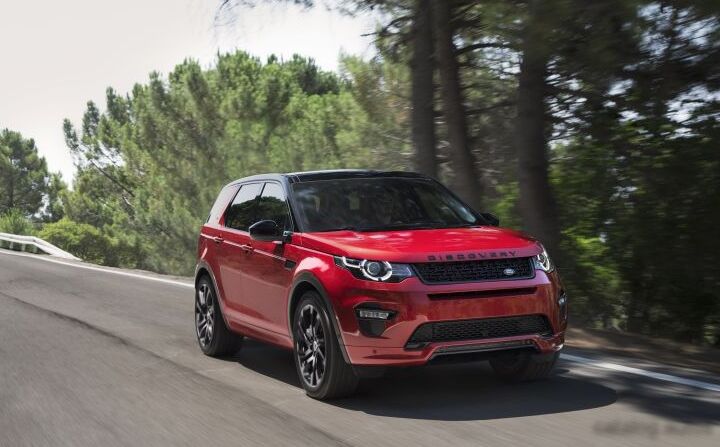
The Land Rover Discovery Sport 2.0 (180 hp) AWD, powered by the Ingenium engine, was a crucial model in the first generation of the Discovery Sport, produced from 2016 to 2018. Positioned as a mid-range offering, it aimed to strike a balance between fuel efficiency, performance, and all-terrain capability for families and drivers desiring a premium compact SUV. This variant played a significant role in establishing the Discovery Sport as a popular choice in both European and North American markets, providing a more accessible entry point into the Land Rover brand compared to the higher-powered and more expensive trims.
Powertrain & Engine Architecture
The core of this Discovery Sport variant is the Ingenium 2.0-liter four-cylinder diesel engine, specifically the 204DTD code. This engine marked a significant advancement for Jaguar Land Rover, being entirely designed and manufactured in-house. The Ingenium family was conceived with modularity in mind, allowing for easy adaptation to various fuel types and power outputs. The 204DTD utilizes a sophisticated diesel commonrail fuel injection system, delivering fuel at extremely high pressures for optimized combustion. It also incorporates a low-pressure exhaust gas recirculation (EGR) system to minimize NOx emissions and a turbocharger with an intercooler to enhance both power and efficiency. The engine generates 180 horsepower at 4000 rpm and a substantial 430 Nm (317 lb-ft) of torque at a low 1750 rpm. This torque output is a defining characteristic of the Ingenium engine, delivering strong pulling power from low engine speeds. The engine is mounted transversely in the front of the vehicle. A 6-speed manual transmission was standard, selected for its balance of efficiency and driver engagement.
Driving Characteristics
The 180 hp Ingenium diesel, coupled with the 6-speed manual gearbox, delivered a comfortable and capable driving experience. While not as aggressively sporty as the higher-powered versions, it provided sufficient power for everyday driving and longer journeys. The robust low-end torque made overtaking relatively straightforward, and the manual transmission allowed for greater driver control. The gear ratios were optimized for fuel economy, meaning the engine didn’t feel strained at highway speeds. Compared to the 240 hp version, the 180 hp model exhibited a less urgent acceleration, taking approximately 9.9 seconds to reach 62 mph. However, this difference was often deemed acceptable by buyers prioritizing fuel economy and a more relaxed driving style. The all-wheel-drive system provided excellent traction in diverse conditions, enhancing stability and driver confidence.
Equipment & Trim Levels
The 180 hp Discovery Sport typically included a generous level of standard equipment. This encompassed features such as automatic headlights, rain-sensing wipers, a leather-wrapped steering wheel, and an 8-inch touchscreen infotainment system with navigation. Interior upholstery was generally cloth, although leather options were available as upgrades. Popular optional extras included a panoramic sunroof, heated seats, a premium sound system, and parking assistance features. Trim levels varied depending on the market, but generally, this engine was offered in SE, HSE, and Landmark trims, with each successive level adding more luxury and technological enhancements.
Chassis & Braking
The Discovery Sport’s chassis was engineered to provide a balance between on-road comfort and off-road capability. It featured an independent McPherson strut front suspension and an independent multi-link rear suspension. The suspension was tuned to deliver a compliant ride, effectively absorbing bumps and road imperfections. Braking was managed by ventilated discs at the front and solid discs at the rear. An Anti-lock Braking System (ABS) was standard, along with Electronic Stability Control (ESC) and Traction Control. The vehicle’s weight of approximately 1775 kg (3913 lbs) was handled effectively by the suspension and braking system.
Market Reception & Comparison
The Discovery Sport 2.0 (180 hp) AWD was generally well-received by automotive reviewers. It was praised for its stylish design, spacious interior, and capable all-wheel-drive system. The Ingenium engine was lauded for its refinement and fuel efficiency, achieving around 48 US mpg on the combined cycle. Compared to the more powerful 240 hp version, the 180 hp model offered a more affordable entry point into the Discovery Sport range, appealing to a broader customer base. However, some critics noted that the manual transmission wasn’t as refined as some competitors, and the acceleration wasn’t particularly thrilling. Against rivals like the Audi Q3 and BMW X1, the Discovery Sport offered a compelling combination of luxury, practicality, and off-road prowess.
Legacy
The Ingenium engine family has proven to be remarkably durable, and the 204DTD variant in the Discovery Sport is no exception. While early iterations of the Ingenium engines experienced some minor software glitches, these were largely resolved through software updates. Today, well-maintained examples of the Discovery Sport 2.0 (180 hp) AWD remain relatively common in the used car market. They represent a good value proposition for buyers seeking a stylish, capable, and fuel-efficient compact SUV. The engine’s longevity and relatively low running costs contribute to its continued popularity in the pre-owned vehicle segment.