Technical Specifications
| Brand | Nissan |
| Model | Micra |
| Generation | Micra (K13) |
| Type (Engine) | 1.2 (80 Hp) |
| Start of production | 2010 |
| End of production | 2013 |
| Powertrain Architecture | Internal Combustion engine |
| Body type | Hatchback |
| Seats | 5 |
| Doors | 3/5 |
| Fuel consumption (urban) | 6.1 l/100 km (38.6 US mpg, 46.3 UK mpg, 16.4 km/l) |
| Fuel consumption (extra urban) | 4.3 l/100 km (54.7 US mpg, 65.7 UK mpg, 23.3 km/l) |
| Fuel consumption (combined) | 5 l/100 km (47 US mpg, 56.5 UK mpg, 20 km/l) |
| Fuel Type | Petrol (Gasoline) |
| Acceleration 0 – 100 km/h | 13.7 sec |
| Acceleration 0 – 62 mph | 13.7 sec |
| Acceleration 0 – 60 mph | 13 sec |
| Maximum speed | 170 km/h (105.63 mph) |
| Emission standard | Euro 5 |
| Weight-to-power ratio | 11.4 kg/Hp, 87.9 Hp/tonne |
| Weight-to-torque ratio | 8.3 kg/Nm, 120.9 Nm/tonne |
| Power | 80 Hp @ 6000 rpm |
| Power per litre | 66.8 Hp/l |
| Torque | 110 Nm @ 4000 rpm (81.13 lb.-ft. @ 4000 rpm) |
| Engine layout | Front, Transverse |
| Engine Model/Code | HR12DE |
| Engine displacement | 1198 cm3 (73.11 cu. in.) |
| Number of cylinders | 3 |
| Engine configuration | Inline |
| Number of valves per cylinder | 4 |
| Fuel injection system | Multi-port manifold injection |
| Engine aspiration | Naturally aspirated engine |
| Engine oil capacity | 3.4 l (3.59 US qt | 2.99 UK qt) |
| Coolant capacity | 5.5 l (5.81 US qt | 4.84 UK qt) |
| Kerb Weight | 910 kg (2006.21 lbs.) |
| Max. weight | 1425 kg (3141.59 lbs.) |
| Max load | 515 kg (1135.38 lbs.) |
| Trunk (boot) space – minimum | 515 l (18.19 cu. ft.) |
| Fuel tank capacity | 41 l (10.83 US gal | 9.02 UK gal) |
| Length | 3780 mm (148.82 in.) |
| Width | 1675 mm (65.94 in.) |
| Height | 1525 mm (60.04 in.) |
| Wheelbase | 2450 mm (96.46 in.) |
| Minimum turning circle | 9.3 m (30.51 ft.) |
| Number of gears and type of gearbox | 5 gears, manual transmission |
| Front suspension | Independent type McPherson |
| Rear suspension | Torsion |
| Front brakes | Disc |
| Rear brakes | Drum |
| Assisting systems | ABS (Anti-lock braking system) |
| Steering type | Steering rack and pinion |
| Power steering | Electric Steering |
| Tires size | 165/70 R14; 175/60 R15 |
| Wheel rims size | 14; 15 |
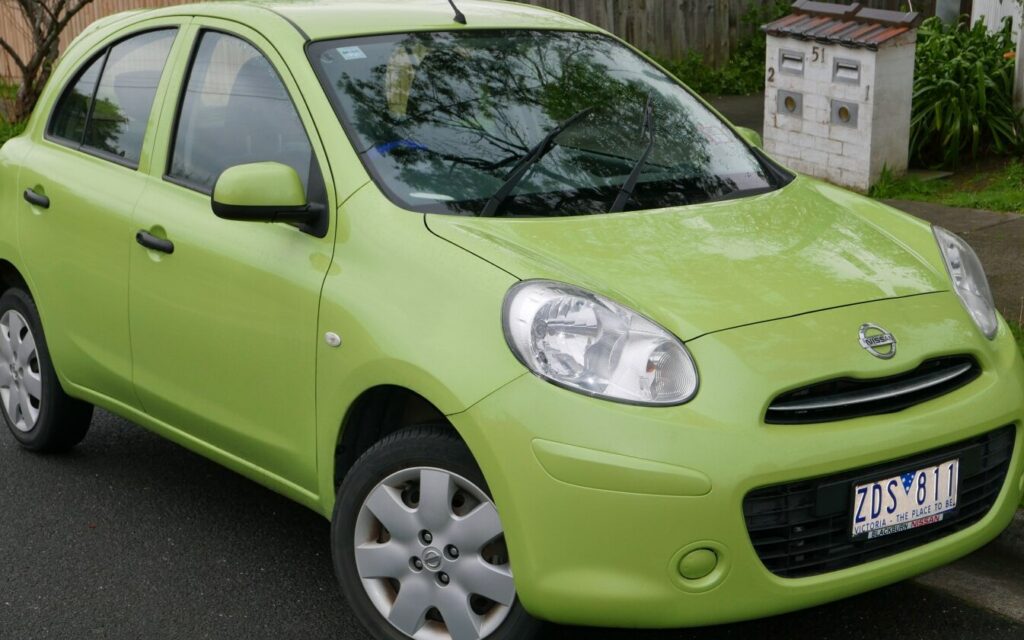
The Nissan Micra K13 1.2 (80 Hp) was positioned as the entry point into the fourth-generation Micra lineup. Introduced in 2010 and continuing through 2013, it aimed to provide affordable and efficient transportation for city dwellers. The K13 represented a significant redesign for the Micra, moving away from the more utilitarian styling of the previous generation towards a more contemporary and visually appealing aesthetic. This variant, with its smaller engine and manual transmission, was specifically targeted at buyers prioritizing fuel economy and low running costs over outright performance. It was a common sight in European cities, where its compact size and nimble handling proved advantageous.
Powertrain & Engine Architecture
The heart of the Micra 1.2 is the HR12DE, a 1.2-liter inline three-cylinder petrol engine. This engine is characterized by its lightweight construction and relatively simple design, contributing to its fuel efficiency. The HR12DE utilizes a multi-point fuel injection system, delivering fuel directly into the intake ports. It features four valves per cylinder, enhancing breathing and contributing to a reasonable power output for its size. The engine’s 80 horsepower peak is achieved at 6000 rpm, while its 110 Nm (81.13 lb-ft) of torque is available at 4000 rpm. Paired with a five-speed manual transmission, the powertrain is designed for smooth and economical operation. The transmission itself is a conventional setup, prioritizing reliability and ease of use over sporty performance. The engine’s transverse mounting and front-wheel-drive configuration are typical for vehicles in this class.
Driving Characteristics
The 1.2-liter Micra offers a driving experience best described as practical and undemanding. Acceleration is modest, taking approximately 13.7 seconds to reach 62 mph (100 km/h). The engine feels most comfortable in the lower to mid-range of the rev band, providing adequate power for urban driving and moderate highway speeds. The five-speed manual transmission is light and easy to operate, but the gear ratios are geared towards fuel efficiency rather than spirited acceleration. Compared to higher-spec Micras equipped with larger engines, the 1.2 feels noticeably slower, particularly when fully loaded or tackling steep inclines. However, its lighter weight and nimble handling make it surprisingly enjoyable to drive in city environments. The steering is light and precise, making maneuvering in tight spaces easy.
Equipment & Trim Levels
The 1.2-liter Micra typically came with a basic but functional equipment list. Standard features generally included power steering, central locking, electric front windows, and an ABS anti-lock braking system. Interior upholstery was typically cloth, with a simple and durable design. Air conditioning was often an optional extra, as were features like alloy wheels and a CD player with auxiliary input. Trim levels varied slightly depending on the market, but the 1.2 generally represented the base model, with fewer frills than the higher-spec 1.4 or 1.6-liter variants. The dashboard layout was straightforward and easy to use, prioritizing functionality over aesthetic flair.
Chassis & Braking
The Micra K13 utilizes a McPherson strut front suspension and a torsion beam rear suspension. This setup provides a comfortable ride quality, absorbing bumps and imperfections in the road surface effectively. The front brakes are discs, offering adequate stopping power, while the rear brakes are drums, a cost-saving measure common in this segment. The steering is rack and pinion, providing precise and responsive handling. The relatively lightweight construction of the vehicle contributes to its nimble handling characteristics. Stabilizer bars were typically fitted to the front suspension, helping to reduce body roll during cornering.
Market Reception & Comparison
The Nissan Micra 1.2 received generally positive reviews for its fuel efficiency, practicality, and affordability. Critics praised its nimble handling and comfortable ride, but noted its lack of outright performance. Compared to other engines in the K13 lineup, the 1.2 offered the lowest running costs but also the slowest acceleration. The 1.4-liter engine provided a noticeable performance boost, while the 1.6-liter offered even more power but at the expense of fuel economy. In terms of reliability, the HR12DE engine proved to be generally robust, with few major issues reported. Fuel economy figures of around 5 liters per 100 kilometers (47 US mpg) were typical, making it an attractive option for budget-conscious buyers.
Legacy
The Nissan Micra K13 1.2 remains a popular choice in the used car market, particularly for first-time drivers or those seeking an economical city car. The HR12DE engine has proven to be relatively reliable, although regular maintenance is essential to ensure longevity. Common issues include occasional oil leaks and wear on the timing chain. Parts availability is generally good, and repair costs are relatively low. While not the most exciting car to drive, the Micra 1.2 offers a practical and affordable solution for everyday transportation, and its reputation for reliability has ensured its continued popularity in the used car market.