
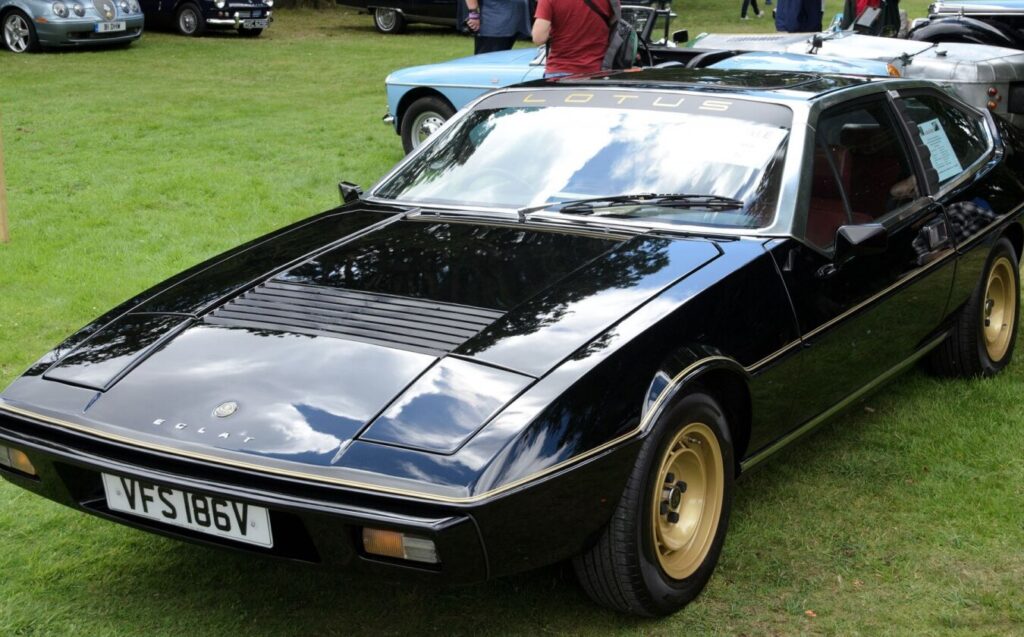
The Lotus Eclat 2.2, produced between 1980 and 1986, represented a significant step forward for Lotus in terms of practicality and market appeal. Positioned as a more accessible and comfortable grand tourer than the more focused and expensive Esprit, the Eclat aimed to broaden Lotus’s customer base. The 2.2-liter variant, producing 162 horsepower, was a mainstay of the Eclat lineup during these years, offering a balance of performance and usability within the 2+2 coupe segment. It was built on the backbone chassis, a signature of Lotus engineering, and served as a bridge between the earlier Series 1 Eclats and the later, more refined models.
Technical Specifications
| Brand | Lotus |
| Model | Eclat |
| Generation | Eclat |
| Type (Engine) | 2.2 (162 Hp) |
| Start of production | 1980 |
| End of production | 1986 |
| Powertrain Architecture | Internal Combustion engine |
| Body type | Coupe |
| Seats | 4 |
| Doors | 2 |
| Fuel consumption (economy) – urban | 15 l/100 km (15.7 US mpg, 18.8 UK mpg, 6.7 km/l) |
| Fuel consumption (economy) – extra urban | 10 l/100 km (23.5 US mpg, 28.2 UK mpg, 10 km/l) |
| Fuel consumption (economy) – combined | 12.5 l/100 km (18.8 US mpg, 22.6 UK mpg, 8 km/l) |
| Fuel Type | Petrol (Gasoline) |
| Acceleration 0 – 100 km/h | 7.2 sec |
| Acceleration 0 – 62 mph | 7.2 sec |
| Acceleration 0 – 60 mph | 7.9 sec |
| Maximum speed | 211 km/h (131.11 mph) |
| Weight-to-power ratio | 6.8 kg/Hp, 147 Hp/tonne |
| Weight-to-torque ratio | 5.1 kg/Nm, 196.9 Nm/tonne |
| Power | 162 Hp @ 6500 rpm |
| Power per litre | 74.5 Hp/l |
| Torque | 217 Nm @ 5000 rpm (160.05 lb.-ft. @ 5000 rpm) |
| Engine layout | Front, Longitudinal |
| Engine Model/Code | Lotus 912 |
| Engine displacement | 2174 cm3 (132.67 cu. in.) |
| Number of cylinders | 4 |
| Engine configuration | Inline |
| Cylinder Bore | 95.29 mm (3.75 in.) |
| Piston Stroke | 76.2 mm (3 in.) |
| Compression ratio | 9.44:1 |
| Number of valves per cylinder | 4 |
| Fuel injection system | Carburettor |
| Engine aspiration | Naturally aspirated engine |
| Kerb Weight | 1102 kg (2429.49 lbs.) |
| Fuel tank capacity | 67 l (17.7 US gal, 14.74 UK gal) |
| Length | 4458 mm (175.51 in.) |
| Width | 1816 mm (71.5 in.) |
| Height | 1207 mm (47.52 in.) |
| Wheelbase | 2483 mm (97.76 in.) |
| Front track | 1486 mm (58.5 in.) |
| Rear (Back) track | 1499 mm (59.02 in.) |
| Minimum turning circle (turning diameter) | 10.5 m (34.45 ft.) |
| Drivetrain Architecture | The Internal combustion engine (ICE) drives the rear wheels of the vehicle. |
| Drive wheel | Rear wheel drive |
| Number of gears and type of gearbox | 5 gears, manual transmission |
| Front suspension | Independent torsion bar, double wishbone |
| Rear suspension | Trailing arm |
| Front brakes | Disc |
| Rear brakes | Drum |
| Steering type | Steering rack and pinion |
| Power steering | Hydraulic Steering |
| Tires size | 205/60 R14 V |
| Wheel rims size | 7J x 14 |
Powertrain & Engine Architecture
The heart of the Eclat 2.2 is the Lotus 912 engine, a 2.2-liter (2174 cc) inline-four cylinder powerplant. This engine, while sharing some lineage with the earlier Lotus 911, featured a larger displacement and revised internals to deliver increased power and torque. It utilized a twin overhead camshaft design with four valves per cylinder, contributing to its relatively high specific output for the era. Notably, the 912 employed twin Weber 38DCOF carburetors for fuel delivery, a characteristic that, while contributing to the engine’s responsiveness, also meant it was less fuel-efficient and required more frequent tuning compared to contemporary fuel-injected engines. The engine is longitudinally mounted, driving the rear wheels. The five-speed manual transmission, a key component of the driving experience, was sourced from Citroen and known for its robust construction and precise shift feel.
Driving Characteristics
The Eclat 2.2 with the five-speed manual transmission offered a compelling driving experience. Acceleration to 60 mph took approximately 7.9 seconds, and it could reach a top speed of 131 mph. While not blistering by modern standards, this performance was respectable for a four-seat coupe of the early 1980s. The relatively light weight of the Eclat (around 2430 lbs) contributed to its nimble handling. The suspension, featuring independent torsion bar front suspension and a trailing arm rear setup, provided a good balance between ride comfort and handling precision. The gearbox ratios were well-chosen, allowing the engine to remain in its powerband during spirited driving. Compared to the later, fuel-injected Eclats, the carbureted 2.2 felt more raw and demanded more driver involvement, but many enthusiasts appreciated this characteristic.
Equipment & Trim Levels
The Eclat 2.2 typically came equipped with a reasonable level of standard features for its price point. Interior appointments included cloth upholstery, although leather was available as an option. The dashboard layout was functional and driver-focused, with clearly marked gauges. Power steering was standard, making the car easier to maneuver at low speeds. Optional extras included air conditioning, a sunroof, and upgraded audio systems. The Eclat wasn’t overtly luxurious, but it offered a comfortable and well-equipped cabin for a sports-oriented coupe. The 2.2 model generally represented a mid-range offering within the Eclat lineup, positioned above the earlier, smaller-engined versions but below the more expensive and performance-focused Esprit.
Chassis & Braking
The Eclat’s chassis was a steel backbone design, a Lotus hallmark. This construction method provided a high degree of rigidity while keeping weight to a minimum. The front suspension utilized independent torsion bars and double wishbones, while the rear employed a trailing arm setup. Braking was accomplished via disc brakes at the front and drum brakes at the rear. While adequate for most driving situations, the rear drum brakes were a point of criticism, as they lacked the stopping power and fade resistance of disc brakes. The steering was a rack and pinion system with hydraulic assistance, providing precise and responsive control.
Market Reception & Comparison
The Lotus Eclat 2.2 was generally well-received by automotive critics. It was praised for its handling, performance, and relatively practical interior space. However, the carbureted engine was sometimes criticized for its fuel consumption and maintenance requirements. Compared to other coupes in its class, such as the Porsche 924 and the BMW 320i, the Eclat offered a unique blend of British sports car character and everyday usability. The 2.2-liter engine provided a noticeable performance improvement over the earlier 1.6-liter versions, making it a more desirable option for many buyers. Reliability was generally good, although Lotus cars of this era required diligent maintenance to prevent issues.
Legacy
Today, the Lotus Eclat 2.2 is a sought-after classic car, particularly among Lotus enthusiasts. The 912 engine, while requiring regular maintenance, is generally considered to be a robust and reliable unit when properly cared for. Parts availability can be a challenge, but a dedicated network of Lotus specialists and suppliers exists to support owners. The Eclat’s unique combination of style, performance, and practicality has ensured its enduring appeal. Well-maintained examples command respectable prices in the used car market, and the Eclat continues to provide a rewarding and engaging driving experience for those who appreciate classic British sports cars.
