
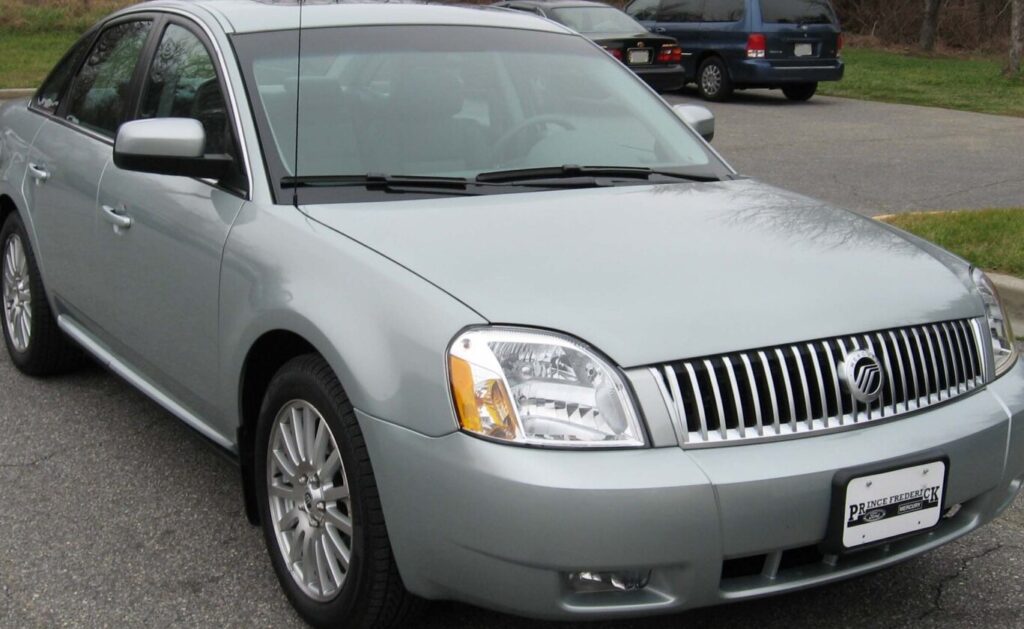
The Mercury Montego 3.0 i V6 24V AWD, produced from 2005 to April 2007, represented a mid-size sedan offering from the now-defunct Mercury brand. Positioned as a somewhat upscale offering within the Ford Motor Company lineup, the Montego aimed to provide a comfortable and spacious alternative to more mainstream competitors. This particular variant, equipped with the 3.0-liter Duratec V6 engine and all-wheel drive, was a mid-range offering, slotting between the base 3.0-liter front-wheel-drive model and the higher-trim versions with optional features. It was built on the Ford D2C platform, shared with the Ford Five Hundred and Lincoln MKZ.
Technical Specifications
| Brand | Mercury |
| Model | Montego |
| Generation | Montego |
| Type (Engine) | 3.0 i V6 24V AWD (203 Hp) |
| Start of production | 2005 |
| End of production | April, 2007 |
| Powertrain Architecture | Internal Combustion engine |
| Body type | Sedan |
| Seats | 5 |
| Doors | 4 |
| Fuel consumption (urban) | 12.4 l/100 km (19 US mpg) |
| Fuel consumption (extra urban) | 9.1 l/100 km (25.8 US mpg) |
| Fuel Type | Petrol (Gasoline) |
| Maximum speed | 177 km/h (109.98 mph) |
| Weight-to-power ratio | 8.7 kg/Hp |
| Weight-to-torque ratio | 6.5 kg/Nm |
| Power | 203 Hp @ 5750 rpm |
| Power per litre | 68.4 Hp/l |
| Torque | 271 Nm @ 4500 rpm (199.88 lb.-ft. @ 4500 rpm) |
| Engine layout | Front, Transverse |
| Engine displacement | 2967 cm3 (181.06 cu. in.) |
| Number of cylinders | 6 |
| Engine configuration | V-engine |
| Cylinder Bore | 89 mm (3.5 in.) |
| Piston Stroke | 79.5 mm (3.13 in.) |
| Compression ratio | 10:1 |
| Number of valves per cylinder | 4 |
| Fuel injection system | Multi-port manifold injection |
| Engine aspiration | Naturally aspirated engine |
| Valvetrain | DOHC |
| Engine oil capacity | 5.7 l (6.02 US qt | 5.02 UK qt) |
| Coolant | 11 l (11.62 US qt | 9.68 UK qt) |
| Kerb Weight | 1770 kg (3902.18 lbs.) |
| Trunk (boot) space (minimum) | 595 l (21.01 cu. ft.) |
| Fuel tank capacity | 72 l (19.02 US gal | 15.84 UK gal) |
| Length | 5100 mm (200.79 in.) |
| Width | 1870 mm (73.62 in.) |
| Height | 1530 mm (60.24 in.) |
| Wheelbase | 2870 mm (112.99 in.) |
| Front track | 1640 mm (64.57 in.) |
| Rear track | 1650 mm (64.96 in.) |
| Drive wheel | All wheel drive (4×4) |
| Front suspension | Spring Strut |
| Rear suspension | Transverse stabilizer |
| Front brakes | Ventilated discs |
| Rear brakes | Disc |
| Assisting systems | ABS (Anti-lock braking system) |
| Steering type | Steering rack and pinion |
| Tires size | 225/55 R18 |
Powertrain & Engine Architecture
The heart of the Montego 3.0 i AWD was the Duratec 30 V6 engine. This 2.967-liter (181.06 cubic inch) engine featured a 60-degree V-configuration, four valves per cylinder, and dual overhead camshafts (DOHC). The engine utilized a multi-port fuel injection system, delivering fuel directly into the intake ports. The Duratec 30 was known for its relatively smooth operation and decent power output for its displacement. The engine code is generally identified as the 3.0L Duratec. Paired with this engine was a 5-speed automatic transmission, providing smooth shifts but not offering the driver much control. This transmission was a common unit used across various Ford and Mercury models of the era. The all-wheel-drive system was a viscous coupling system, automatically distributing torque between the front and rear axles as needed, enhancing traction in slippery conditions.
Driving Characteristics
The Montego 3.0 i AWD offered a comfortable, if not particularly sporty, driving experience. The 203 horsepower and 199.88 lb-ft of torque provided adequate acceleration for everyday driving, but it wasn’t a performance-oriented vehicle. The automatic transmission, while smooth, could feel somewhat sluggish, especially during quick overtaking maneuvers. The all-wheel-drive system provided enhanced stability and traction, particularly in inclement weather, making it a practical choice for regions with snow or rain. Compared to the base 3.0-liter front-wheel-drive Montego, the AWD version offered improved handling and grip, but at the expense of slightly reduced fuel economy. It lacked the responsiveness of a manual transmission and the outright power of potential upgrades available in other Ford models.
Equipment & Trim Levels
The Montego 3.0 i AWD typically came standard with features such as air conditioning, power windows and locks, a CD player, and cloth upholstery. Higher trim levels offered upgrades like leather seats, a premium sound system, and a sunroof. Safety features included anti-lock brakes (ABS) and front airbags. Optional extras included a navigation system, heated seats, and alloy wheels. The interior design was generally conservative, focusing on comfort and practicality rather than luxury or style. The dashboard layout was straightforward and easy to use, with clearly labeled controls.
Chassis & Braking
The Montego utilized an independent front suspension with MacPherson struts and a multi-link rear suspension. This setup provided a comfortable ride, absorbing bumps and imperfections in the road effectively. The front brakes were ventilated discs, while the rear brakes were solid discs. The ABS system helped to prevent wheel lockup during hard braking, enhancing safety. The steering was a rack-and-pinion system, providing reasonably precise steering feel. The suspension was tuned for comfort, prioritizing ride quality over sporty handling.
Market Reception & Comparison
The Mercury Montego faced stiff competition from established mid-size sedans like the Toyota Camry, Honda Accord, and Ford Fusion. Critics generally praised the Montego’s spacious interior and comfortable ride, but noted its somewhat bland styling and uninspired driving dynamics. The 3.0-liter V6 and automatic transmission combination was considered adequate, but not particularly exciting. Fuel economy was average for the class. Compared to the base 3.0-liter front-wheel-drive Montego, the AWD version offered better handling and traction, but at a higher price point and with slightly worse fuel economy. The Montego struggled to gain significant market share, and production was discontinued after only two model years.
Legacy
The Mercury Montego, and particularly the 3.0 i V6 AWD variant, hasn’t achieved a significant following among collectors or enthusiasts. The Duratec 30 engine is generally considered reliable, but like any engine, it can be susceptible to issues such as oil leaks and timing chain wear with age and high mileage. Parts availability is generally good, as the engine and transmission were used in a variety of Ford and Mercury vehicles. Today, used Montegos are relatively affordable, making them a potentially practical option for budget-conscious buyers seeking a spacious and comfortable sedan. However, potential buyers should be aware of the vehicle’s age and potential maintenance needs.
