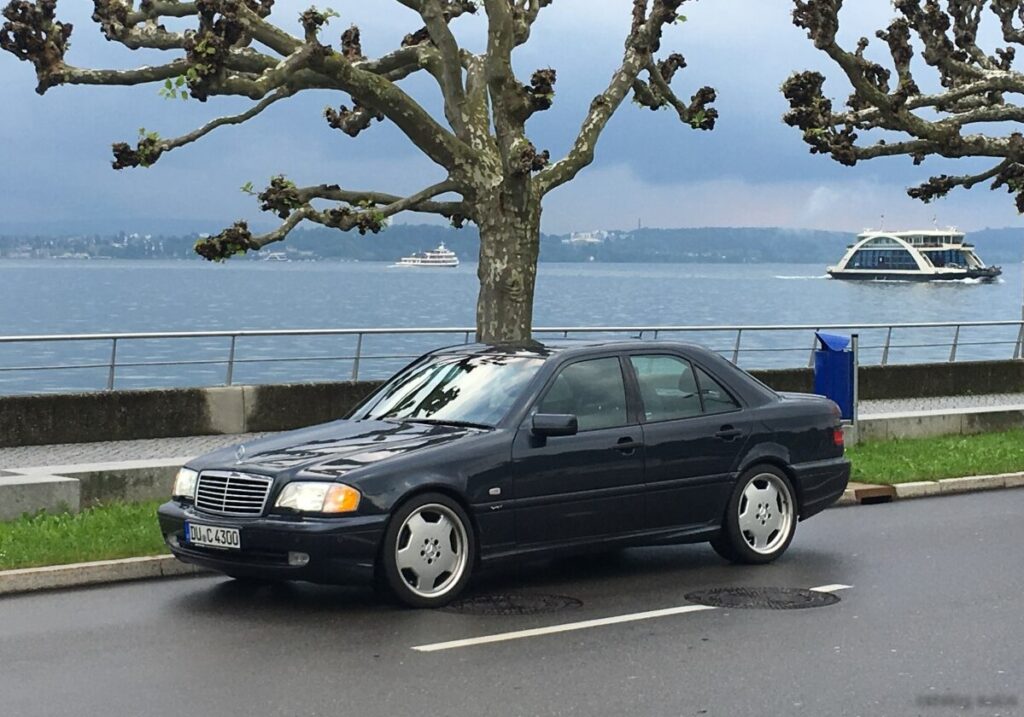
The Mercedes-Benz C 200 CDI, produced from May 1998 to May 2000, was a variant of the W202 C-Class following the 1997 facelift. This model represented Mercedes-Benz’s entry into the compact executive diesel market, offering a fuel-efficient and relatively affordable option within the C-Class range. Positioned as a more economical alternative to the petrol-powered C 180 and C 220 models, and below the more powerful C 250 Turbo Diesel, the C 200 CDI aimed to appeal to buyers prioritizing fuel economy and practicality. It was a key offering in the European market, where diesel engines held a significant share of the automotive landscape.
Technical Specifications
| Brand | Mercedes-Benz |
| Model | C-class |
| Generation | C-class (W202, facelift 1997) |
| Type (Engine) | C 200 CDI (102 Hp) |
| Start of production | May, 1998 |
| End of production | May, 2000 |
| Powertrain Architecture | Internal Combustion engine |
| Body type | Sedan |
| Seats | 5 |
| Doors | 4 |
| Fuel consumption (urban) | 8.2 l/100 km (28.7 US mpg, 34.4 UK mpg, 12.2 km/l) |
| Fuel consumption (extra urban) | 5 l/100 km (47 US mpg, 56.5 UK mpg, 20 km/l) |
| Fuel consumption (combined) | 6.1 l/100 km (38.6 US mpg, 46.3 UK mpg, 16.4 km/l) |
| Fuel Type | Diesel |
| Acceleration 0 – 100 km/h | 13.1 sec |
| Acceleration 0 – 62 mph | 13.1 sec |
| Acceleration 0 – 60 mph | 12.4 sec |
| Maximum speed | 185 km/h (114.95 mph) |
| Weight-to-power ratio | 13.8 kg/Hp, 72.3 Hp/tonne |
| Weight-to-torque ratio | 6 kg/Nm, 166.7 Nm/tonne |
| Power | 102 Hp @ 4200 rpm |
| Power per litre | 47.4 Hp/l |
| Torque | 235 Nm @ 1500-2600 rpm (173.33 lb.-ft. @ 1500-2600 rpm) |
| Engine layout | Front, Longitudinal |
| Engine Model/Code | OM 611 DE 22 LA LR / 611.960 |
| Engine displacement | 2151 cm3 (131.26 cu. in.) |
| Number of cylinders | 4 |
| Engine configuration | Inline |
| Cylinder Bore | 88 mm (3.46 in.) |
| Piston Stroke | 88.4 mm (3.48 in.) |
| Compression ratio | 19:1 |
| Number of valves per cylinder | 4 |
| Fuel injection system | Diesel Commonrail |
| Engine aspiration | Turbocharger, Intercooler |
| Valvetrain | DOHC |
| Engine oil capacity | 6 l (6.34 US qt | 5.28 UK qt) |
| Coolant | 8 l (8.45 US qt | 7.04 UK qt) |
| Kerb Weight | 1410 kg (3108.52 lbs.) |
| Max. weight | 1890 kg (4166.74 lbs.) |
| Max load | 480 kg (1058.22 lbs.) |
| Fuel tank capacity | 62 l (16.38 US gal | 13.64 UK gal) |
| Length | 4516 mm (177.8 in.) |
| Width | 1723 mm (67.83 in.) |
| Height | 1427 mm (56.18 in.) |
| Wheelbase | 2690 mm (105.91 in.) |
| Front track | 1499 mm (59.02 in.) |
| Rear track | 1464 mm (57.64 in.) |
| Drivetrain Architecture | The Internal combustion engine (ICE) drives the rear wheels of the vehicle. |
| Drive wheel | Rear wheel drive |
| Number of gears and type of gearbox | 5 gears, manual transmission |
| Front suspension | Double wishbone |
| Rear suspension | Independent multi-link spring suspension with stabilizer |
| Front brakes | Ventilated discs |
| Rear brakes | Disc |
| Assisting systems | ABS (Anti-lock braking system) |
| Steering type | Cone worm with recirculation balls |
| Power steering | Hydraulic Steering |
| Tires size | 195/65 R15 |
| Wheel rims size | 6.5J x 15 |
Powertrain & Engine Architecture
The C 200 CDI was powered by the OM 611 DE 22 LA LR engine, a 2.2-liter inline-four cylinder diesel. This engine was a significant step forward for Mercedes-Benz, incorporating common rail direct injection technology. The common rail system, operating at extremely high pressures, allowed for finer control of fuel delivery, resulting in improved combustion efficiency, reduced noise, and lower emissions compared to older diesel injection systems. The engine featured a turbocharger with an intercooler, boosting power output to 102 horsepower and 235 Nm (173 lb-ft) of torque. The torque curve was relatively flat, providing good pulling power from low engine speeds. The engine utilized a double overhead camshaft (DOHC) valvetrain with four valves per cylinder, further enhancing its performance. The standard transmission was a 5-speed manual gearbox, although an optional 5-speed automatic transmission was available.
Driving Characteristics
The C 200 CDI with the manual transmission offered a practical and economical driving experience. Acceleration was modest, taking around 13.1 seconds to reach 62 mph (100 km/h), but the engine’s strong low-end torque made it feel more responsive in everyday driving situations. The automatic transmission, while offering convenience, slightly dulled performance due to its less efficient power transfer. Compared to the petrol-powered C 180, the C 200 CDI offered significantly better fuel economy, making it ideal for long-distance journeys. However, it lacked the refinement and outright performance of the higher-end C 220 or C 250 Turbo Diesel models. The rear-wheel drive configuration provided a balanced handling feel, typical of Mercedes-Benz sedans of the era.
Equipment & Trim Levels
The C 200 CDI typically came equipped with a reasonable level of standard features, including power windows, central locking, and an anti-lock braking system (ABS). Interior upholstery was generally cloth, although leather options were available. The dashboard layout was typical of the W202 C-Class, with a functional and understated design. Optional extras included air conditioning, a sunroof, and upgraded audio systems. The C 200 CDI didn’t typically receive the same level of luxury appointments as the higher-trim models, focusing instead on providing a well-equipped and practical package.
Chassis & Braking
The C 200 CDI utilized a double wishbone front suspension and an independent multi-link rear suspension, providing a comfortable ride and good handling characteristics. The braking system consisted of ventilated discs at the front and solid discs at the rear. ABS was standard, enhancing braking performance and stability. The suspension was tuned to prioritize comfort over outright sportiness, making it well-suited for everyday driving. Stabilizer bars were fitted to both the front and rear axles to reduce body roll during cornering.
Market Reception & Comparison
The C 200 CDI was generally well-received by automotive critics as a sensible and economical option within the C-Class range. Its fuel efficiency was a major selling point, particularly in Europe where diesel fuel was often cheaper than petrol. Compared to the petrol-powered C 180, the C 200 CDI offered superior fuel economy and torque, but at the expense of some refinement and performance. The C 250 Turbo Diesel offered significantly more power and a more luxurious experience, but at a higher price point. Reliability was generally good, although the common rail injection system required careful maintenance to ensure optimal performance.
Legacy
The OM 611 engine family, including the version used in the C 200 CDI, proved to be a durable and reliable powerplant. These engines are known for their longevity and relatively low maintenance costs, provided they are properly serviced. Today, the W202 C 200 CDI can be found as a relatively affordable used car, appealing to buyers seeking a classic Mercedes-Benz with good fuel economy. While not a performance icon, the C 200 CDI represents a significant step in the development of modern diesel technology and remains a practical and economical choice for those seeking a reliable and well-built compact executive sedan.