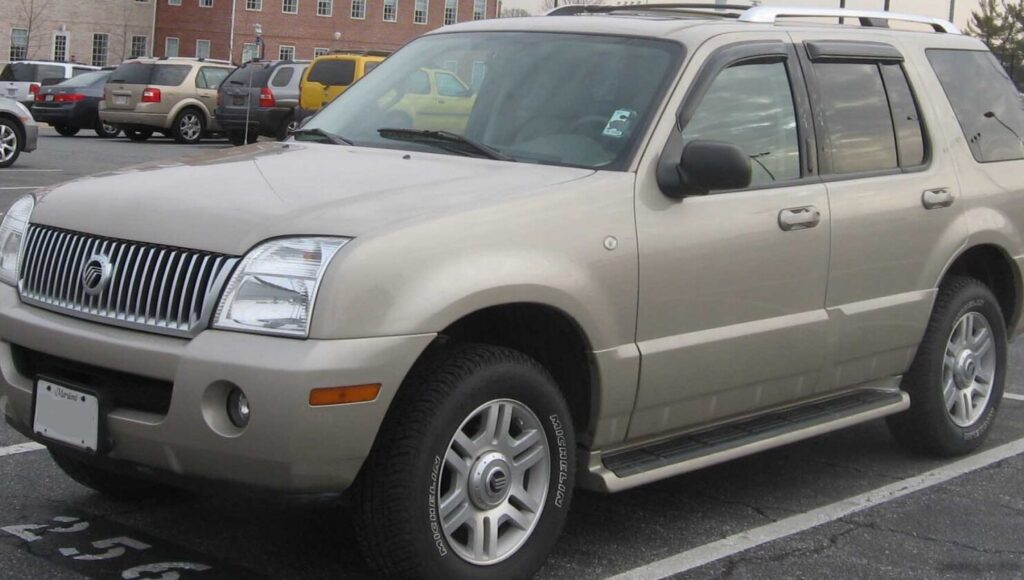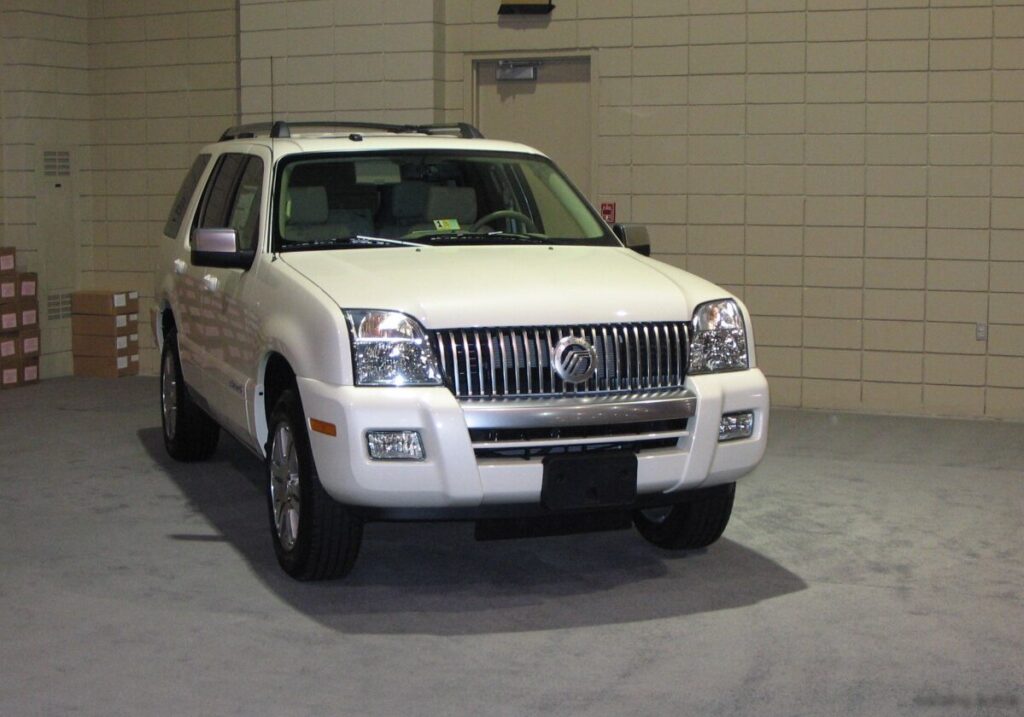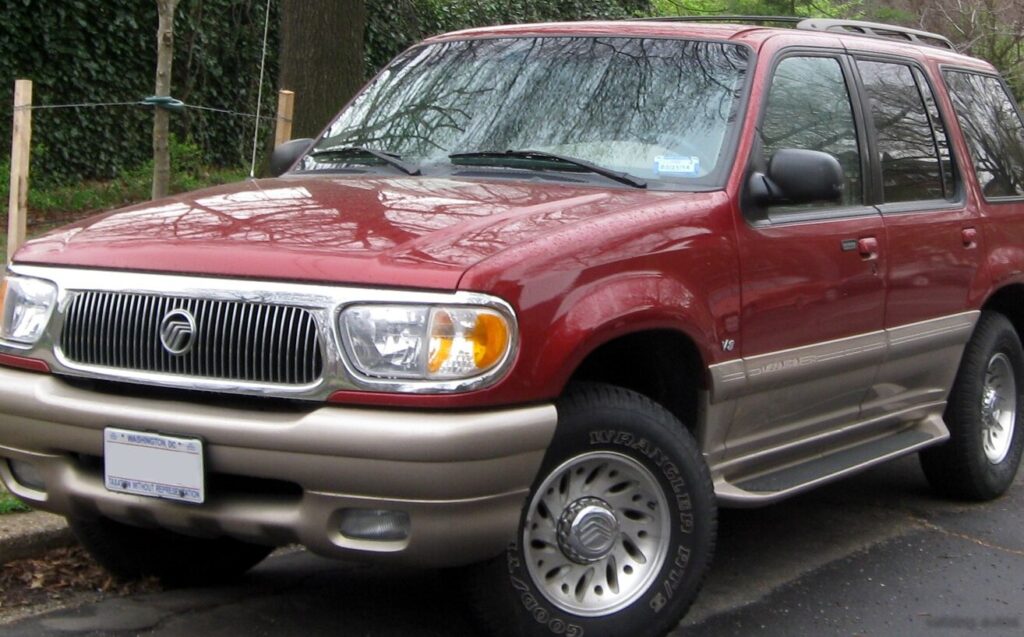
The Mercury Mountaineer I 4.0i V6, produced between 1998 and 2001, represented Mercury’s entry into the mid-size SUV market. Built on the Ford Explorer platform (UN83), the Mountaineer aimed to offer a more upscale alternative with enhanced features and a distinct styling compared to its Ford sibling. This particular variant, equipped with the 4.0-liter V6 engine and a five-speed automatic transmission, occupied a middle ground in the Mountaineer lineup, offering a balance between performance, fuel economy, and price. It was positioned below the higher-trim models that offered optional four-wheel drive and luxury packages.
Technical Specifications
| Brand | Mercury |
| Model | Mountaineer |
| Generation | Mountaineer I |
| Type (Engine) | 4.0 i V6 (213 Hp) |
| Start of production | 1998 |
| End of production | 2001 |
| Powertrain Architecture | Internal Combustion engine |
| Body type | SUV |
| Seats | 5 |
| Doors | 5 |
| Fuel consumption (urban) | 18.2 l/100 km (12.9 US mpg) |
| Fuel consumption (extra urban) | 11.1 l/100 km (21.2 US mpg) |
| Fuel Type | Petrol (Gasoline) |
| Maximum speed | 170 km/h (105.63 mph) |
| Weight-to-power ratio | 8.3 kg/Hp |
| Weight-to-torque ratio | 5.4 kg/Nm |
| Power | 213 Hp @ 5250 rpm |
| Power per litre | 53.3 Hp/l |
| Torque | 326 Nm @ 3250 rpm (240.45 lb.-ft. @ 3250 rpm) |
| Engine layout | Front, Longitudinal |
| Engine displacement | 3996 cm3 (243.85 cu. in.) |
| Number of cylinders | 6 |
| Engine configuration | V-engine |
| Cylinder Bore | 100.3 mm (3.95 in.) |
| Piston Stroke | 84.3 mm (3.32 in.) |
| Compression ratio | 9.7:1 |
| Number of valves per cylinder | 2 |
| Fuel injection system | Multi-port manifold injection |
| Engine aspiration | Naturally aspirated engine |
| Engine oil capacity | 4.7 l (4.97 US qt | 4.14 UK qt) |
| Coolant | 13.2 l (13.95 US qt | 11.61 UK qt) |
| Kerb Weight | 1760 kg (3880.14 lbs.) |
| Max. weight | 2510 kg (5533.6 lbs.) |
| Max load | 750 kg (1653.47 lbs.) |
| Trunk (boot) space – minimum | 1205 l (42.55 cu. ft.) |
| Trunk (boot) space – maximum | 2310 l (81.58 cu. ft.) |
| Fuel tank capacity | 79 l (20.87 US gal | 17.38 UK gal) |
| Length | 4790 mm (188.58 in.) |
| Width | 1875 mm (73.82 in.) |
| Height | 1830 mm (72.05 in.) |
| Wheelbase | 2830 mm (111.42 in.) |
| Front track | 1490 mm (58.66 in.) |
| Rear (Back) track | 1490 mm (58.66 in.) |
| Drivetrain Architecture | The Internal combustion engine (ICE) drives the rear wheels of the vehicle. |
| Drive wheel | Rear wheel drive |
| Number of gears and type of gearbox | 5 gears, automatic transmission |
| Front suspension | Double wishbone |
| Rear suspension | Coil spring |
| Front brakes | Ventilated discs |
| Rear brakes | Disc |
| Assisting systems | ABS (Anti-lock braking system) |
| Steering type | Steering rack and pinion |
| Power steering | Hydraulic Steering |
| Tires size | 225/70 R15 |
Powertrain & Engine Architecture
The heart of this Mountaineer variant is the Ford 4.0-liter OHV (Overhead Valve) V6 engine, internally designated as the 4.0L Windsor. This engine, a staple in Ford’s lineup for many years, featured a cast iron block and aluminum cylinder heads. The engine utilized a multi-port fuel injection system, delivering fuel directly to each intake port for improved efficiency and power delivery. The 9.7:1 compression ratio was a compromise between performance and the ability to run on readily available gasoline grades. The five-speed automatic transmission (5R55E) was a crucial component, offering smooth shifts and a wide gear ratio spread. This transmission was known for its reliability, though later years saw some issues with torque converter failures. The longitudinal engine placement and rear-wheel drive configuration were standard for the Mountaineer.
Driving Characteristics
The 4.0L V6, producing 213 horsepower and 240 lb-ft of torque, provided adequate, but not exhilarating, performance for the Mountaineer. Acceleration from 0 to 60 mph was typically in the 8-9 second range. Compared to the optional 5.0L V8, the 4.0L felt noticeably less powerful, particularly when fully loaded or towing. The automatic transmission, while smooth, sometimes felt hesitant during quick acceleration. The gear ratios were tuned for comfortable cruising rather than sporty driving. The Mountaineer I 4.0i V6 offered a more relaxed driving experience than its V8 counterpart, prioritizing fuel efficiency and ease of use over outright speed. The rear-wheel drive configuration provided a more traditional SUV feel, though it lacked the all-weather capability of four-wheel drive models.
Equipment & Trim Levels
The Mountaineer I 4.0i V6 typically came standard with features like air conditioning, power windows and locks, a CD player, and cloth upholstery. Higher trim levels added features such as leather seats, a power driver’s seat, upgraded audio systems, and alloy wheels. Optional extras included a sunroof, rear entertainment system, and upgraded towing packages. The interior design was generally functional and comfortable, though it lacked the luxurious appointments found in some competing SUVs. The dashboard layout was straightforward, with easy-to-read gauges and logically placed controls.
Chassis & Braking
The Mountaineer I utilized a body-on-frame construction, providing a robust and durable platform. The front suspension featured an independent double wishbone design, while the rear suspension employed a solid axle with coil springs. This setup offered a comfortable ride, but handling was not particularly sharp. The braking system consisted of ventilated discs at the front and solid discs at the rear. Anti-lock brakes (ABS) were standard, enhancing safety and control during emergency braking situations. The Mountaineer’s relatively heavy weight (approximately 3,880 lbs) contributed to a noticeable braking distance.
Market Reception & Comparison
The Mercury Mountaineer I 4.0i V6 was generally well-received by critics as a competent and comfortable mid-size SUV. However, it often faced criticism for its lack of refinement compared to some competitors, such as the Jeep Grand Cherokee. Fuel economy was average for its class, with EPA estimates around 13 mpg city and 18 mpg highway. Compared to the V8-powered Mountaineer, the 4.0L V6 offered better fuel economy but significantly less power. The 4.0L version was often seen as a good value for buyers who didn’t require the extra performance of the V8.
Legacy
The 4.0L Windsor V6 engine and 5R55E transmission proved to be relatively reliable powertrains, though regular maintenance was crucial. Common issues included oil leaks, timing chain wear, and occasional transmission slippage. Today, the Mountaineer I 4.0i V6 can be found on the used car market at affordable prices. Its simplicity and relatively low maintenance costs make it an attractive option for budget-conscious buyers. However, potential buyers should be aware of the age-related issues common to vehicles of this era, such as rust and worn suspension components. The Mountaineer I represents a transitional period in SUV design, bridging the gap between traditional body-on-frame construction and the more modern unibody designs that would become prevalent in later years.