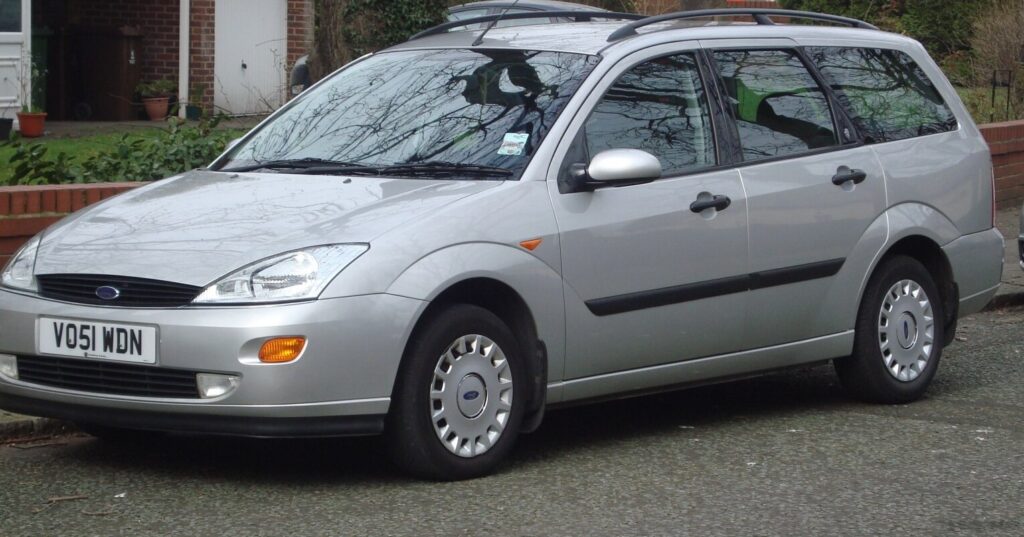
The Ford Focus Turnier I 1.4 16V, produced between 1999 and 2005, represented the entry point into the first generation Focus range in many European markets. Positioned as a practical and affordable station wagon (estate), it offered family-friendly versatility based on Ford’s new C-segment platform (code-named C170). This variant, powered by the Zetec-E engine and typically paired with a five-speed manual transmission, aimed to provide economical transportation with reasonable space and functionality. While not a performance leader, it played a crucial role in establishing the Focus as a popular choice in the compact class.
Technical Specifications
| Brand | Ford |
| Model | Focus |
| Generation | Focus Turnier I |
| Type (Engine) | 1.4 16V (75 Hp) |
| Start of production | 1999 year |
| End of production | 2005 year |
| Powertrain Architecture | Internal Combustion engine |
| Body type | Station wagon (estate) |
| Seats | 5 |
| Doors | 5 |
| Fuel consumption (economy) – urban | 8.7 l/100 km (27 US mpg, 32.5 UK mpg, 11.5 km/l) |
| Fuel consumption (economy) – extra urban | 5.3 l/100 km (44.4 US mpg, 53.3 UK mpg, 18.9 km/l) |
| Fuel consumption (economy) – combined | 6.6 l/100 km (35.6 US mpg, 42.8 UK mpg, 15.2 km/l) |
| Fuel Type | Petrol (Gasoline) |
| Acceleration 0 – 100 km/h | 14.6 sec |
| Acceleration 0 – 62 mph | 14.6 sec |
| Acceleration 0 – 60 mph | 13.9 sec |
| Maximum speed | 171 km/h (106.25 mph) |
| Weight-to-power ratio | 14.9 kg/Hp, 67.3 Hp/tonne |
| Weight-to-torque ratio | 8.9 kg/Nm, 112.1 Nm/tonne |
| Power | 75 Hp @ 5000 rpm |
| Power per litre | 54 Hp/l |
| Torque | 125 Nm @ 3500 rpm (92.2 lb.-ft. @ 3500 rpm) |
| Engine layout | Front, Transverse |
| Engine Model/Code | FXDA, FXDC, FXDB, FXDD |
| Engine displacement | 1388 cm3 (84.7 cu. in.) |
| Number of cylinders | 4 |
| Engine configuration | Inline |
| Cylinder Bore | 76 mm (2.99 in.) |
| Piston Stroke | 76.5 mm (3.01 in.) |
| Compression ratio | 11:1 |
| Number of valves per cylinder | 4 |
| Fuel injection system | Multi-port manifold injection |
| Engine aspiration | Naturally aspirated engine |
| Valvetrain | DOHC |
| Engine oil capacity | 3.75 l (3.96 US qt | 3.3 UK qt) |
| Coolant | 5 l (5.28 US qt | 4.4 UK qt) |
| Kerb Weight | 1115 kg (2458.15 lbs.) |
| Max. weight | 1630 kg (3593.53 lbs.) |
| Max load | 515 kg (1135.38 lbs.) |
| Trunk (boot) space – minimum | 520 l (18.36 cu. ft.) |
| Trunk (boot) space – maximum | 1580 l (55.8 cu. ft.) |
| Fuel tank capacity | 55 l (14.53 US gal | 12.1 UK gal) |
| Length | 4438 mm (174.72 in.) |
| Width | 1698 mm (66.85 in.) |
| Height | 1447 mm (56.97 in.) |
| Wheelbase | 2615 mm (102.95 in.) |
| Front track | 1484 mm (58.43 in.) |
| Rear (Back) track | 1477 mm (58.15 in.) |
| Drivetrain Architecture | The Internal combustion engine (ICE) drives the front wheels of the vehicle. |
| Drive wheel | Front wheel drive |
| Number of gears and type of gearbox | 5 gears, manual transmission |
| Front suspension | Wishbone |
| Rear suspension | Coil spring |
| Front brakes | Ventilated discs |
| Rear brakes | Drum |
| Assisting systems | ABS (Anti-lock braking system) |
| Steering type | Steering rack and pinion |
| Power steering | Hydraulic Steering |
| Tires size | 175/70R14 |
Powertrain & Engine Architecture
The heart of the Focus Turnier I 1.4 16V is the Zetec-E engine, a 1.4-liter inline-four cylinder gasoline engine. Engine codes varied slightly depending on the market and year, including FXDA, FXDC, FXDB, and FXDD. This engine featured a dual overhead camshaft (DOHC) valvetrain with four valves per cylinder, contributing to its relatively efficient breathing. Fuel delivery was handled by a multi-port fuel injection system, providing precise fuel metering for improved combustion. The engine’s 1388cc displacement produced 75 horsepower at 5000 rpm and 125 Nm (92.2 lb-ft) of torque at 3500 rpm. The five-speed manual transmission was the most common pairing, offering a reasonable spread of gears for both urban and highway driving. The transmission itself was a conventional design, prioritizing durability and affordability over sporty shift feel.
Driving Characteristics
The 1.4-liter engine in the Focus Turnier I, when coupled with the five-speed manual, provided adequate, but not exhilarating, performance. Acceleration from 0-60 mph took around 13.9 seconds, and top speed was approximately 106 mph. The engine felt somewhat strained when fully loaded or climbing hills, requiring frequent downshifts to maintain momentum. The gear ratios were tuned for economy rather than outright speed, with a relatively tall fifth gear designed for efficient cruising. Compared to the higher-output 1.6-liter or the more powerful Focus variants, the 1.4 felt noticeably slower. However, its lighter weight and predictable handling made it a pleasant enough driving experience for everyday use.
Equipment & Trim Levels
The 1.4 16V typically represented the base trim level in the Focus Turnier I range. Standard equipment generally included power steering, central locking, electric front windows, and an adjustable steering column. Interior upholstery was typically cloth, and the dashboard featured a functional, if somewhat basic, design. Optional extras included air conditioning, alloy wheels, and a radio/CD player. Higher trim levels, such as the LX or Ghia, added features like upgraded upholstery, more comprehensive electrical equipment, and exterior enhancements.
Chassis & Braking
The Focus Turnier I utilized a MacPherson strut front suspension and a coil spring rear suspension. The suspension setup was tuned for comfort and stability, providing a reasonably smooth ride over most road surfaces. Front brakes were ventilated discs, offering good stopping power, while rear brakes were drums, a cost-saving measure common in entry-level models. Anti-lock Braking System (ABS) was often included as standard equipment, enhancing safety. The chassis was relatively lightweight, contributing to the car’s nimble handling characteristics.
Market Reception & Comparison
The Ford Focus Turnier I 1.4 16V was generally well-received as a practical and affordable family car. Critics praised its spacious interior, good fuel economy (around 35.6 US mpg combined), and predictable handling. However, the engine’s lack of power was a common criticism. Compared to the 1.6-liter variant, the 1.4 offered lower running costs but sacrificed performance. The 1.8-liter models provided a significant power boost but came at a higher price point. In terms of reliability, the Zetec-E engine proved to be generally robust, although regular maintenance was essential.
Legacy
The Ford Focus Turnier I 1.4 16V remains a relatively common sight on used car markets today. Its simple mechanical design and readily available parts contribute to its affordability and ease of maintenance. While not a collector’s item, it represents a solid and dependable choice for those seeking an economical and practical station wagon. The Zetec-E engine, in particular, has a reputation for longevity, provided it has been properly maintained. The 1.4 variant, while not the most exciting Focus model, played a vital role in establishing the Focus as a successful and popular vehicle in Europe and beyond.