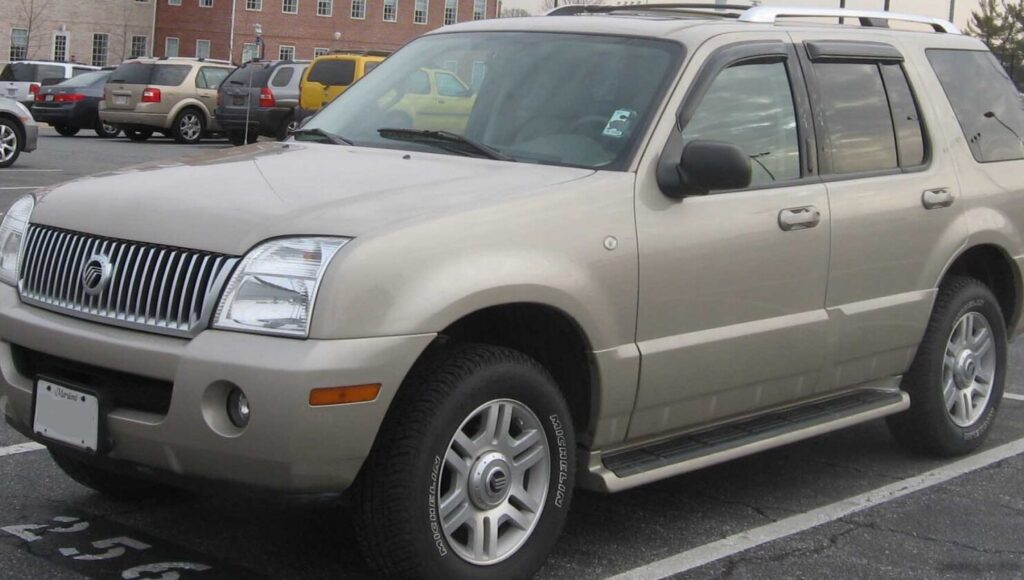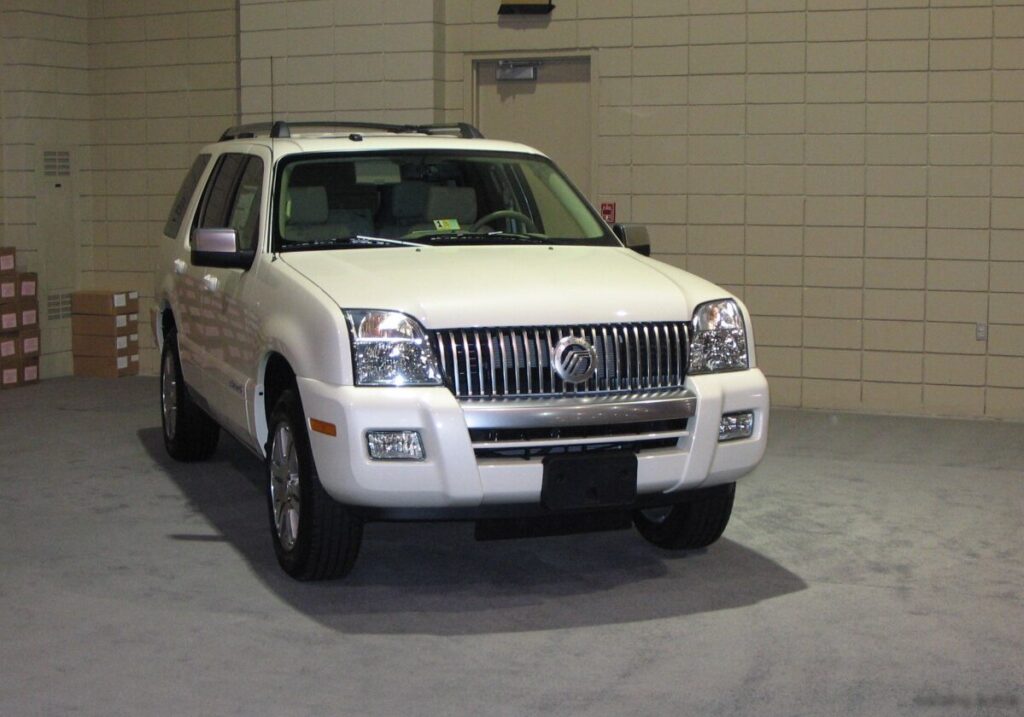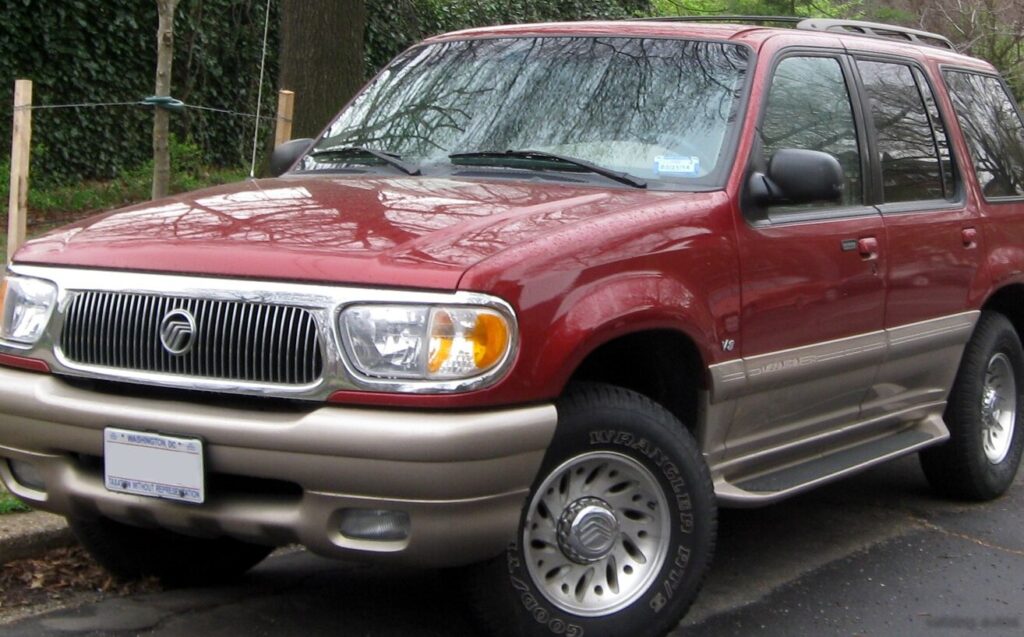
The Mercury Mountaineer I 4.9i V8, produced from 1996 to 2001, represented Mercury’s entry into the burgeoning mid-size SUV market. Sharing a platform with the Ford Explorer (UN83), the Mountaineer aimed to offer a more upscale alternative with enhanced features and a slightly more refined driving experience. This particular variant, equipped with the 4.9-liter V8 engine and a four-speed automatic transmission, occupied a mid-range position within the Mountaineer lineup, offering a balance between capability and affordability. It was positioned above the base 4.0L inline-six models but below the later, more powerful 5.0L V8 options.
Technical Specifications
| Brand | Mercury |
| Model | Mountaineer |
| Generation | Mountaineer I |
| Type (Engine) | 4.9 i V8 (218 Hp) |
| Start of production | 1996 |
| End of production | 2001 |
| Powertrain Architecture | Internal Combustion engine |
| Body type | SUV |
| Seats | 7 |
| Doors | 5 |
| Fuel consumption (urban) | 15.7 l/100 km (15 US mpg, 18 UK mpg) |
| Fuel consumption (extra urban) | 11.7 l/100 km (20.1 US mpg, 24.1 UK mpg) |
| Fuel Type | Petrol (Gasoline) |
| Maximum speed | 180 km/h (111.85 mph) |
| Weight-to-power ratio | 8.3 kg/Hp |
| Weight-to-torque ratio | 4.6 kg/Nm |
| Power | 218 Hp @ 4200 rpm |
| Power per litre | 44.1 Hp/l |
| Torque | 391 Nm @ 3300 rpm (288.39 lb.-ft. @ 3300 rpm) |
| Engine layout | Front, Longitudinal |
| Engine displacement | 4942 cm3 (301.58 cu. in.) |
| Number of cylinders | 8 |
| Engine configuration | V-engine |
| Cylinder Bore | 101.6 mm (4 in.) |
| Piston Stroke | 76.2 mm (3 in.) |
| Compression ratio | 8.8:1 |
| Number of valves per cylinder | 2 |
| Fuel injection system | Multi-port manifold injection |
| Engine aspiration | Naturally aspirated engine |
| Valvetrain | OHC |
| Engine oil capacity | 4.7 l (4.97 US qt | 4.14 UK qt) |
| Coolant | 14.9 l (15.74 US qt | 13.11 UK qt) |
| Kerb Weight | 1800 kg (3968.32 lbs.) |
| Trunk (boot) space – minimum | 1205 l (42.55 cu. ft.) |
| Trunk (boot) space – maximum | 2310 l (81.58 cu. ft.) |
| Fuel tank capacity | 79 l (20.87 US gal | 17.38 UK gal) |
| Length | 4790 mm (188.58 in.) |
| Width | 1875 mm (73.82 in.) |
| Height | 1830 mm (72.05 in.) |
| Wheelbase | 2830 mm (111.42 in.) |
| Front track | 1490 mm (58.66 in.) |
| Rear (Back) track | 1490 mm (58.66 in.) |
| Drivetrain Architecture | Rear wheel drive |
| Number of gears | 4 |
| Type of gearbox | automatic transmission |
| Front suspension | Double wishbone |
| Rear suspension | Coil spring |
| Front brakes | Ventilated discs |
| Rear brakes | Disc |
| Assisting systems | ABS (Anti-lock braking system) |
| Steering type | Steering rack and pinion |
| Power steering | Hydraulic Steering |
| Tires size | 225/70 R15 |
Powertrain & Engine Architecture
The heart of this Mountaineer variant is the 4.9-liter (301 cubic inch) Ford Windsor V8 engine. This engine, designated as the 302 in Ford nomenclature, is a pushrod engine featuring a cast iron block and aluminum cylinder heads. It utilizes a multi-port fuel injection system, delivering fuel directly to each intake port for improved efficiency and power delivery. The engine’s overhead camshaft (OHC) valvetrain operates two valves per cylinder. The 4.9L V8 produced 218 horsepower at 4200 rpm and 288 lb-ft of torque at 3300 rpm. Paired with this engine is a four-speed automatic transmission (typically the AOD-E), chosen for its smooth operation and ease of use, catering to the target audience seeking a comfortable and convenient driving experience. This transmission featured electronic control for improved shift quality and adaptability.
Driving Characteristics
The 4.9L V8 and four-speed automatic combination provided adequate, though not exhilarating, performance. Acceleration was reasonable for its time, but the Mountaineer wasn’t designed for sporty driving. The automatic transmission’s gear ratios were tuned for everyday usability and towing capacity rather than outright speed. The Mountaineer felt capable when merging onto highways or climbing moderate inclines, benefiting from the V8’s low-end torque. Compared to the base 4.0L inline-six, the 4.9L offered a noticeable improvement in power and responsiveness. However, it lacked the higher-revving character and overall performance of the later 5.0L V8 options. Fuel economy was typical for a V8-powered SUV of the era, averaging around 15 mpg in the city and 20 mpg on the highway.
Equipment & Trim Levels
The Mountaineer I 4.9i V8 typically came standard with features such as air conditioning, power windows and locks, a tilt steering wheel, and an AM/FM stereo. Interior upholstery was generally cloth, though leather options were available. Higher trim levels added features like upgraded sound systems, power seats, and alloy wheels. Optional extras included a sunroof, rear entertainment system, and a towing package. The Mountaineer aimed for a more premium feel than the Ford Explorer, with a focus on comfort and convenience features.
Chassis & Braking
The Mountaineer I utilized a body-on-frame construction, providing a robust and durable platform. The front suspension featured an independent double wishbone design, while the rear suspension employed a coil spring setup. Braking duties were handled by ventilated discs up front and discs in the rear, providing adequate stopping power for the vehicle’s weight. An anti-lock braking system (ABS) was standard, enhancing safety and control during emergency braking situations. The Mountaineer’s chassis was tuned for a comfortable ride, prioritizing smoothness over sporty handling.
Market Reception & Comparison
The Mercury Mountaineer was generally well-received by critics as a comfortable and capable SUV. The 4.9L V8 variant was praised for its improved performance over the base engine, but some reviewers noted that it wasn’t as refined or powerful as competing V8-powered SUVs. Fuel economy was a common criticism, as expected for a vehicle of this size and engine type. Compared to the Ford Explorer, the Mountaineer offered a more upscale interior and a slightly more refined driving experience, justifying its higher price point. The 4.9L version offered a good balance between price and performance, making it a popular choice for families seeking a versatile and capable SUV.
Legacy
The 4.9L V8 engine, while not known for being particularly high-tech, proved to be a durable and reliable powerplant. Mountaineers equipped with this engine, when properly maintained, can still be found on the road today. Common maintenance issues include oil leaks, cooling system problems, and wear and tear on the automatic transmission. However, parts availability is generally good, and the engine is relatively easy to work on. In the used car market, the Mountaineer I 4.9i V8 represents an affordable and capable option for those seeking a classic SUV with a proven V8 engine. Its enduring appeal lies in its simplicity, durability, and spacious interior.