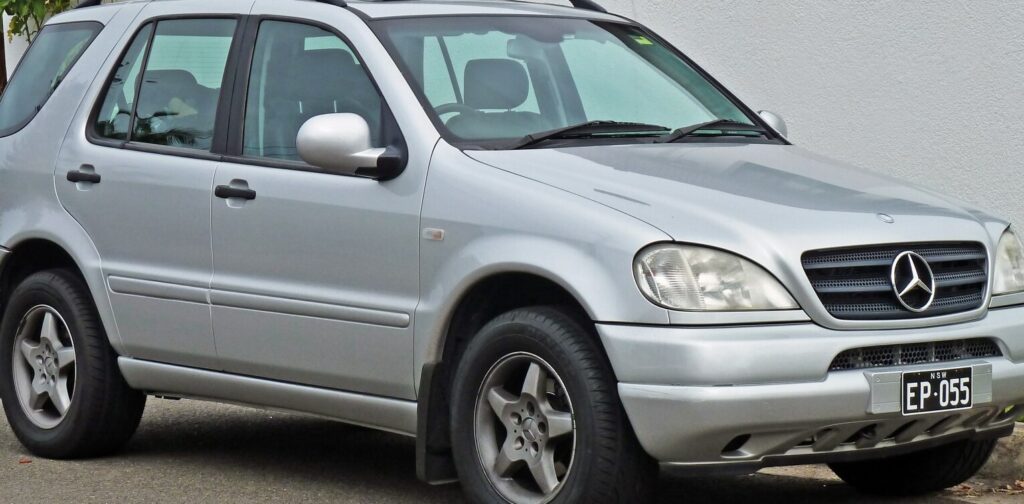
The Mercedes-Benz M-Class (W163) ML 270 CDI 4MATIC, produced from 2001 to 2005, represented a significant offering in the burgeoning luxury SUV market. This variant, powered by a 2.7-liter five-cylinder turbodiesel engine producing 163 horsepower, occupied a middle ground within the W163 lineup, positioned as a more fuel-efficient and torque-rich alternative to the gasoline-powered models like the ML 320 and ML 500. The facelifted W163, introduced in 2001, brought styling updates and refinements to the original 1997 model, solidifying the M-Class’s position as a key player for Mercedes-Benz in the North American and European markets.
Technical Specifications
| Brand | Mercedes-Benz |
| Model | M-Class |
| Generation | M-Class (W163, facelift 2001) |
| Type (Engine) | ML 270 CDI (163 Hp) 4MATIC |
| Start of production | 2001 |
| End of production | 2005 |
| Powertrain Architecture | Internal Combustion engine |
| Body type | SUV |
| Seats | 5 |
| Doors | 5 |
| Fuel consumption (urban) | 12.5 l/100 km (18.8 US mpg, 22.6 UK mpg, 8 km/l) |
| Fuel consumption (extra urban) | 7.7 l/100 km (30.5 US mpg, 36.7 UK mpg, 13 km/l) |
| Fuel consumption (combined) | 9.4 l/100 km (25 US mpg, 30.1 UK mpg, 10.6 km/l) |
| CO2 emissions | 248 g/km |
| Fuel Type | Diesel |
| Acceleration 0 – 100 km/h | 11.9 sec |
| Acceleration 0 – 62 mph | 11.9 sec |
| Acceleration 0 – 60 mph | 11.3 sec |
| Maximum speed | 185 km/h (114.95 mph) |
| Emission standard | Euro 3 |
| Weight-to-power ratio | 12.9 kg/Hp, 77.6 Hp/tonne |
| Weight-to-torque ratio | 5.7 kg/Nm, 176.2 Nm/tonne |
| Power | 163 Hp @ 4200 rpm |
| Power per litre | 60.7 Hp/l |
| Torque | 370 Nm @ 1600-2800 rpm (272.9 lb.-ft. @ 1600-2800 rpm) |
| Maximum engine speed | 4600 rpm |
| Engine layout | Front, Longitudinal |
| Engine Model/Code | OM 612.963 |
| Engine displacement | 2685 cm3 (163.85 cu. in.) |
| Number of cylinders | 5 |
| Engine configuration | Inline |
| Cylinder Bore | 88 mm (3.46 in.) |
| Piston Stroke | 88.4 mm (3.48 in.) |
| Compression ratio | 18:1 |
| Number of valves per cylinder | 4 |
| Fuel injection system | Diesel Commonrail |
| Engine aspiration | Turbocharger, Intercooler |
| Valvetrain | DOHC |
| Engine oil capacity | 7.5 l (7.93 US qt | 6.6 UK qt) |
| Coolant capacity | 11 l (11.62 US qt | 9.68 UK qt) |
| Kerb Weight | 2100 kg (4629.71 lbs.) |
| Max. weight | 2870 kg (6327.27 lbs.) |
| Max load | 770 kg (1697.56 lbs.) |
| Trunk (boot) space – minimum | 633 l (22.35 cu. ft.) |
| Trunk (boot) space – maximum | 2020 l (71.34 cu. ft.) |
| Fuel tank capacity | 83 l (21.93 US gal | 18.26 UK gal) |
| Permitted trailer load with brakes (12%) | 3500 kg (7716.18 lbs.) |
| Permitted trailer load without brakes | 750 kg (1653.47 lbs.) |
| Permitted towbar download | 135 kg (297.62 lbs.) |
| Length | 4638 mm (182.6 in.) |
| Width | 1840 mm (72.44 in.) |
| Width including mirrors | 2126 mm (83.7 in.) |
| Height | 1820 mm (71.65 in.) |
| Wheelbase | 2820 mm (111.02 in.) |
| Front track | 1555 mm (61.22 in.) |
| Rear track | 1555 mm (61.22 in.) |
| Front overhang | 874 mm (34.41 in.) |
| Rear overhang | 944 mm (37.17 in.) |
| Ride height (ground clearance) | 204 mm (8.03 in.) |
| Drag coefficient (Cd) | 0.39 |
| Minimum turning circle | 11.9 m (39.04 ft.) |
| Approach angle | 30° |
| Departure angle | 30° |
| Climb angle | 31° |
| Wading depth | 500 mm (19.69 in.) |
| Drivetrain Architecture | All wheel drive (4×4). Internal Combustion engine. |
| Drive wheel | All wheel drive (4×4) |
| Number of gears and type of gearbox | 6 gears, manual transmission |
| Front suspension | Double wishbone, Transverse stabilizer |
| Rear suspension | Double wishbone, Transverse stabilizer |
| Front brakes | Ventilated discs |
| Rear brakes | Disc |
| Assisting systems | ABS (Anti-lock braking system) |
| Steering type | Steering rack and pinion |
| Power steering | Hydraulic Steering |
| Tires size | 255/60 R17 |
| Wheel rims size | 8J x 17 |
Powertrain & Engine Architecture
The heart of the ML 270 CDI 4MATIC is the OM 612.963, a 2.7-liter inline five-cylinder diesel engine. This engine was a key component of Mercedes-Benz’s efforts to offer more fuel-efficient diesel options in the SUV segment. It featured a cast iron block and aluminum cylinder head, incorporating a single overhead camshaft (SOHC) design operating four valves per cylinder. The engine utilized a second-generation common rail direct injection system, delivering fuel at extremely high pressures for optimized combustion and reduced emissions. A turbocharger with an intercooler further enhanced performance, boosting power and torque. The engine’s robust construction and relatively simple design contributed to its reputation for durability. The 4MATIC system is a full-time all-wheel-drive system, distributing power to all four wheels for enhanced traction and stability. The standard transmission was a 6-speed manual, though a 5-speed automatic transmission was also available, impacting acceleration and fuel economy.
Driving Characteristics
The ML 270 CDI 4MATIC offered a distinctly different driving experience compared to its gasoline-powered siblings. While lacking the outright acceleration of the ML 320 or ML 500, the 270 CDI excelled in providing strong low-end torque. This made it particularly well-suited for towing and navigating challenging terrain. The 370 Nm (272.9 lb-ft) of torque available from 1600-2800 rpm provided ample pulling power, even at lower engine speeds. The 6-speed manual transmission allowed for precise control, while the optional automatic, though smoother, resulted in slightly slower acceleration times. The 4MATIC system provided confident handling in various conditions, enhancing stability and grip. The ride quality, typical of Mercedes-Benz, was generally comfortable, though the vehicle’s weight and SUV stature were noticeable in cornering.
Equipment & Trim Levels
The ML 270 CDI 4MATIC typically came equipped with a respectable level of standard features. These included automatic climate control, power windows and locks, a multi-function steering wheel, and a basic audio system. Upholstery was generally cloth, with leather options available as an upgrade. Optional extras included a premium audio system, sunroof, navigation system, and heated seats. Trim levels were relatively limited, with most variations stemming from the addition of optional packages. The interior design was functional and well-built, reflecting Mercedes-Benz’s commitment to quality and refinement.
Chassis & Braking
The W163 M-Class featured an independent suspension system on all four wheels, utilizing double wishbones. This setup provided a good balance between ride comfort and handling. Stabilizer bars were fitted to both the front and rear axles to reduce body roll during cornering. Braking duties were handled by ventilated discs at the front and solid discs at the rear, equipped with an Anti-lock Braking System (ABS) for enhanced safety. The chassis was a robust body-on-frame construction, contributing to the vehicle’s durability and off-road capability.
Market Reception & Comparison
The ML 270 CDI 4MATIC was generally well-received by automotive critics, particularly for its fuel efficiency and torque output. It offered a compelling alternative to the more powerful, but less economical, gasoline-powered models. Compared to the ML 320, the 270 CDI delivered significantly better fuel economy, making it a more practical choice for drivers covering long distances. However, the ML 320 offered quicker acceleration and a more refined engine note. Reliability was generally good, though some owners reported issues with the diesel particulate filter (DPF) and fuel injection system. The ML 270 CDI 4MATIC appealed to buyers seeking a luxurious and capable SUV with a focus on fuel efficiency and practicality.
Legacy
The Mercedes-Benz M-Class (W163) ML 270 CDI 4MATIC has become a relatively sought-after vehicle in the used car market, particularly among those seeking a durable and fuel-efficient SUV. The OM 612 engine, when properly maintained, is known for its longevity. However, potential buyers should be aware of potential issues with the DPF, fuel injectors, and turbocharger. The W163 M-Class paved the way for the subsequent generations of M-Class/GLE SUVs, establishing Mercedes-Benz as a major player in the luxury SUV segment. The 270 CDI variant remains a testament to Mercedes-Benz’s engineering prowess and its commitment to offering a diverse range of powertrain options.