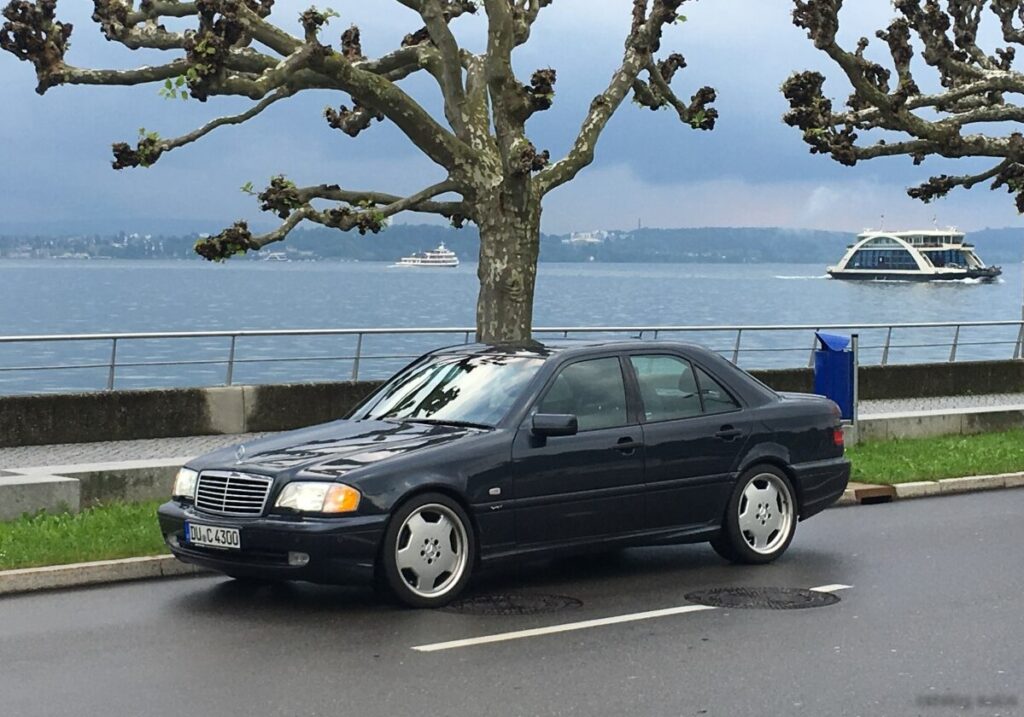
The Mercedes-Benz C 200 Kompressor, produced from June 1997 to May 2000, was a significant variant within the W202 C-Class facelift range. Positioned as a mid-range offering, it bridged the gap between the base C 180 and the more powerful C 230 Kompressor. This model represented Mercedes-Benz’s foray into forced induction for the C-Class, aiming to deliver improved performance and responsiveness without significantly increasing engine displacement. The C 200 Kompressor was primarily marketed in Europe and other international markets, offering a blend of luxury, efficiency, and performance that appealed to a broad customer base.
| Brand | Mercedes-Benz |
| Model | C-Class |
| Generation | C-Class (W202, facelift 1997) |
| Type | C 200 Kompressor (192 Hp) 5G-TRONIC |
| Start of production | June, 1997 |
| End of production | May, 2000 |
| Powertrain Architecture | Internal Combustion engine |
| Body type | Sedan |
| Seats | 5 |
| Doors | 4 |
| Fuel consumption (urban) | 13.9 l/100 km (16.9 US mpg) |
| Fuel consumption (extra urban) | 7.4 l/100 km (31.8 US mpg) |
| Fuel consumption (combined) | 9.8 l/100 km (24 US mpg) |
| Fuel Type | Petrol (Gasoline) |
| Acceleration 0 – 100 km/h | 8.4 sec |
| Acceleration 0 – 62 mph | 8.4 sec |
| Acceleration 0 – 60 mph | 8 sec |
| Maximum speed | 227 km/h (141.05 mph) |
| Weight-to-power ratio | 7.3 kg/Hp |
| Weight-to-torque ratio | 5.2 kg/Nm |
| Power | 192 Hp @ 5300 rpm |
| Torque | 270 Nm @ 2500-4800 rpm (199.14 lb.-ft.) |
| Engine layout | Front, Longitudinal |
| Engine Model/Code | M 111 E 20 ML / 111.944 |
| Engine displacement | 1998 cm3 (121.93 cu. in.) |
| Number of cylinders | 4 |
| Engine configuration | Inline |
| Cylinder Bore | 89.9 mm (3.54 in.) |
| Piston Stroke | 78.7 mm (3.1 in.) |
| Compression ratio | 8.5:1 |
| Number of valves per cylinder | 4 |
| Fuel injection system | Multi-port manifold injection |
| Engine aspiration | Supercharger, Intercooler |
| Valvetrain | DOHC |
| Engine oil capacity | 5.5 l (5.81 US qt | 4.84 UK qt) |
| Coolant capacity | 8.5 l (8.98 US qt | 7.48 UK qt) |
| Kerb Weight | 1410 kg (3108.52 lbs.) |
| Max. weight | 1890 kg (4166.74 lbs.) |
| Max load | 480 kg (1058.22 lbs.) |
| Fuel tank capacity | 62 l (16.38 US gal | 13.64 UK gal) |
| Length | 4516 mm (177.8 in.) |
| Width | 1723 mm (67.83 in.) |
| Height | 1427 mm (56.18 in.) |
| Wheelbase | 2690 mm (105.91 in.) |
| Front track | 1499 mm (59.02 in.) |
| Rear track | 1464 mm (57.64 in.) |
| Drag coefficient (Cd) | 0.32 |
| Drivetrain Architecture | Rear wheel drive |
| Number of gears | 5 |
| Gearbox type | Automatic transmission 5G-TRONIC |
| Front suspension | Double wishbone |
| Rear suspension | Independent multi-link spring suspension with stabilizer |
| Front brakes | Ventilated discs |
| Rear brakes | Disc |
| Assisting systems | ABS (Anti-lock braking system) |
| Steering type | Cone worm with recirculation balls |
| Power steering | Hydraulic |
| Tires size | 195/65 R15 |
| Wheel rims size | 6.5J x 15 |
Powertrain & Engine Architecture
The heart of the C 200 Kompressor was the M111 E 20 ML engine, a 1.998-liter inline-four cylinder powerplant. This engine was a significant departure from the naturally aspirated engines previously offered in the C-Class. The “Kompressor” designation indicated the presence of a mechanically driven supercharger, specifically a Lysholm-type unit. This supercharger, coupled with an intercooler, boosted power output to 192 horsepower at 5300 rpm and 270 Nm (199 lb-ft) of torque available between 2500 and 4800 rpm. The engine utilized multi-port fuel injection and a double overhead camshaft (DOHC) valvetrain with four valves per cylinder. The 5G-TRONIC automatic transmission, a five-speed unit, was the sole transmission option for this variant. This transmission was known for its smooth shifting and adaptability to various driving conditions.
Driving Characteristics
The C 200 Kompressor offered a noticeable improvement in performance compared to the naturally aspirated C 180. The supercharger provided strong low-end and mid-range torque, making it feel responsive in everyday driving situations. While not as overtly sporty as the C 230 Kompressor, the C 200 offered a good balance between performance and fuel economy. The 5G-TRONIC transmission contributed to a comfortable driving experience, with well-spaced gear ratios. Acceleration from 0 to 60 mph was achieved in approximately 8.4 seconds, and the car had a top speed of 141 mph. Compared to the manual transmission options available on other C-Class models, the automatic version prioritized ease of use over outright performance.
Equipment & Trim Levels
The C 200 Kompressor typically came equipped with a respectable level of standard features. These included power windows, central locking, air conditioning, and an audio system. Interior upholstery was generally cloth, although leather options were available. The dashboard layout was typical of the W202 facelift, featuring a functional and straightforward design. Optional extras included a sunroof, upgraded audio systems, and various interior trim packages. The C 200 Kompressor aimed to provide a comfortable and well-equipped experience without the premium price tag of the higher-end models.
Chassis & Braking
The C 200 Kompressor utilized a double wishbone suspension at the front and an independent multi-link spring suspension with a stabilizer bar at the rear. This suspension setup provided a good balance between ride comfort and handling. Braking duties were handled by ventilated discs at the front and solid discs at the rear, equipped with an Anti-lock Braking System (ABS) as standard. The steering was a cone worm type with hydraulic power assistance. The tires were typically 195/65 R15, mounted on 6.5J x 15 inch wheels.
Market Reception & Comparison
The C 200 Kompressor was generally well-received by automotive critics. It was praised for its improved performance over the base models and its smooth-shifting automatic transmission. Fuel economy was considered reasonable for a car of its class. Compared to the C 180, the C 200 Kompressor offered a significant performance upgrade. However, the C 230 Kompressor provided even more power and a sportier driving experience, albeit at a higher price point. The C 200 Kompressor’s main competitors included the BMW 318i and the Audi A4 1.8, both of which offered similar levels of performance and luxury.
Legacy
The M111 engine family, including the version used in the C 200 Kompressor, proved to be relatively reliable. While superchargers can sometimes require maintenance, the Lysholm unit used in this engine was generally durable. Today, the C 200 Kompressor can be found as a relatively affordable used car. Its combination of Mercedes-Benz build quality, comfortable ride, and decent performance makes it an attractive option for those seeking a classic German sedan. However, potential buyers should be aware of the age-related issues common to older vehicles, such as wear and tear on suspension components and potential electrical problems. Overall, the C 200 Kompressor remains a well-regarded and capable car that represents a significant step forward in the evolution of the Mercedes-Benz C-Class.