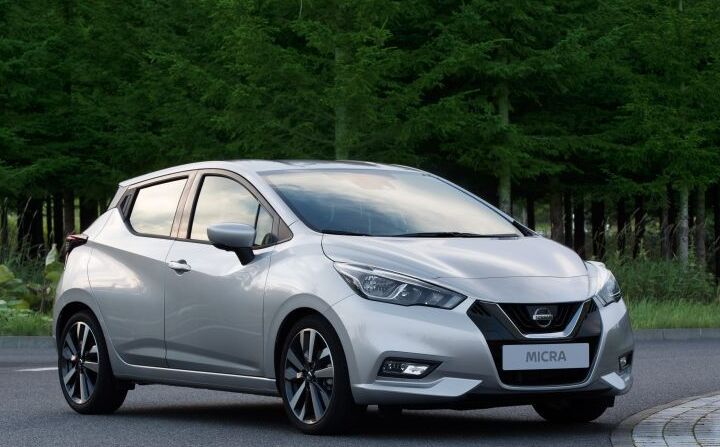
The Nissan Micra K14 1.0 IG (71 hp) represents an entry-level offering within the fourth generation of Nissan’s supermini, produced from August 2018 to August 2019. Positioned as the most affordable variant in the K14 lineup, it aimed to provide economical transportation for urban drivers. This model was primarily sold in the European market, where the Micra competed with rivals like the Volkswagen Polo, Ford Fiesta, and Renault Clio. The K14 generation marked a significant departure from its predecessors, adopting a more modern design and a focus on improved interior quality and technology. This particular 1.0-liter engine and five-speed manual transmission combination was designed to maximize fuel efficiency and minimize running costs, appealing to first-time car buyers and those seeking a budget-friendly city car.
Technical Specifications
| Brand | Nissan |
| Model | Micra |
| Generation | Micra (K14) |
| Type (Engine) | 1.0 IG (71 Hp) |
| Start of production | August, 2018 |
| End of production | August, 2019 |
| Powertrain Architecture | Internal Combustion engine |
| Body type | Hatchback |
| Seats | 5 |
| Doors | 5 |
| Fuel consumption (urban) | 6.3 l/100 km (37.3 US mpg, 44.8 UK mpg, 15.9 km/l) |
| Fuel consumption (extra urban) | 4.6 l/100 km (51.1 US mpg, 61.4 UK mpg, 21.7 km/l) |
| Fuel consumption (combined) | 5.3 l/100 km (44.4 US mpg, 53.3 UK mpg, 18.9 km/l) |
| CO2 emissions | 121 g/km |
| Fuel Type | Petrol (Gasoline) |
| Acceleration 0 – 100 km/h | 16.4 sec |
| Acceleration 0 – 62 mph | 16.4 sec |
| Acceleration 0 – 60 mph | 15.6 sec |
| Maximum speed | 158 km/h (98.18 mph) |
| Emission standard | Euro 6 c |
| Weight-to-power ratio | 14.3 kg/Hp, 69.9 Hp/tonne |
| Weight-to-torque ratio | 10.7 kg/Nm, 93.5 Nm/tonne |
| Power | 71 Hp @ 6300 rpm |
| Power per litre | 71.1 Hp/l |
| Torque | 95 Nm @ 3500 rpm (70.07 lb.-ft. @ 3500 rpm) |
| Engine layout | Front, Transverse |
| Engine Model/Code | BR10DE |
| Engine displacement | 998 cm3 (60.9 cu. in.) |
| Number of cylinders | 3 |
| Engine configuration | Inline |
| Cylinder Bore | 71 mm (2.8 in.) |
| Piston Stroke | 84.1 mm (3.31 in.) |
| Compression ratio | 10.5:1 |
| Number of valves per cylinder | 4 |
| Fuel injection system | Multi-port manifold injection |
| Engine aspiration | Naturally aspirated engine |
| Engine oil capacity | 3.1 l (3.28 US qt, 2.73 UK qt) |
| Coolant | 5.8 l (6.13 US qt, 5.1 UK qt) |
| Kerb Weight | 1016-1063 kg (2239.9 – 2343.51 lbs.) |
| Max. weight | 1490 kg (3284.89 lbs.) |
| Max load | 427-474 kg (941.37 – 1044.99 lbs.) |
| Trunk (boot) space – minimum | 300 l (10.59 cu. ft.) |
| Trunk (boot) space – maximum | 1004 l (35.46 cu. ft.) |
| Fuel tank capacity | 41 l (10.83 US gal, 9.02 UK gal) |
| Permitted trailer load with brakes (12%) | 900 kg (1984.16 lbs.) |
| Permitted trailer load without brakes | 510 kg (1124.36 lbs.) |
| Permitted towbar download | 75 kg (165.35 lbs.) |
| Length | 3999 mm (157.44 in.) |
| Width | 1743 mm (68.62 in.) |
| Width including mirrors | 1935 mm (76.18 in.) |
| Height | 1455 mm (57.28 in.) |
| Wheelbase | 2525 mm (99.41 in.) |
| Front track | 1510 mm (59.45 in.) |
| Rear (Back) track | 1520 mm (59.84 in.) |
| Minimum turning circle | 10.3 m (33.79 ft.) |
| Drivetrain Architecture | Front wheel drive |
| Drive wheel | Front wheel drive |
| Number of gears and type of gearbox | 5 gears, manual transmission |
| Front brakes | Disc |
| Rear brakes | Drum |
| Assisting systems | ABS (Anti-lock braking system) |
| Steering type | Steering rack and pinion |
| Power steering | Electric Steering |
| Tires size | 185/65 R15; 195/55 R16; 205/45 R17 |
| Wheel rims size | 6.0J x 15; 6.0J x 16; 6.5J x 17 |
INTRODUCTION
The Nissan Micra K14 1.0 IG (71 hp) was introduced as part of a broader revitalization of the Micra nameplate. Launched in 2018, the K14 represented the fourth generation of the Micra, and a significant shift in design and engineering philosophy. Built on the CMF-B platform (shared with the Renault Clio IV), the K14 aimed to offer a more sophisticated and appealing package than its predecessors. The 1.0 IG variant served as the entry point to the range, offering a balance of affordability and efficiency. It was targeted towards urban commuters and drivers prioritizing low running costs. Production of this specific configuration lasted for a relatively short period, ending in August 2019, likely due to shifting market demands and the introduction of updated engine options.
Powertrain & Engine Architecture
The heart of the Micra 1.0 IG is the BR10DE, a 998cc three-cylinder petrol engine. This engine belongs to Nissan’s “IG” (Intelligent Generation) series, designed for improved fuel economy and reduced emissions. It features multi-point fuel injection and a relatively high compression ratio of 10.5:1. The engine utilizes a timing chain, contributing to lower maintenance costs compared to timing belt setups. The engine’s modest 71 horsepower at 6300 rpm and 95 Nm (70 lb-ft) of torque at 3500 rpm are delivered through a five-speed manual transmission. This transmission is a standard unit, chosen for its simplicity and efficiency. The engine’s small displacement and three-cylinder configuration contribute to its inherent vibrations, which Nissan addressed through engine mounts and balancing shafts. The engine is transversely mounted at the front of the vehicle, driving the front wheels.
Driving Characteristics
The 1.0-liter engine and manual transmission combination in the Micra K14 delivers a driving experience focused on economy rather than performance. Acceleration is leisurely, taking approximately 16.4 seconds to reach 62 mph (100 km/h). In real-world driving, the engine feels adequate for city commutes and short trips, but struggles when fully loaded or attempting to overtake on highways. The five-speed gearbox is light and easy to use, but the relatively wide gear ratios necessitate frequent shifting to maintain optimal engine speed. Compared to higher-spec Micra models equipped with the 1.5-liter engine, the 1.0 IG feels significantly underpowered. However, the lighter engine weight contributes to nimble handling in urban environments. The steering is light and precise, making maneuvering in tight spaces easy.
Equipment & Trim Levels
The 1.0 IG variant of the Micra K14 typically came with a basic but functional equipment list. Standard features generally included air conditioning, power steering, electric front windows, a basic audio system with USB connectivity, and ABS brakes. Safety features such as airbags were also standard. Interior upholstery was typically cloth, with a simple dashboard layout. Optional extras included alloy wheels, a touchscreen infotainment system with navigation, and parking sensors. The trim level was generally positioned as the entry-level offering, with more luxurious trims like the Visia, Acenta, and Tekna offering additional features and styling enhancements.
Chassis & Braking
The Micra K14 utilizes a front MacPherson strut suspension and a rear torsion beam suspension. This setup provides a comfortable ride quality, particularly on smooth roads. The torsion beam rear suspension is a cost-effective solution, but it doesn’t offer the same level of sophistication as a multi-link setup found in some competitors. Braking duties are handled by front disc brakes and rear drum brakes. ABS (Anti-lock Braking System) is standard, providing enhanced stopping power and stability. The relatively light weight of the 1.0 IG variant helps to compensate for the rear drum brakes, providing adequate stopping performance for everyday driving.
Market Reception & Comparison
The Nissan Micra K14 1.0 IG was generally well-received by critics as an affordable and economical city car. However, the engine’s lack of power was a common criticism. Compared to the 1.5-liter engine option, the 1.0 IG offered significantly lower performance, but also better fuel economy. Fuel economy figures of around 5.3 l/100 km (44.4 US mpg) were competitive within its class. Reliability reports suggest that the BR10DE engine is generally reliable, although some owners have reported minor issues with the engine mounts and exhaust system. The Micra K14 1.0 IG offered a compelling value proposition for budget-conscious buyers, but those prioritizing performance or long-distance driving were better served by other options.
Legacy
The Nissan Micra K14 1.0 IG, while a short-lived configuration, represents a key step in the Micra’s evolution. The BR10DE engine, despite its modest output, proved to be a reliable and fuel-efficient powerplant. In the used car market, these models are typically available at very affordable prices, making them attractive to first-time car buyers or those seeking a cheap and cheerful runabout. Maintenance costs are generally low, and parts availability is good. However, potential buyers should be aware of the engine’s limited power and the potential for minor vibrations. Overall, the Micra K14 1.0 IG remains a practical and economical choice for urban driving, offering a blend of affordability, efficiency, and reliability.