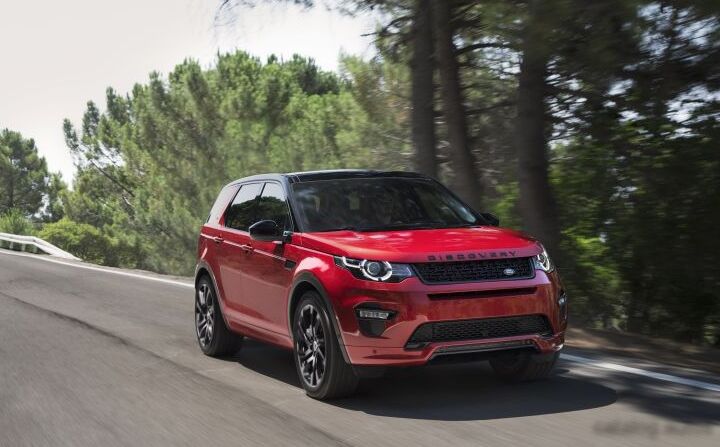
The Land Rover Discovery Sport 2.0 TD4, producing 180 horsepower, with all-wheel drive and an automatic transmission, was a key variant in the first generation (L550) of the Discovery Sport model line, produced from 2018 to 2019. Positioned as a mid-range offering, it aimed to balance fuel efficiency, performance, and capability within the broader Discovery Sport range. This model represented Land Rover’s entry into the compact luxury SUV segment, offering a blend of on-road comfort and off-road prowess, appealing to a wider customer base than previous Land Rover offerings.
Technical Specifications
| Brand | Land Rover |
| Model | Discovery Sport |
| Generation | Discovery Sport |
| Type (Engine) | 2.0 TD4 (180 Hp) AWD Automatic |
| Start of production | 2018 |
| End of production | 2019 |
| Powertrain Architecture | Internal Combustion engine |
| Body type | SUV |
| Seats | 5 |
| Doors | 5 |
| Fuel consumption (combined) | 6.4 l/100 km (36.8 US mpg, 44.1 UK mpg, 15.6 km/l) |
| CO2 emissions | 169 g/km |
| Fuel Type | Diesel |
| Acceleration 0 – 100 km/h | 9.5 sec |
| Acceleration 0 – 62 mph | 9.5 sec |
| Acceleration 0 – 60 mph | 9 sec |
| Maximum speed | 188 km/h (116.82 mph) |
| Weight-to-power ratio | 9.9 kg/Hp, 100.8 Hp/tonne |
| Weight-to-torque ratio | 4.2 kg/Nm, 240.9 Nm/tonne |
| Power | 180 Hp |
| Power per litre | 90 Hp/l |
| Torque | 430 Nm @ 1750 rpm (317.15 lb.-ft. @ 1750 rpm) |
| Engine layout | Front, Transverse |
| Engine Model/Code | Ingenium / 204DTD |
| Engine displacement | 1999 cm3 (121.99 cu. in.) |
| Number of cylinders | 4 |
| Engine configuration | Inline |
| Cylinder Bore | 83 mm (3.27 in.) |
| Piston Stroke | 92.35 mm (3.64 in.) |
| Compression ratio | 15.5:1 |
| Number of valves per cylinder | 4 |
| Fuel injection system | Diesel Commonrail |
| Engine aspiration | Turbocharger, Intercooler |
| Engine oil capacity | 6.5 l (6.87 US qt | 5.72 UK qt) |
| Coolant | 7.4 l (7.82 US qt | 6.51 UK qt) |
| Kerb Weight | 1785 kg (3935.25 lbs.) |
| Max. weight | 2505 kg (5522.58 lbs.) |
| Max load | 720 kg (1587.33 lbs.) |
| Fuel tank capacity | 54 l (14.27 US gal | 11.88 UK gal) |
| Max. roof load | 75 kg (165.35 lbs.) |
| Permitted trailer load with brakes (12%) | 2000 kg (4409.25 lbs.) |
| Permitted trailer load without brakes | 750 kg (1653.47 lbs.) |
| Permitted towbar download | 100 kg (220.46 lbs.) |
| Length | 4599 mm (181.06 in.) |
| Width with mirrors folded | 2069 mm (81.46 in.) |
| Width including mirrors | 2173 mm (85.55 in.) |
| Height | 1724 mm (67.87 in.) |
| Wheelbase | 2741 mm (107.91 in.) |
| Front track | 1621 mm (63.82 in.) |
| Rear (Back) track | 1630 mm (64.17 in.) |
| Ride height (ground clearance) | 211 mm (8.31 in.) |
| Minimum turning circle | 11.86 m (38.91 ft.) |
| Approach angle | 23.4° |
| Departure angle | 31° |
| Ramp-over angle | 20° |
| Wading depth | 600 mm (23.62 in.) |
| Drive wheel | All wheel drive (4×4) |
| Number of gears and type of gearbox | 9 gears, automatic transmission |
| Rear suspension | Independent multi-link suspension |
| Front brakes | Disc, 325 mm |
| Rear brakes | Disc, 300 mm |
| Assisting systems | ABS (Anti-lock braking system) |
| Steering type | Steering rack and pinion |
| Power steering | Electric Steering |
| Wheel rims size | 17; 18; 19 |
INTRODUCTION
The Land Rover Discovery Sport 2.0 TD4 (180 Hp) AWD Automatic, launched in 2018 and continuing through 2019, was a significant model within the L550 Discovery Sport range. Built on the Land Rover-Geely Joint Venture’s Premium Transverse Architecture (PTA), also known as the 1HX0/A3 platform, it aimed to provide a more accessible entry point into the Discovery family. This variant offered a balance between performance, fuel economy, and the all-weather, all-terrain capability Land Rover is known for. It was designed to appeal to buyers seeking a compact SUV with a premium badge and a degree of off-road ability.
Powertrain & Engine Architecture
At the heart of the 2.0 TD4 was Land Rover’s Ingenium engine family, specifically the 204DTD four-cylinder diesel. This engine featured a 1999cc displacement, utilizing a turbocharger and intercooler to produce 180 horsepower and 430 Nm (317 lb-ft) of torque at 1750 rpm. The engine employed a sophisticated diesel commonrail fuel injection system, contributing to its efficiency and reduced emissions. The Ingenium engines were designed for modularity, allowing for easy upgrades and variations. The 9-speed automatic transmission, sourced from ZF, was a key component, offering smooth gear changes and contributing to improved fuel economy. This transmission was known for its wide gear ratio spread, optimizing both acceleration and cruising efficiency.
Driving Characteristics
The 180 horsepower output, coupled with the 9-speed automatic, provided adequate performance for everyday driving. Acceleration from 0-60 mph took approximately 9.5 seconds, which was competitive within its class, but noticeably slower than the higher-powered variants like the 240 horsepower version. The automatic transmission, while smooth, could sometimes feel hesitant during quick overtaking maneuvers. The all-wheel-drive system, featuring Terrain Response technology, allowed drivers to select different driving modes (General, Grass/Gravel/Snow, Mud & Ruts, Sand) to optimize traction for various conditions. This made the Discovery Sport 2.0 TD4 a surprisingly capable off-roader, despite its compact size. The gear ratios were tuned for a balance of fuel efficiency and usability, with taller gearing in higher gears for relaxed highway cruising.
Equipment & Trim Levels
The 2.0 TD4 Automatic typically came equipped with a respectable level of standard features. These included leather upholstery, automatic climate control, an 8-inch touchscreen infotainment system with navigation, and a suite of safety features like autonomous emergency braking and lane departure warning. Optional extras included a panoramic sunroof, premium audio systems, and adaptive cruise control. Trim levels varied depending on the market, but generally offered increasing levels of luxury and technology. Interior materials were generally of good quality, reflecting the Land Rover brand’s premium positioning. The dashboard layout was relatively straightforward and user-friendly.
Chassis & Braking
The Discovery Sport featured a robust chassis designed to handle both on-road and off-road conditions. The suspension consisted of MacPherson struts at the front and a multi-link setup at the rear. Braking duties were handled by disc brakes on all four wheels, with ventilated discs at the front for improved heat dissipation. The size of the front discs was 325mm, while the rear discs measured 300mm. Anti-lock Braking System (ABS) and Electronic Stability Control (ESC) were standard features, enhancing safety and control. Stabilizer bars were fitted to both axles to reduce body roll during cornering.
Market Reception & Comparison
The Discovery Sport 2.0 TD4 Automatic was generally well-received by critics, who praised its stylish design, comfortable ride, and off-road capability. However, some reviewers noted that the 180 horsepower engine felt somewhat underpowered, particularly when fully loaded or tackling steep inclines. Compared to the more powerful 240 horsepower version, the 2.0 TD4 offered better fuel economy (around 36.8 US mpg combined) but sacrificed some performance. The 1.5L Ingenium petrol variant was also available, but the diesel offered superior torque and fuel efficiency, making it a popular choice for those covering long distances. Reliability reports were generally positive, although some owners reported minor issues with the infotainment system.
Legacy
The Land Rover Discovery Sport 2.0 TD4 (180 Hp) AWD Automatic remains a popular choice in the used car market. The Ingenium engine has proven to be relatively reliable, although regular maintenance is crucial. The 9-speed automatic transmission, while generally robust, can sometimes require software updates to address occasional jerky shifting. Overall, this variant represents a good value proposition for buyers seeking a compact luxury SUV with a premium badge, all-wheel-drive capability, and reasonable running costs. Its blend of practicality, comfort, and off-road prowess has ensured its continued appeal in the used car market.