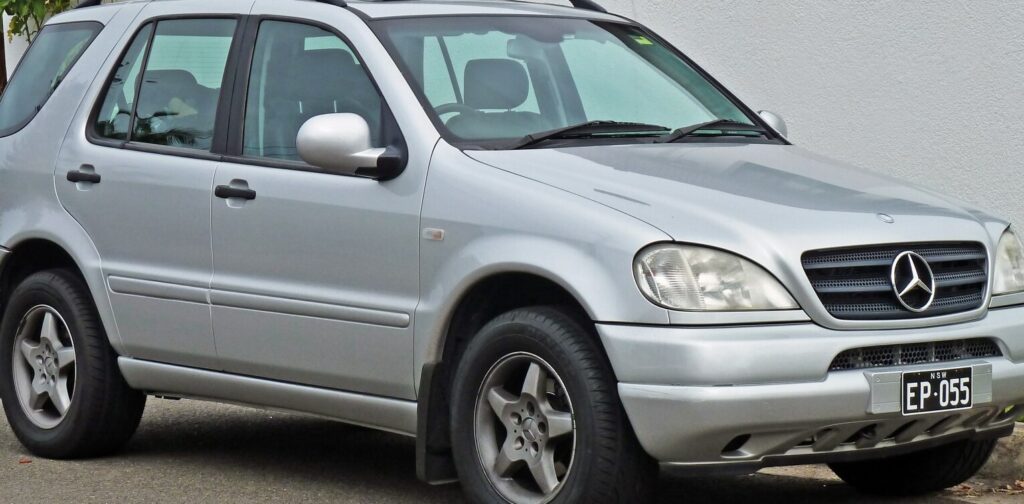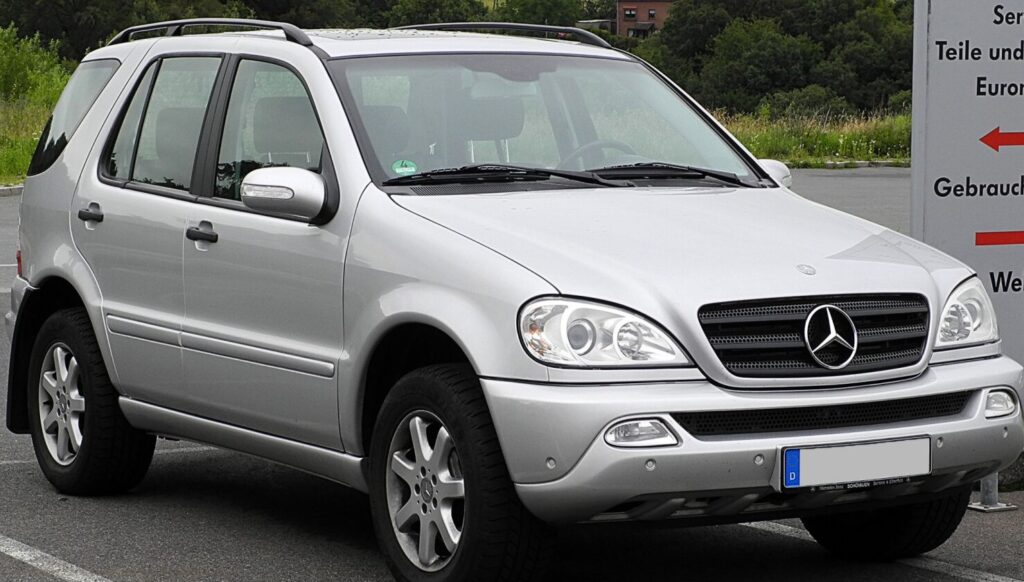
The Mercedes-Benz M-Class (W163), particularly the facelifted version introduced in 2001, represented a pivotal moment for the German automaker. It was Mercedes-Benz’s first foray into the mid-size luxury SUV segment, a market rapidly gaining popularity in the late 1990s. The ML 350 V6 4MATIC, produced from 2002 to 2003, occupied a significant position within the W163 range, offering a balance between performance, luxury, and capability. It was positioned as a step up from the base ML 320, providing more power and a more refined driving experience, while remaining below the higher-performance ML 500. This variant was primarily sold in North America and Europe, catering to buyers seeking a premium SUV with all-weather capability.
Technical Specifications
| Brand | Mercedes-Benz |
| Model | M-Class |
| Generation | M-Class (W163, facelift 2001) |
| Type | ML 350 V6 (245 Hp) 4MATIC 5G-TRONIC |
| Start of production | 2002 |
| End of production | 2003 |
| Powertrain Architecture | Internal Combustion engine |
| Body type | SUV |
| Seats | 5 |
| Doors | 5 |
| Fuel consumption (urban) | 19.4 l/100 km (12.1 US mpg, 14.6 UK mpg, 5.2 km/l) |
| Fuel consumption (extra urban) | 11 l/100 km (21.4 US mpg, 25.7 UK mpg, 9.1 km/l) |
| Fuel consumption (combined) | 14.1 l/100 km (16.7 US mpg, 20 UK mpg, 7.1 km/l) |
| CO2 emissions | 338 g/km |
| Fuel Type | Petrol (Gasoline) |
| Acceleration 0-100 km/h | 8.7 sec |
| Acceleration 0-62 mph | 8.7 sec |
| Acceleration 0-60 mph | 8.3 sec |
| Maximum speed | 205 km/h (127.38 mph) |
| Emission standard | Euro 4 |
| Weight-to-power ratio | 8.3 kg/Hp, 120.1 Hp/tonne |
| Weight-to-torque ratio | 5.8 kg/Nm, 171.6 Nm/tonne |
| Power | 245 Hp @ 5600 rpm |
| Torque | 350 Nm @ 3500-4800 rpm (258.15 lb.-ft. @ 3500-4800 rpm) |
| Engine layout | Front, Longitudinal |
| Engine Model/Code | M 112 |
| Engine displacement | 3724 cm3 (227.25 cu. in.) |
| Number of cylinders | 6 |
| Engine configuration | V-engine |
| Cylinder Bore | 97 mm (3.82 in.) |
| Piston Stroke | 84 mm (3.31 in.) |
| Compression ratio | 10:1 |
| Number of valves per cylinder | 3 |
| Fuel injection system | Multi-port manifold injection |
| Engine aspiration | Naturally aspirated engine |
| Valvetrain | SOHC |
| Engine oil capacity | 8 l (8.45 US qt | 7.04 UK qt) |
| Coolant capacity | 12 l (12.68 US qt | 10.56 UK qt) |
| Kerb Weight | 2040 kg (4497.43 lbs.) |
| Max. weight | 2870 kg (6327.27 lbs.) |
| Max load | 830 kg (1829.84 lbs.) |
| Trunk (boot) space (min) | 633 l (22.35 cu. ft.) |
| Trunk (boot) space (max) | 2020 l (71.34 cu. ft.) |
| Fuel tank capacity | 83 l (21.93 US gal | 18.26 UK gal) |
| Permitted trailer load (braked) | 3500 kg (7716.18 lbs.) |
| Permitted trailer load (unbraked) | 750 kg (1653.47 lbs.) |
| Permitted towbar download | 135 kg (297.62 lbs.) |
| Length | 4638 mm (182.6 in.) |
| Width | 1840 mm (72.44 in.) |
| Width (including mirrors) | 2126 mm (83.7 in.) |
| Height | 1820 mm (71.65 in.) |
| Wheelbase | 2820 mm (111.02 in.) |
| Front track | 1555 mm (61.22 in.) |
| Rear track | 1555 mm (61.22 in.) |
| Front overhang | 874 mm (34.41 in.) |
| Rear overhang | 944 mm (37.17 in.) |
| Ride height (ground clearance) | 204 mm (8.03 in.) |
| Drag coefficient (Cd) | 0.39 |
| Minimum turning circle | 11.9 m (39.04 ft.) |
| Approach angle | 30° |
| Departure angle | 30° |
| Climb angle | 31° |
| Wading depth | 500 mm (19.69 in.) |
| Drivetrain Architecture | All wheel drive (4×4). Internal Combustion engine. |
| Number of gears | 5 |
| Gearbox type | Automatic transmission G-TRONIC |
| Front suspension | Double wishbone, Transverse stabilizer |
| Rear suspension | Double wishbone, Transverse stabilizer |
| Front brakes | Ventilated discs |
| Rear brakes | Disc |
| Assisting systems | ABS (Anti-lock braking system) |
| Steering type | Steering rack and pinion |
| Power steering | Hydraulic Steering |
| Tires size | 255/60 R17 |
| Wheel rims size | 8J x 17 |
Powertrain & Engine Architecture
The ML 350 4MATIC was powered by the M112 V6 engine, a 3.7-liter naturally aspirated powerplant. This engine, a cornerstone of Mercedes-Benz’s mid-range offerings at the time, featured a 60-degree V-angle and a single overhead camshaft (SOHC) design per cylinder bank. The M112 utilized a multi-port fuel injection system, delivering fuel directly into the intake ports. This engine was known for its relatively smooth operation and decent power output. The 245 horsepower and 350 Nm (258 lb-ft) of torque were sufficient for comfortable highway cruising and reasonable acceleration. The engine’s longitudinal mounting and the 4MATIC all-wheel-drive system contributed to balanced handling. The transmission was a 5G-TRONIC automatic, a five-speed unit that provided smooth shifts, though it wasn’t particularly quick or sporty in its operation. The transmission was tuned for comfort and fuel efficiency rather than aggressive performance.
Driving Characteristics
The ML 350 4MATIC offered a comfortable and composed driving experience. The automatic transmission, while not offering manual shift control, provided smooth gear changes. Acceleration from 0-60 mph took around 8.3 seconds, which was adequate for the time but not particularly brisk compared to some competitors. The 4MATIC all-wheel-drive system provided excellent traction in various weather conditions, making it a capable vehicle for year-round use. Compared to the ML 320, the ML 350 offered noticeably more power, resulting in improved acceleration and passing ability. However, it lacked the outright performance of the ML 500, which featured a larger V8 engine. The suspension was tuned for comfort, absorbing bumps and imperfections in the road well, but it wasn’t particularly sporty or engaging.
Equipment & Trim Levels
The ML 350 4MATIC came standard with a respectable array of features, including leather upholstery, power-adjustable front seats, automatic climate control, a premium sound system, and alloy wheels. Optional extras included a sunroof, navigation system, upgraded sound system, and parking assist. Interior trim options varied, with wood trim being a popular choice. The overall interior design was typical of Mercedes-Benz at the time – luxurious and well-appointed, but perhaps lacking the cutting-edge technology found in some competitors.
Chassis & Braking
The W163 M-Class featured an independent suspension system at all four corners, utilizing double wishbones. This setup provided a comfortable ride and reasonable handling. The ML 350 4MATIC was equipped with ventilated disc brakes at the front and solid disc brakes at the rear. Anti-lock braking system (ABS) was standard. The steering was a hydraulic power-assisted rack and pinion system, providing a reasonably direct feel. The chassis was robust and well-built, contributing to the vehicle’s overall feeling of solidity.
Market Reception & Comparison
The ML 350 4MATIC was generally well-received by critics. It was praised for its comfortable ride, spacious interior, and all-weather capability. However, some reviewers noted that the automatic transmission was somewhat slow to respond and that the fuel economy was relatively poor. Compared to rivals like the BMW X5 and the Lexus RX 300, the ML 350 offered a more traditional luxury experience, with a focus on comfort and refinement. The BMW X5 offered sportier handling, while the Lexus RX 300 prioritized fuel efficiency and reliability.
Legacy
The M112 engine, while generally reliable, can be prone to oil leaks as it ages. The 5G-TRONIC transmission is also known to require regular maintenance, including fluid changes, to prevent issues. Today, the W163 ML 350 4MATIC can be found on the used car market at relatively affordable prices. It remains a popular choice for buyers seeking a comfortable and capable luxury SUV, but potential buyers should be aware of the potential maintenance costs associated with an older vehicle. The W163 M-Class paved the way for future generations of Mercedes-Benz SUVs and established the brand as a major player in the luxury SUV segment.