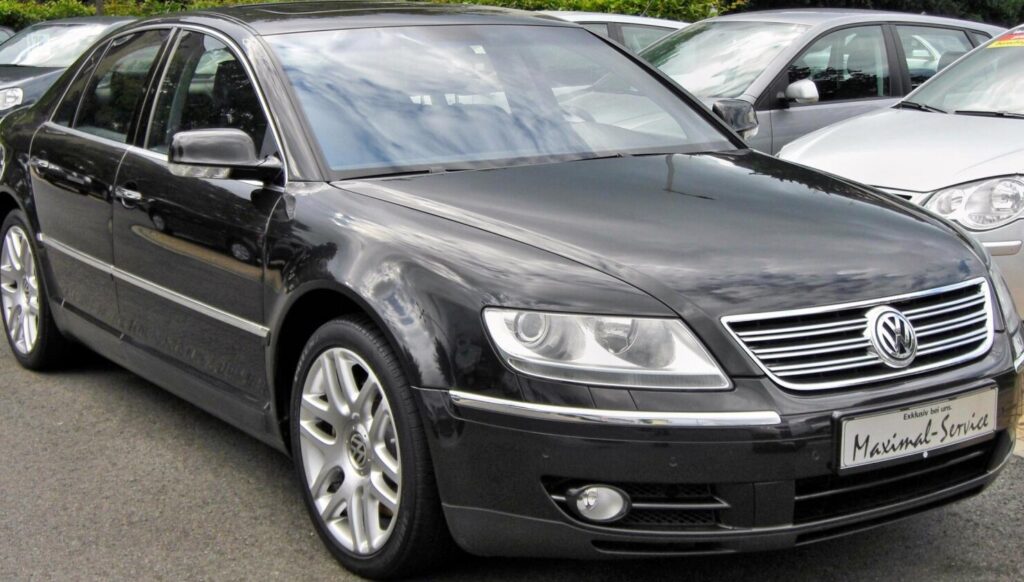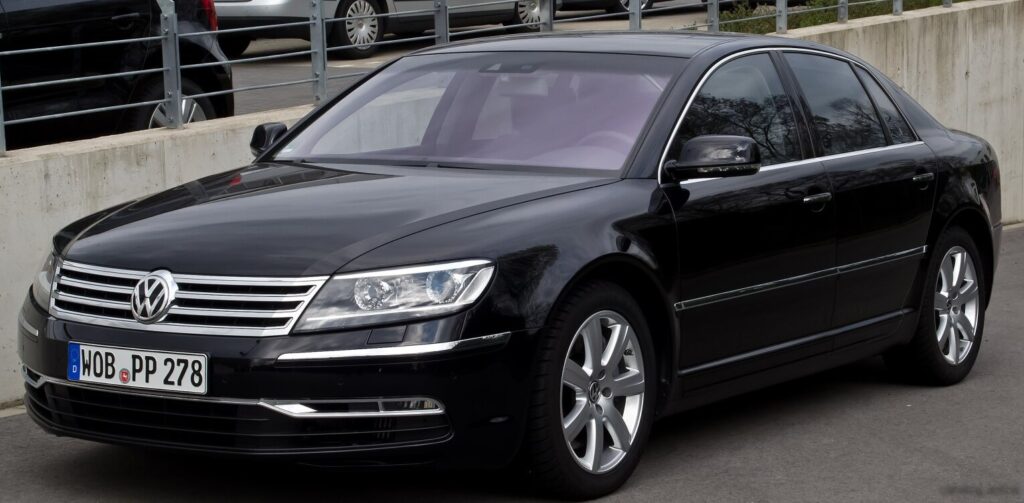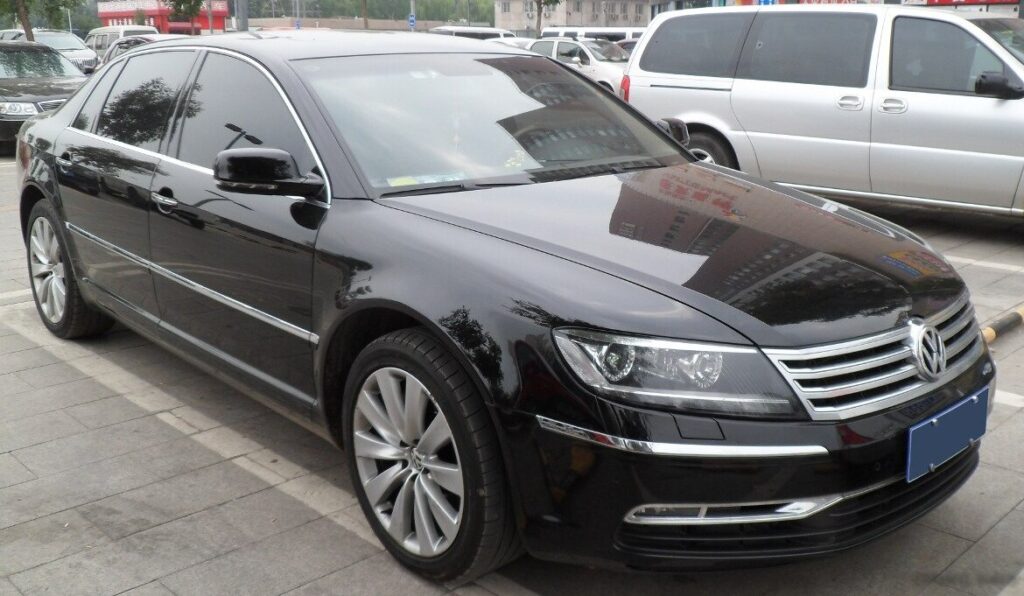
The Volkswagen Phaeton Long (facelift, 2010) 3.6 V6 FSI 4MOTION Tiptronic, a four-seat sedan, represented a significant evolution of Volkswagen’s flagship luxury vehicle. Introduced in May 2010 and continuing through April 2015, this variant occupied a middle ground within the Phaeton lineup, offering a balance between performance, comfort, and technology. It was positioned above the base 3.6L models and below the more powerful 4.2L V8 and diesel options. The facelift brought revised styling, updated technology, and refinements to the already luxurious interior, aiming to further solidify the Phaeton’s position as a competitor to established luxury brands like BMW, Mercedes-Benz, and Audi. This model was primarily aimed at the European and Asian markets, though limited numbers were also sold in other regions.
Technical Specifications
| Brand | Volkswagen |
| Model | Phaeton |
| Generation | Phaeton Long (facelift 2010) |
| Type (Engine) | 3.6 V6 FSI (280 Hp) 4MOTION Tiptronic 4 Seat |
| Start of production | May, 2010 |
| End of production | April, 2015 |
| Powertrain Architecture | Internal Combustion engine |
| Body type | Sedan |
| Seats | 4 |
| Doors | 4 |
| Fuel consumption (economy) – urban (NEDC) | 16.5 l/100 km (14.3 US mpg, 17.1 UK mpg, 6.1 km/l) |
| Fuel consumption (economy) – extra urban (NEDC) | 8.4 l/100 km (28 US mpg, 33.6 UK mpg, 11.9 km/l) |
| Fuel consumption (economy) – combined (NEDC) | 11.4 l/100 km (20.6 US mpg, 24.8 UK mpg, 8.8 km/l) |
| CO2 emissions (NEDC) | 265 g/km |
| Fuel Type | Petrol (Gasoline) |
| Acceleration 0 – 100 km/h | 9.2 sec |
| Acceleration 0 – 62 mph | 9.2 sec |
| Acceleration 0 – 60 mph | 8.7 sec |
| Maximum speed | 250 km/h (155.34 mph) |
| Emission standard | Euro 5 |
| Weight-to-power ratio | 8 kg/Hp, 125.1 Hp/tonne |
| Weight-to-torque ratio | 6 kg/Nm, 165.3 Nm/tonne |
| Power | 280 Hp @ 6250 rpm |
| Power per litre | 77.8 Hp/l |
| Torque | 370 Nm @ 3500 rpm (272.9 lb.-ft. @ 3500 rpm) |
| Engine layout | Front, Longitudinal |
| Engine Model/Code | EA390 / CHNA, CMVA |
| Engine displacement | 3597 cm3 (219.5 cu. in.) |
| Number of cylinders | 6 |
| Engine configuration | VR-engine |
| Cylinder Bore | 89 mm (3.5 in.) |
| Piston Stroke | 96.4 mm (3.8 in.) |
| Compression ratio | 12:1 |
| Number of valves per cylinder | 4 |
| Fuel injection system | Direct injection |
| Engine aspiration | Naturally aspirated engine |
| Valvetrain | DOHC |
| Engine oil capacity | 6.2 l (6.55 US qt | 5.46 UK qt) |
| Kerb Weight | 2238 kg (4933.95 lbs.) |
| Max. weight | 2770 kg (6106.8 lbs.) |
| Max load | 532 kg (1172.86 lbs.) |
| Trunk (boot) space – minimum | 500 l (17.66 cu. ft.) |
| Fuel tank capacity | 90 l (23.78 US gal | 19.8 UK gal) |
| Max. roof load | 100 kg (220.46 lbs.) |
| Permitted trailer load with brakes (8%) | 2500 kg (5511.56 lbs.) |
| Permitted trailer load with brakes (12%) | 2300 kg (5070.63 lbs.) |
| Permitted trailer load without brakes | 750 kg (1653.47 lbs.) |
| Permitted towbar download | 100 kg (220.46 lbs.) |
| Length | 5179 mm (203.9 in.) |
| Width | 1903 mm (74.92 in.) |
| Width including mirrors | 2118 mm (83.39 in.) |
| Height | 1450 mm (57.09 in.) |
| Wheelbase | 3001 mm (118.15 in.) |
| Front track | 1630 mm (64.17 in.) |
| Rear (Back) track | 1617 mm (63.66 in.) |
| Ride height (ground clearance) | 120 mm (4.72 in.) |
| Minimum turning circle (turning diameter) | 12.5 m (41.01 ft.) |
| Drivetrain Architecture | The Internal combustion engine (ICE) drives permanently the four wheels of the vehicle. |
| Drive wheel | All wheel drive (4×4) |
| Number of gears and type of gearbox | 6 gears, automatic transmission Tiptronic |
| Front suspension | Double wishbone, Transverse stabilizer, Air suspension |
| Rear suspension | Independent on trapezoidal lever, Air suspension, Transverse stabilizer |
| Front brakes | Ventilated discs, 360×34 mm |
| Rear brakes | Ventilated discs, 310×22 mm |
| Assisting systems | ABS (Anti-lock braking system) |
| Steering type | Steering rack and pinion |
| Power steering | Electric Steering |
| Tires size | 235/55 R17; 235/50 R18; 255/45 R18; 245/45 R19; 255/40 R19; 275/35 R20 |
| Wheel rims size | 7.5J x 17; 7.5J x 18; 8.5J x 18; 8.5J x 19; 9J x 19; 9J x 20 |
Powertrain & Engine Architecture
The heart of this Phaeton variant is the 3.6-liter VR6 FSI engine, designated EA390. This engine is a 60-degree V6, utilizing Volkswagen’s unique VR configuration, which combines the compactness of an inline engine with the smoothness of a V6. The ‘FSI’ designation indicates direct fuel injection, a technology that improves fuel efficiency and power output. The engine produces 280 horsepower at 6250 rpm and 370 Nm (272.9 lb-ft) of torque at 3500 rpm. The engine features a dual overhead camshaft (DOHC) valvetrain with four valves per cylinder. The 6-speed Tiptronic automatic transmission, a torque converter-based unit, was standard. This transmission offered both fully automatic operation and manual shift control via steering wheel-mounted paddles or the gear selector. The 4MOTION all-wheel-drive system distributes power between the front and rear axles as needed, enhancing traction and stability.
Driving Characteristics
The 3.6L V6 with the Tiptronic transmission provided a comfortable and refined driving experience. While not as overtly sporty as some of its competitors, the Phaeton offered ample power for effortless cruising and confident overtaking. The Tiptronic transmission, while smooth, wasn’t as quick-shifting as some dual-clutch transmissions found in other luxury vehicles. Acceleration from 0-60 mph took approximately 8.7 seconds, and the car had a governed top speed of 155 mph. The 4MOTION system provided excellent grip in all weather conditions. The air suspension contributed to a smooth and isolated ride, absorbing bumps and imperfections in the road effectively.
Equipment & Trim Levels
The Phaeton Long 3.6 V6 FSI 4MOTION Tiptronic came standard with a high level of equipment. This included leather upholstery, wood trim, a premium audio system, navigation, automatic climate control, bi-xenon headlights, and a host of safety features. Optional extras included massaging seats, a rear-seat entertainment system, and various customization options for the interior trim and exterior paint. The “Long” designation indicated an extended wheelbase, providing increased rear legroom for enhanced passenger comfort.
Chassis & Braking
The Phaeton utilized a sophisticated chassis design featuring double wishbone suspension at the front and an independent trapezoidal lever setup at the rear, both incorporating air suspension. This air suspension system allowed for adjustable ride height and damping, further enhancing ride comfort. Braking duties were handled by ventilated disc brakes on all four wheels, providing ample stopping power. The car was equipped with ABS (Anti-lock Braking System) and electronic stability control as standard safety features.
Market Reception & Comparison
The Phaeton, despite its quality and luxury, struggled to gain widespread acceptance in the market. Critics generally praised its build quality, ride comfort, and technology, but often noted its relatively understated styling and lack of brand recognition compared to its established rivals. The 3.6L V6 variant offered a good balance of performance and fuel economy, achieving around 20.6 mpg combined. However, it was often seen as a compromise compared to the more powerful V8 and diesel options. Maintenance costs were also a concern, as the Phaeton’s complex systems could be expensive to repair.
Legacy
The Volkswagen Phaeton, while not a commercial success, remains a fascinating example of Volkswagen’s ambition to compete in the luxury car segment. The 3.6L V6 FSI 4MOTION Tiptronic variant, while not the most sought-after version, offers a compelling combination of comfort, performance, and technology. Today, well-maintained examples are becoming increasingly collectible. The EA390 VR6 engine is generally considered reliable, though preventative maintenance is crucial. The complex electronic systems and air suspension can be potential sources of issues, requiring specialized knowledge for repair. The Phaeton represents a unique and often overlooked chapter in Volkswagen’s history, showcasing the company’s engineering prowess and commitment to quality.