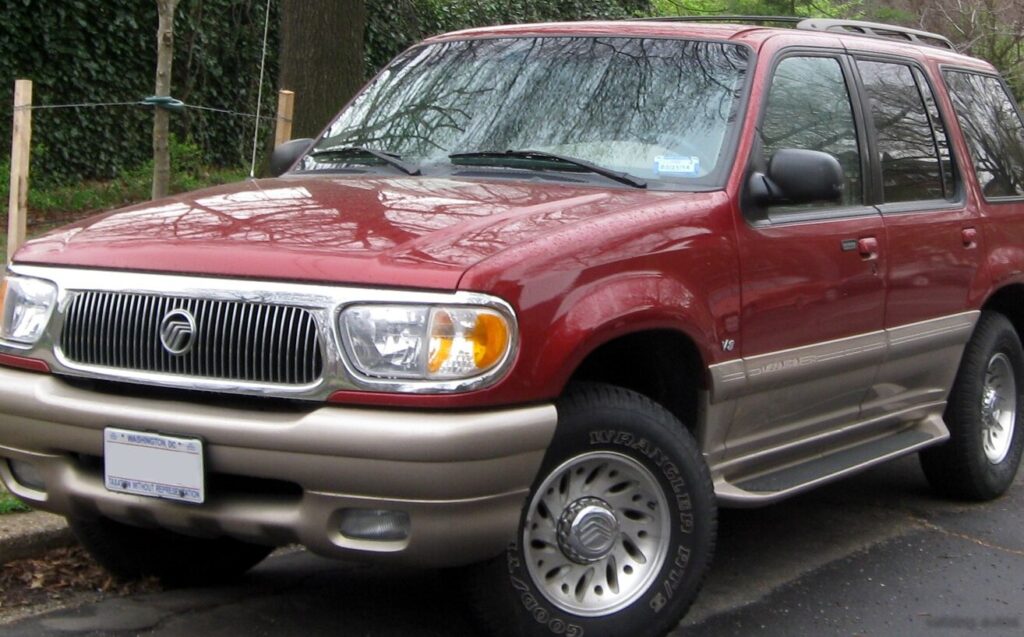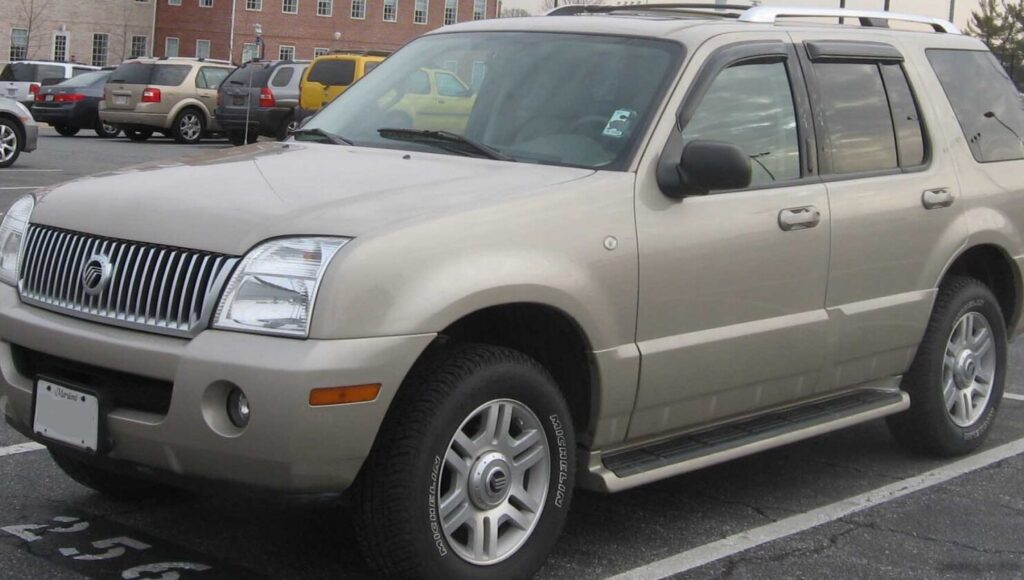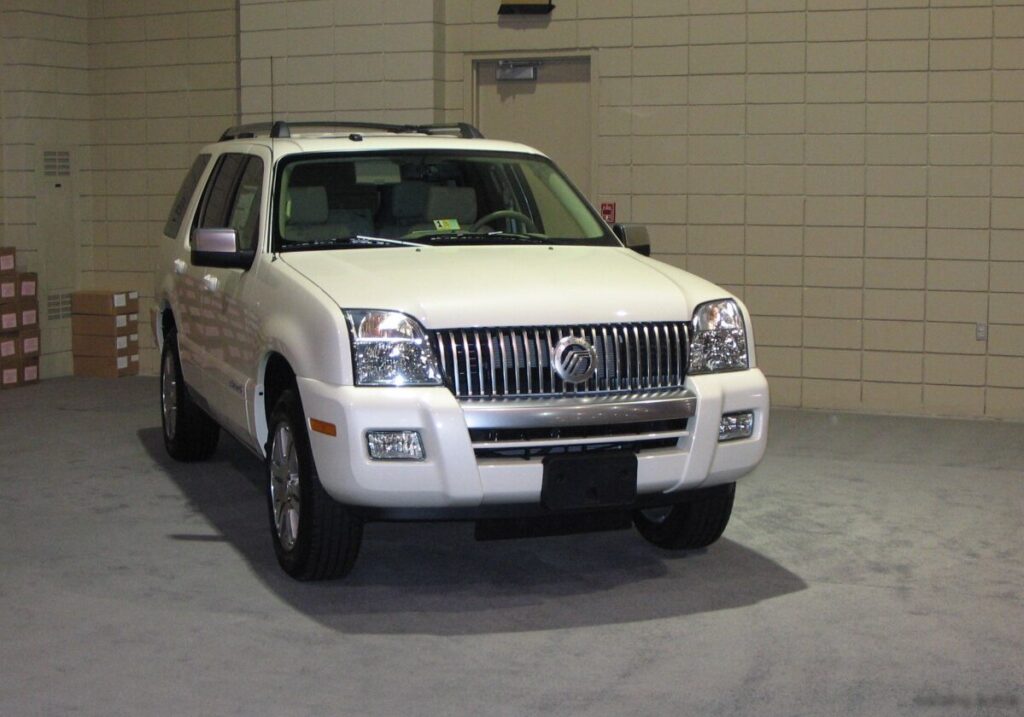
The Mercury Mountaineer III, specifically the variant equipped with the 4.0-liter V6 engine producing 210 horsepower and paired with an automatic transmission and all-wheel drive (AWD), was a mid-size SUV produced from 2005 to 2010. Positioned as a more premium offering within the Ford Motor Company’s SUV lineup, the Mountaineer III shared its platform with the Ford Explorer, but featured distinct styling and a more upscale interior. This particular configuration represented a balance between capability and affordability, targeting families seeking a spacious and versatile vehicle with all-weather traction.
Technical Specifications
| Brand | Mercury |
| Model | Mountaineer |
| Generation | Mountaineer III |
| Type (Engine) | 4.0 V6 (210 Hp) AWD Automatic |
| Start of production | 2005 |
| End of production | 2010 |
| Powertrain Architecture | Internal Combustion engine |
| Body type | SUV |
| Seats | 5 |
| Doors | 5 |
| Fuel consumption (urban) | 15.7-18.1 l/100 km (15 – 13 US mpg, 18 – 15.6 UK mpg, 6.4 – 5.5 km/l) |
| Fuel consumption (extra urban) | 11.8-12.4 l/100 km (19.9 – 19 US mpg, 23.9 – 22.8 UK mpg, 8.5 – 8.1 km/l) |
| Fuel Type | Petrol (Gasoline) |
| Emission standard | ULEV II |
| Weight-to-power ratio | 9.9 kg/Hp, 101.5 Hp/tonne |
| Weight-to-torque ratio | 6 kg/Nm, 166.3 Nm/tonne |
| Power | 210 Hp @ 5100 rpm |
| Power per litre | 52.4 Hp/l |
| Torque | 344 Nm @ 3700 rpm (253.72 lb.-ft. @ 3700 rpm) |
| Maximum engine speed | 6800 rpm |
| Engine layout | Front, Longitudinal |
| Engine Model/Code | Cologne |
| Engine displacement | 4009 cm3 (244.64 cu. in.) |
| Number of cylinders | 6 |
| Engine configuration | V-engine |
| Cylinder Bore | 100.4 mm (3.95 in.) |
| Piston Stroke | 84.4 mm (3.32 in.) |
| Compression ratio | 9.7:1 |
| Number of valves per cylinder | 2 |
| Fuel injection system | Multi-port manifold injection |
| Engine aspiration | Naturally aspirated engine |
| Valvetrain | SOHC |
| Engine oil capacity | 4.7 l (4.97 US qt | 4.14 UK qt) |
| Coolant capacity | 11.5 l (12.15 US qt | 10.12 UK qt) |
| Kerb Weight | 2069-2131 kg (4561.36 – 4698.05 lbs.) |
| Max. weight | 2749-2804 kg (6060.51 – 6181.76 lbs.) |
| Max load | 673-680 kg (1483.71 – 1499.14 lbs.) |
| Trunk (boot) space – minimum | 1277 l (45.1 cu. ft.) |
| Trunk (boot) space – maximum | 2430 l (85.81 cu. ft.) |
| Fuel tank capacity | 85 l (22.45 US gal | 18.7 UK gal) |
| Permitted trailer load with brakes (12%) | 2359 kg (5200.7 lbs.) |
| Length | 4915 mm (193.5 in.) |
| Width | 1867 mm (73.5 in.) |
| Height | 1849 mm (72.8 in.) |
| Wheelbase | 2888 mm (113.7 in.) |
| Front track | 1547 mm (60.91 in.) |
| Rear track | 1570-1575 mm (61.81 – 62.01 in.) |
| Ride height (ground clearance) | 208-221 mm (8.19 – 8.7 in.) |
| Minimum turning circle | 11.2 m (36.75 ft.) |
| Approach angle | 28-28.2° |
| Departure angle | 23.8-24.1° |
| Ramp-over angle | 18.4-19.2° |
| Drivetrain Architecture | ICE drives all four wheels permanently |
| Drive wheel | All wheel drive (4×4) |
| Number of gears | 5 |
| Gearbox type | Automatic transmission |
| Front suspension | Coil spring, Double wishbone, Transverse stabilizer |
| Rear suspension | Double wishbone, Transverse stabilizer, Coil spring |
| Front brakes | Ventilated discs, 305×30 mm |
| Rear brakes | Disc, 301×12 mm |
| Assisting systems | ABS (Anti-lock braking system) |
| Steering type | Steering rack and pinion |
| Power steering | Hydraulic Steering |
| Tires size | 245/65 R17; 235/65 R18; 255/50 R20 |
| Wheel rims size | 7.5J x 17; 7.5J x 18; 8J x 20 |
INTRODUCTION
The Mercury Mountaineer III, launched in 2005, represented a significant update to Mercury’s SUV offering. Built on the D3 platform shared with the Ford Explorer, the Mountaineer aimed for a more refined and luxurious experience. The 4.0-liter V6 AWD Automatic variant occupied a middle ground in the Mountaineer lineup, offering a balance of power, fuel economy, and all-weather capability. It was positioned above the base 4.0-liter V6 2WD model and below the higher-performance 4.6-liter V8 options. Production continued through the 2010 model year, after which the Mountaineer nameplate was discontinued.
Powertrain & Engine Architecture
The heart of this Mountaineer variant is the Ford Cologne 4.0-liter V6 engine. This engine, designated as the 4.0L SOHC, utilizes a single overhead camshaft (SOHC) design with two valves per cylinder. It features multi-port fuel injection, delivering fuel directly to each intake port. The engine’s architecture is a 60-degree V-configuration, contributing to a relatively compact engine bay footprint. The 4.0L engine produced 210 horsepower at 5100 rpm and 253 lb-ft of torque at 3700 rpm. The engine’s block is cast iron, while the cylinder heads are aluminum, a combination designed for durability and weight reduction. Paired with this engine is a five-speed automatic transmission (5R55E), known for its smooth shifting and reliability. This transmission features electronic control and adaptive shifting algorithms to optimize performance and fuel efficiency based on driving conditions.
Driving Characteristics
The 4.0-liter V6 and five-speed automatic combination in the Mountaineer III provided adequate, though not exhilarating, performance. Acceleration from 0 to 60 mph typically took around 8-9 seconds. The automatic transmission’s gear ratios were tuned for everyday drivability, prioritizing smooth transitions and fuel economy over aggressive acceleration. Compared to the available 4.6-liter V8, the V6 felt noticeably less powerful, particularly when fully loaded or towing. However, the V6 offered better fuel economy. The AWD system provided enhanced traction in slippery conditions, making it a capable vehicle for inclement weather. The Mountaineer’s ride quality was generally comfortable, thanks to its independent suspension, but handling was typical for a body-on-frame SUV – somewhat truck-like and less precise than a unibody crossover.
Equipment & Trim Levels
The Mountaineer III 4.0L AWD Automatic typically came standard with features such as air conditioning, power windows and locks, a CD player, and cloth upholstery. Higher trim levels, such as the Luxury and Premier editions, added features like leather upholstery, heated front seats, a premium sound system, and a power liftgate. Optional extras included a navigation system, a sunroof, and rear-seat entertainment. The interior design was generally considered more upscale than the Ford Explorer, with a focus on comfort and convenience. The dashboard layout was straightforward and user-friendly, with logically placed controls.
Chassis & Braking
The Mountaineer III utilized a traditional body-on-frame construction, providing a robust and durable chassis. The front suspension featured an independent double-wishbone design with coil springs and a stabilizer bar, while the rear suspension employed a similar double-wishbone setup with coil springs and a stabilizer bar. Braking duties were handled by ventilated discs at the front and solid discs at the rear. Anti-lock brakes (ABS) were standard. The Mountaineer’s steering system was a hydraulic rack-and-pinion setup, providing reasonably precise steering feel. Wheel sizes varied depending on the trim level, ranging from 17 to 20 inches.
Market Reception & Comparison
Critics generally praised the Mountaineer III for its spacious interior, comfortable ride, and available features. However, the 4.0-liter V6 was sometimes criticized for feeling underpowered, especially when compared to the V8 options. Fuel economy was considered average for its class. Compared to competitors like the Chevrolet TrailBlazer and the Jeep Grand Cherokee, the Mountaineer offered a more refined interior and a smoother ride, but lacked the off-road prowess of the Jeep. The Mountaineer’s reliability was generally good, but some owners reported issues with the automatic transmission and the cooling system.
Legacy
The Mercury Mountaineer III 4.0L V6 AWD Automatic remains a relatively affordable and capable used SUV. The 4.0-liter V6 engine, while not a powerhouse, is known for its durability and relatively low maintenance costs. The five-speed automatic transmission has proven to be generally reliable, although regular fluid changes are essential. Today, these Mountaineers are often found with higher mileage, and careful inspection of the undercarriage for rust and the engine for oil leaks is recommended. While not a collector’s item, the Mountaineer III represents a comfortable and practical SUV option for those seeking a spacious and versatile vehicle at a reasonable price.