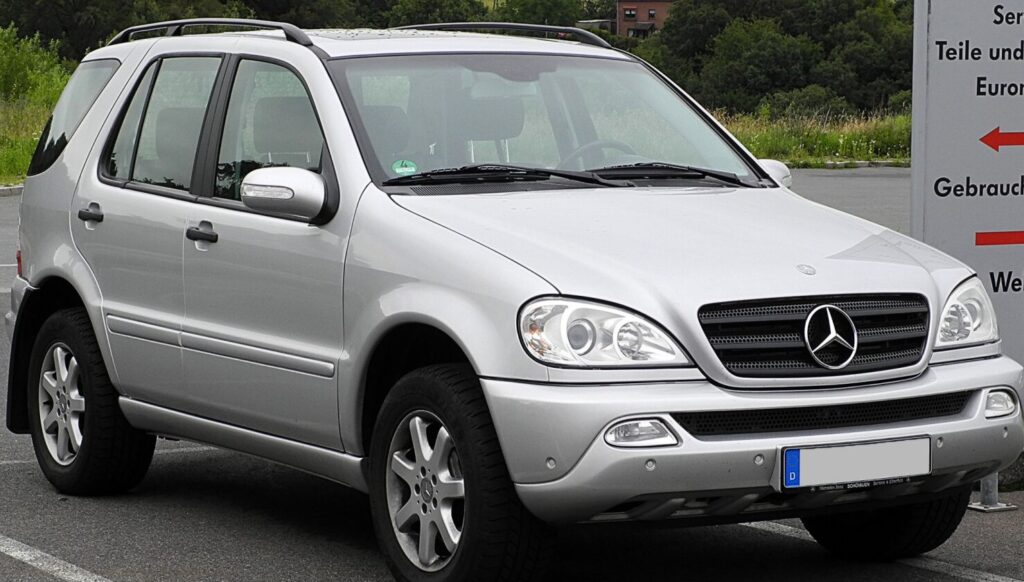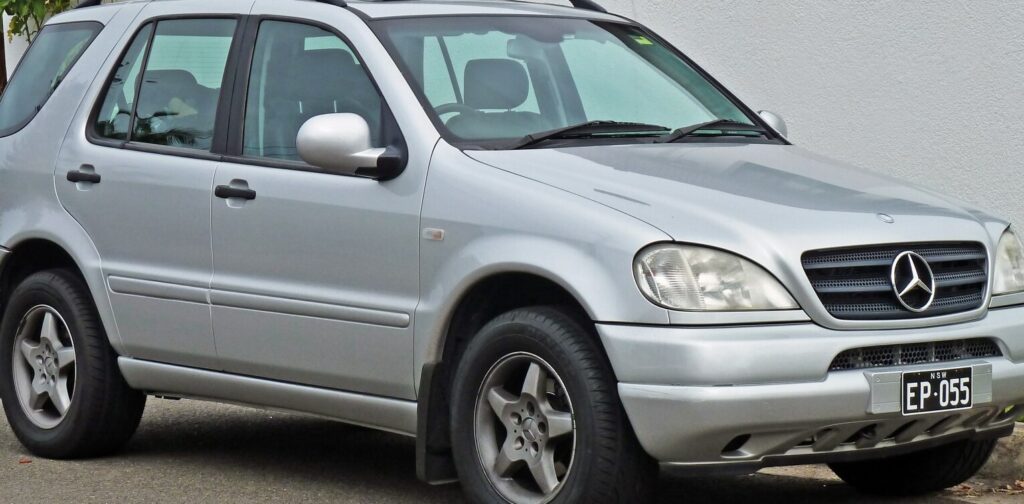
The Mercedes-Benz M-Class (W163) ML 230 4MATIC, produced from 1998 to 2000, represented an important entry point into the burgeoning luxury SUV market for Mercedes-Benz. This variant, powered by a 2.3-liter inline-four engine producing 150 horsepower, was primarily aimed at European markets where smaller displacement engines were favored due to taxation and fuel economy considerations. It served as the base model within the W163 range, positioned below the more powerful ML 320 and ML 430, offering a more affordable and fuel-conscious option for buyers seeking the M-Class’s blend of luxury and all-terrain capability. The ML 230 4MATIC was a key component in establishing the M-Class as a viable competitor against established SUVs like the BMW X5 and the Lexus RX.
Technical Specifications
| Brand | Mercedes-Benz |
| Model | M-Class |
| Generation | M-Class (W163) |
| Type (Engine) | ML 230 (150 Hp) 4MATIC |
| Start of production | 1998 |
| End of production | 2000 |
| Powertrain Architecture | Internal Combustion engine |
| Body type | SUV |
| Seats | 5 |
| Doors | 5 |
| Fuel consumption (urban) | 17.8 l/100 km (13.2 US mpg, 15.9 UK mpg, 5.6 km/l) |
| Fuel consumption (extra urban) | 9.8 l/100 km (24 US mpg, 28.8 UK mpg, 10.2 km/l) |
| Fuel consumption (combined) | 12.8 l/100 km (18.4 US mpg, 22.1 UK mpg, 7.8 km/l) |
| Fuel Type | Petrol (Gasoline) |
| Acceleration 0 – 100 km/h | 12.3 sec |
| Acceleration 0 – 62 mph | 12.3 sec |
| Acceleration 0 – 60 mph | 11.7 sec |
| Maximum speed | 177 km/h (109.98 mph) |
| Emission standard | Euro 2 |
| Weight-to-power ratio | 12.4 kg/Hp, 80.9 Hp/tonne |
| Weight-to-torque ratio | 8.4 kg/Nm, 118.6 Nm/tonne |
| Power | 150 Hp @ 5400 rpm |
| Power per litre | 65.4 Hp/l |
| Torque | 220 Nm @ 3800 rpm (162.26 lb.-ft. @ 3800 rpm) |
| Engine layout | Front, Longitudinal |
| Engine Model/Code | M 111.977 |
| Engine displacement | 2295 cm3 (140.05 cu. in.) |
| Number of cylinders | 4 |
| Engine configuration | Inline |
| Cylinder Bore | 90.9 mm (3.58 in.) |
| Piston Stroke | 88.4 mm (3.48 in.) |
| Compression ratio | 10:1 |
| Number of valves per cylinder | 4 |
| Fuel injection system | Multi-port manifold injection |
| Engine aspiration | Naturally aspirated engine |
| Valvetrain | DOHC |
| Engine oil capacity | 5.5 l (5.81 US qt | 4.84 UK qt) |
| Coolant | 10.5 l (11.1 US qt | 9.24 UK qt) |
| Kerb Weight | 1855 kg (4089.57 lbs.) |
| Max. weight | 2650 kg (5842.25 lbs.) |
| Max load | 795 kg (1752.67 lbs.) |
| Trunk (boot) space – minimum | 633 l (22.35 cu. ft.) |
| Trunk (boot) space – maximum | 2020 l (71.34 cu. ft.) |
| Fuel tank capacity | 83 l (21.93 US gal | 18.26 UK gal) |
| Length | 4587 mm (180.59 in.) |
| Width | 1833 mm (72.17 in.) |
| Height | 1802 mm (70.94 in.) |
| Wheelbase | 2820 mm (111.02 in.) |
| Front track | 1565 mm (61.61 in.) |
| Rear (Back) track | 1565 mm (61.61 in.) |
| Drive wheel | All wheel drive (4×4) |
| Number of gears and type of gearbox | 5 gears, manual transmission |
| Front suspension | Double wishbone |
| Rear suspension | Double wishbone |
| Front brakes | Ventilated discs |
| Rear brakes | Disc |
| Assisting systems | ABS (Anti-lock braking system) |
| Steering type | Steering rack and pinion |
| Power steering | Hydraulic Steering |
| Tires size | 225/75 R16 |
| Wheel rims size | 8J x 16 |
Powertrain & Engine Architecture
The ML 230 4MATIC was powered by the Mercedes-Benz M111.977 engine, a 2.3-liter (2295 cc) inline-four cylinder gasoline engine. This engine featured a double overhead camshaft (DOHC) valvetrain with four valves per cylinder, and utilized multi-port fuel injection. The M111 engine family was known for its relatively smooth operation and decent fuel efficiency for its time. The engine produced 150 horsepower at 5400 rpm and 220 Nm (162 lb-ft) of torque at 3800 rpm. The engine was mounted longitudinally in the chassis. The standard transmission was a 5-speed manual gearbox, although a 5-speed automatic transmission was also available as an option. The automatic transmission, while offering convenience, did slightly diminish acceleration performance compared to the manual.
Driving Characteristics
The ML 230 4MATIC offered a comfortable, albeit not particularly sporty, driving experience. Acceleration was adequate for everyday driving, with a 0-60 mph time of around 11.7 seconds. However, it was noticeably slower than the ML 320 or ML 430 models. The 4MATIC all-wheel-drive system provided enhanced traction in inclement weather and on loose surfaces, making it a capable vehicle for all-season use. The automatic transmission, while smooth, had relatively long gear ratios, prioritizing fuel economy over rapid acceleration. The suspension was tuned for comfort, absorbing bumps and providing a stable ride, but it wasn’t particularly engaging for enthusiastic drivers.
Equipment & Trim Levels
The ML 230 4MATIC typically came standard with features such as air conditioning, power windows and locks, and an AM/FM radio. Upholstery was typically cloth, although leather was available as an option. Optional extras included a sunroof, upgraded audio system, heated seats, and automatic climate control. The trim level was generally considered the entry-level offering, focusing on providing essential luxury features at a more accessible price point. The interior design was typical of Mercedes-Benz at the time, with a focus on quality materials and a functional layout.
Chassis & Braking
The W163 M-Class utilized a body-on-frame construction, providing robust durability and off-road capability. The ML 230 4MATIC featured a double wishbone suspension at both the front and rear, providing a comfortable ride. Brakes were ventilated discs at the front and solid discs at the rear. Anti-lock braking system (ABS) was standard. The steering was a hydraulic power-assisted rack and pinion system. The tires were typically 225/75 R16, providing a good balance of comfort and grip.
Market Reception & Comparison
The ML 230 4MATIC was generally well-received by critics as an affordable entry point into the M-Class range. However, its relatively modest performance compared to the larger-engined models was often noted. Fuel economy was a strong point, particularly compared to the V6 and V8 variants. The ML 230 4MATIC offered a more economical alternative for buyers who didn’t require the extra power of the higher-spec models. Compared to competitors like the BMW X5 and Lexus RX, the ML 230 4MATIC offered a more rugged and utilitarian character, with a greater emphasis on off-road capability.
Legacy
The M111 engine, in general, proved to be a reliable powerplant, and the ML 230 4MATIC is no exception. While age and mileage can lead to typical wear and tear, these engines are generally known for their longevity. Today, the ML 230 4MATIC can be found on the used car market at relatively affordable prices. It represents a good value for buyers seeking a comfortable and capable SUV with the prestige of the Mercedes-Benz brand. However, potential buyers should be aware of the potential for age-related maintenance issues, such as suspension wear and corrosion. The ML 230 4MATIC remains a significant model in the history of Mercedes-Benz, marking the brand’s entry into the popular luxury SUV segment.