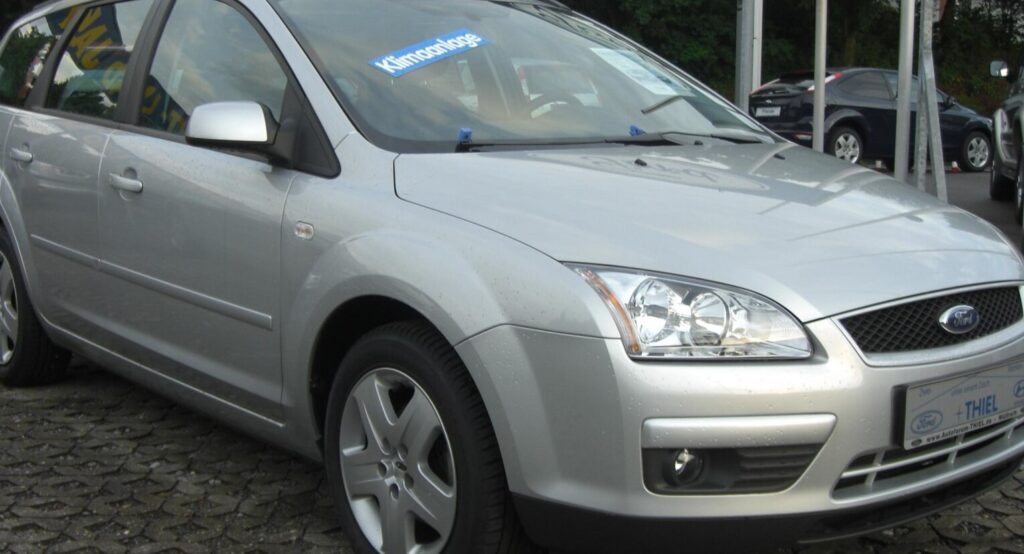
The Ford Focus Turnier II 1.6 Duratec 16V Automatic, produced between 2005 and 2010, represents a practical and accessible entry point into the second-generation Focus range, specifically the European station wagon (estate) body style. Positioned as a mid-range offering, this variant aimed to provide a balance between affordability, fuel efficiency, and the versatility expected of a family vehicle. It was a key component of Ford’s strategy to offer a diverse lineup catering to various customer needs within the competitive C-segment. The Turnier II, based on the Ford C170 platform (shared with the Mazda 3 and Volvo S40/V50), was primarily marketed in Europe, offering a more spacious alternative to the hatchback version.
| Brand | Ford |
| Model | Focus |
| Generation | Focus Turnier II |
| Type | 1.6 Duratec 16V (100 Hp) Automatic |
| Start of production | 2005 |
| End of production | 2010 |
| Powertrain Architecture | Internal Combustion engine |
| Body type | Station wagon (estate) |
| Seats | 5 |
| Doors | 5 |
| Fuel consumption (urban) | 10.4 l/100 km (22.6 US mpg, 27.2 UK mpg, 9.6 km/l) |
| Fuel consumption (extra urban) | 6 l/100 km (39.2 US mpg, 47.1 UK mpg, 16.7 km/l) |
| Fuel consumption (combined) | 7.7 l/100 km (30.5 US mpg, 36.7 UK mpg, 13 km/l) |
| Fuel Type | Petrol (Gasoline) |
| Acceleration 0 – 100 km/h | 13.9 sec |
| Acceleration 0 – 62 mph | 13.9 sec |
| Acceleration 0 – 60 mph | 13.2 sec |
| Maximum speed | 172 km/h (106.88 mph) |
| Emission standard | Euro 4 |
| Weight-to-power ratio | 12.9 kg/Hp, 77.3 Hp/tonne |
| Weight-to-torque ratio | 9 kg/Nm, 110.5 Nm/tonne |
| Power | 100 Hp @ 6000 rpm |
| Power per litre | 62.7 Hp/l |
| Torque | 143 Nm @ 4000 rpm (105.47 lb.-ft. @ 4000 rpm) |
| Engine layout | Front, Transverse |
| Engine Model/Code | HWDA, HWDB, SHDA, SHDB, SHDC |
| Engine displacement | 1596 cm3 (97.39 cu. in.) |
| Number of cylinders | 4 |
| Engine configuration | Inline |
| Cylinder Bore | 79 mm (3.11 in.) |
| Piston Stroke | 81.4 mm (3.2 in.) |
| Compression ratio | 11:1 |
| Number of valves per cylinder | 4 |
| Fuel injection system | Multi-port manifold injection |
| Engine aspiration | Naturally aspirated engine |
| Valvetrain | DOHC |
| Engine oil capacity | 4.1 l (4.33 US qt | 3.61 UK qt) |
| Coolant capacity | 5.5 l (5.81 US qt | 4.84 UK qt) |
| Kerb Weight | 1294 kg (2852.78 lbs.) |
| Max. weight | 1820 kg (4012.41 lbs.) |
| Max load | 526 kg (1159.63 lbs.) |
| Trunk (boot) space – minimum | 482 l (17.02 cu. ft.) |
| Trunk (boot) space – maximum | 1525 l (53.85 cu. ft.) |
| Fuel tank capacity | 55 l (14.53 US gal | 12.1 UK gal) |
| Length | 4472 mm (176.06 in.) |
| Width | 1840 mm (72.44 in.) |
| Height | 1501 mm (59.09 in.) |
| Wheelbase | 2640 mm (103.94 in.) |
| Drivetrain Architecture | Front wheel drive |
| Number of gears | 4 |
| Gearbox type | Automatic transmission |
| Front suspension | Spring Strut |
| Rear suspension | Transverse stabilizer |
| Front brakes | Ventilated discs |
| Rear brakes | Disc |
| Assisting systems | ABS (Anti-lock braking system) |
| Steering type | Steering rack and pinion |
| Tires size | 195/65 R15 |
| Wheel rims size | 6JX15 |
Powertrain & Engine Architecture
The heart of this Focus variant is the 1.6-liter Duratec 16V engine, specifically identified by engine codes such as HWDA, HWDB, SHDA, SHDB, and SHDC. This engine is a naturally aspirated, inline-four cylinder unit featuring a double overhead camshaft (DOHC) valvetrain and four valves per cylinder. The Duratec engine family was designed to be a modular and relatively simple design, prioritizing reliability and ease of maintenance. Fuel delivery is managed by a multi-port fuel injection system, providing adequate atomization for efficient combustion. The 100 horsepower output at 6000 rpm and 143 Nm (105.47 lb-ft) of torque at 4000 rpm are respectable figures for this displacement, but are noticeably lower than the performance offered by the higher-spec 2.0-liter Duratec engines or the diesel options available in the Focus range. The engine is transversely mounted, driving the front wheels. Paired with this engine is a four-speed automatic transmission. While providing convenience, this transmission is a relatively older design and contributes to slightly lower fuel economy and slower acceleration compared to the five-speed manual transmission offered with the same engine.
Driving Characteristics
The 1.6 Duratec with the four-speed automatic delivers a comfortable, if not particularly exhilarating, driving experience. Acceleration from 0-100 km/h (0-62 mph) takes approximately 13.9 seconds, making it suitable for everyday commuting and relaxed driving. The automatic transmission’s gear ratios are tuned for fuel efficiency rather than outright performance. This results in a noticeable delay during kickdown and a less responsive feel compared to the manual gearbox. The engine feels strained when pushed hard, particularly when overtaking or climbing hills. However, for drivers prioritizing ease of use and a smooth ride, the automatic transmission provides a convenient alternative. The suspension setup, typical for the Focus II, offers a good balance between comfort and handling, providing a stable and predictable ride.
Equipment & Trim Levels
The 1.6 Duratec Automatic typically came equipped as a mid-range trim level, often designated as ‘Comfort’ or ‘Trend’ depending on the specific market. Standard features generally included air conditioning, power steering, electric front windows, central locking, and an audio system. Interior upholstery was typically cloth, with a functional and durable design. Optional extras could include alloy wheels, rear electric windows, a sunroof, and upgraded audio systems. Safety features such as ABS (Anti-lock Braking System) were standard. The interior dashboard layout was typical of the Focus II, with a relatively simple and ergonomic design.
Chassis & Braking
The Focus Turnier II 1.6 Automatic utilizes a MacPherson strut front suspension and a multi-link rear suspension, providing a good level of ride comfort and handling. The front brakes are ventilated discs, offering adequate stopping power, while the rear brakes are typically solid discs. The ABS system helps to maintain steering control during emergency braking. The steering is rack and pinion, providing precise and responsive steering feel. The suspension components are generally robust and reliable, although wear and tear on bushings and shock absorbers is common with age and mileage.
Market Reception & Comparison
The 1.6 Duratec Automatic variant was generally well-received as a practical and affordable option within the Focus range. Critics noted its fuel efficiency and comfortable ride, but also pointed out its relatively modest performance. Compared to the higher-output 2.0-liter Duratec engines, the 1.6 offered significantly less power and acceleration. The diesel variants, such as the 1.6 TDCi and 2.0 TDCi, provided superior fuel economy and torque, but at a higher initial cost. The 1.6 Automatic appealed to drivers who prioritized ease of use and fuel efficiency over sporty performance. Its fuel economy figures of around 7.7 l/100 km (30.5 US mpg) were competitive for its class.
Legacy
The 1.6 Duratec engine, in general, has proven to be a relatively reliable unit, although regular maintenance is crucial. Common issues include oil leaks, particularly from the valve cover gasket, and occasional problems with the throttle body. The four-speed automatic transmission, while generally durable, can be prone to wear and tear with high mileage. Today, the Focus Turnier II 1.6 Automatic represents an affordable and practical used car option. Its relatively simple mechanical design makes it easier and cheaper to maintain compared to more complex modern vehicles. However, potential buyers should be aware of the age-related issues and ensure a thorough inspection before purchase. The Turnier II remains a popular choice for those seeking a spacious and reliable estate car at a reasonable price.