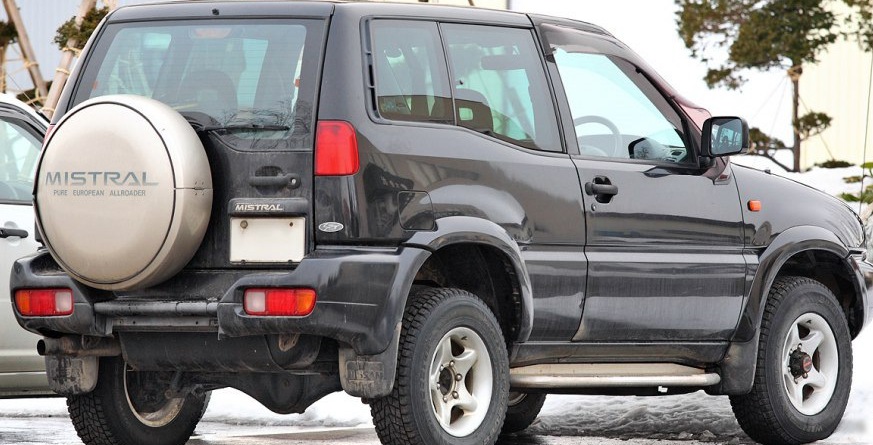
The Nissan Mistral (R20) 5-Door 2.7 TDi, produced between 1994 and 1999, was a mid-size SUV positioned as a robust and practical vehicle primarily for the European market. Based on the Nissan Patrol chassis, the Mistral aimed to offer a blend of off-road capability and on-road comfort, appealing to buyers seeking a versatile family vehicle. This particular 2.7-liter turbocharged diesel variant represented a mid-range offering within the Mistral lineup, slotting between the base gasoline engines and potentially higher-output diesel options depending on the specific market. It was a key model in Nissan’s attempt to gain a foothold in the growing SUV segment in Europe.
Technical Specifications
| Brand | Nissan |
| Model | Mistral |
| Generation | Mistral (R20) 5D |
| Type (Engine) | 2.7 TDi (125 Hp) |
| Start of production | 1994 |
| End of production | 1999 |
| Powertrain Architecture | Internal Combustion engine |
| Body type | SUV |
| Seats | 5 |
| Doors | 5 |
| Fuel consumption (urban) | 11.9 l/100 km (19.8 US mpg, 23.7 UK mpg, 8.4 km/l) |
| Fuel consumption (extra urban) | 8.7 l/100 km (27 US mpg, 32.5 UK mpg, 11.5 km/l) |
| Fuel consumption (combined) | 10.2 l/100 km (23.1 US mpg, 27.7 UK mpg, 9.8 km/l) |
| Fuel Type | Diesel |
| Acceleration 0 – 100 km/h | 16.7 sec |
| Acceleration 0 – 62 mph | 16.7 sec |
| Acceleration 0 – 60 mph | 15.9 sec |
| Maximum speed | 155 km/h (96.31 mph) |
| Weight-to-power ratio | 15 kg/Hp, 66.7 Hp/tonne |
| Weight-to-torque ratio | 6.7 kg/Nm, 148.3 Nm/tonne |
| Power | 125 Hp @ 3600 rpm |
| Power per litre | 46.9 Hp/l |
| Torque | 278 Nm @ 2000 rpm (205.04 lb.-ft. @ 2000 rpm) |
| Engine layout | Front, Longitudinal |
| Engine displacement | 2663 cm3 (162.51 cu. in.) |
| Number of cylinders | 4 |
| Engine configuration | Inline |
| Cylinder Bore | 96 mm (3.78 in.) |
| Piston Stroke | 92 mm (3.62 in.) |
| Compression ratio | 21.9:1 |
| Number of valves per cylinder | 2 |
| Fuel injection system | Precombustion chamber injection |
| Engine aspiration | Turbocharger |
| Kerb Weight | 1875 kg (4133.67 lbs.) |
| Max. weight | 2580 kg (5687.93 lbs.) |
| Max load | 705 kg (1554.26 lbs.) |
| Trunk (boot) space – minimum | 115 l (4.06 cu. ft.) |
| Trunk (boot) space – maximum | 1900 l (67.1 cu. ft.) |
| Fuel tank capacity | 80 l (21.13 US gal, 17.6 UK gal) |
| Length | 4665 mm (183.66 in.) |
| Width | 1755 mm (69.09 in.) |
| Height | 1850 mm (72.83 in.) |
| Wheelbase | 2650 mm (104.33 in.) |
| Front track | 1455 mm (57.28 in.) |
| Rear (Back) track | 1430 mm (56.3 in.) |
| Drive wheel | All wheel drive (4×4) |
| Number of gears and type of gearbox | 5 gears, manual transmission |
| Front suspension | Double wishbone |
| Rear suspension | Coil spring |
| Front brakes | Ventilated discs |
| Rear brakes | Drum |
| Assisting systems | ABS (Anti-lock braking system) |
| Power steering | Hydraulic Steering |
| Tires size | 235/75 R15 S |
Powertrain & Engine Architecture
The heart of the Mistral 2.7 TDi was the Nissan SD27 engine, a 2.7-liter inline-four cylinder diesel. This engine utilized a precombustion chamber injection system, a common technology for diesel engines of the era, designed to improve combustion efficiency and reduce noise. The addition of a turbocharger significantly boosted power output to 125 horsepower at 3600 rpm and 278 Nm (205 lb-ft) of torque at 2000 rpm. The engine was mounted longitudinally in the chassis, driving all four wheels through a five-speed manual transmission. The SD27 was known for its durability, but its pre-combustion chamber design could be prone to carbon buildup over time, potentially affecting performance and requiring periodic maintenance.
Driving Characteristics
The 2.7 TDi Mistral offered a practical, if not particularly sporty, driving experience. The engine’s torque peak at 2000 rpm provided reasonable pulling power for everyday driving and towing, but acceleration was relatively slow, taking around 16.7 seconds to reach 62 mph. The five-speed manual transmission was well-suited to the engine’s characteristics, allowing drivers to keep the engine in its optimal torque band. Compared to potential gasoline variants, the diesel offered significantly better fuel economy, but at the expense of refinement and outright speed. Against higher-output diesel versions (if available in certain markets), the 2.7 TDi provided a more economical option, prioritizing fuel efficiency over performance.
Equipment & Trim Levels
The Mistral 2.7 TDi typically came equipped with a reasonable level of standard features for a vehicle of its class in the mid-1990s. These generally included power steering, ABS brakes, and a basic audio system. Interior upholstery was typically cloth, with a functional, rather than luxurious, dashboard layout. Optional extras could include air conditioning, power windows, and upgraded audio systems. Trim levels varied by market, but the 2.7 TDi often represented a mid-range offering, providing a balance between affordability and features.
Chassis & Braking
The Mistral’s chassis was based on the rugged Nissan Patrol platform, providing a solid foundation for both on-road and off-road driving. Front suspension utilized a double wishbone setup, while the rear employed a coil spring arrangement. Braking consisted of ventilated discs at the front and drum brakes at the rear. The all-wheel-drive system provided enhanced traction in challenging conditions, making the Mistral a capable vehicle for navigating rough terrain or inclement weather. Stabilizer bars were included to reduce body roll during cornering, but the vehicle’s high center of gravity meant it wasn’t designed for aggressive handling.
Market Reception & Comparison
The Nissan Mistral 2.7 TDi was generally well-received as a practical and reliable SUV. Critics praised its robust construction, all-wheel-drive capability, and fuel-efficient diesel engine. However, it was often criticized for its relatively slow acceleration and somewhat basic interior. Compared to competitors like the Toyota RAV4 or Honda CR-V, the Mistral offered a more rugged and utilitarian experience, appealing to buyers who prioritized practicality and durability over refinement. Its fuel economy was competitive with other diesel SUVs of the time, and its reliability was generally considered good, although maintenance costs could be higher due to the engine’s pre-combustion chamber design.
Legacy
The Nissan Mistral, while not a massive sales success, established Nissan as a player in the European SUV market. The 2.7 TDi variant, in particular, has proven to be a relatively durable powertrain, with many examples still on the road today. However, age and mileage can lead to issues with the pre-combustion chamber injection system and other diesel engine components. In the used car market, the Mistral 2.7 TDi is often sought after by enthusiasts looking for a rugged and affordable SUV with good off-road capability. Its simplicity and robust construction make it a relatively easy vehicle to maintain, provided that regular servicing is performed.