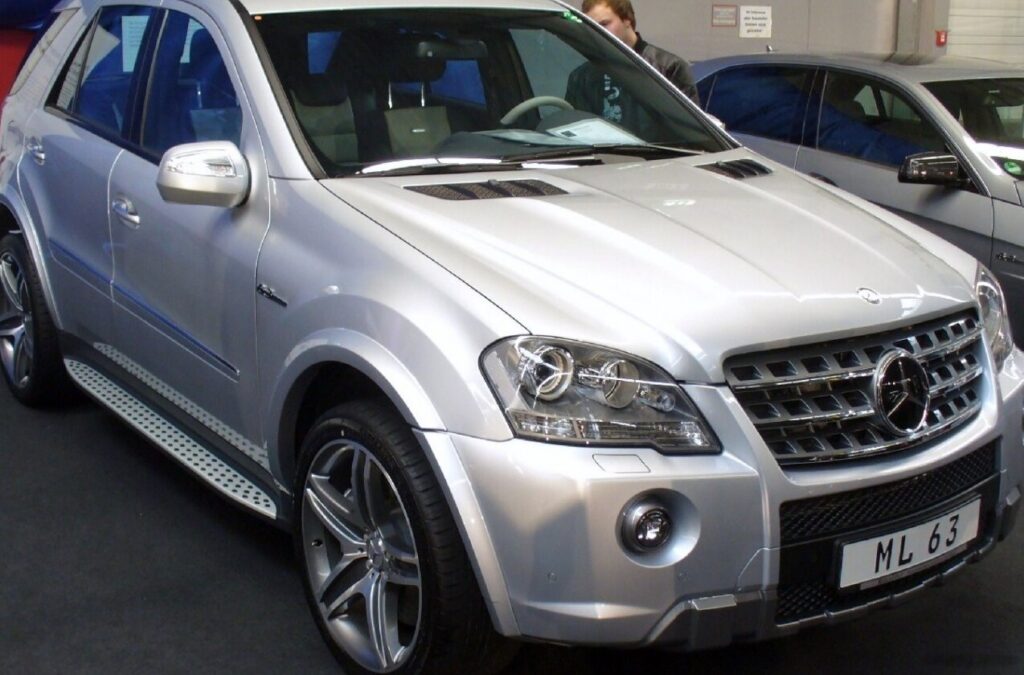
The Mercedes-Benz M-Class (W164) facelifted in 2008, and specifically the AMG ML 63 variant, represented the high-performance pinnacle of the second-generation M-Class. Produced from 2008 to 2010, this model combined the practicality of a mid-size luxury SUV with the potent power of Mercedes-AMG’s naturally aspirated V8 engine. Positioned as the flagship trim, the ML 63 catered to buyers seeking a blend of performance, luxury, and all-weather capability. It sat above the ML 350 and ML 550 in the lineup, offering significantly more power and a more aggressive aesthetic.
Technical Specifications
| Brand | Mercedes-Benz |
| Model | M-Class |
| Generation | M-Class (W164, facelift 2008) |
| Type | AMG ML 63 V8 (510 Hp) 4MATIC 7G-TRONIC AMG SPEEDSHIFT |
| Start of production | 2008 |
| End of production | 2010 |
| Powertrain Architecture | Internal Combustion engine |
| Body type | SUV |
| Seats | 5 |
| Doors | 5 |
| Fuel consumption (urban) | 24.1 l/100 km (9.8 US mpg, 11.7 UK mpg, 4.1 km/l) |
| Fuel consumption (extra urban) | 12.2 l/100 km (19.3 US mpg, 23.2 UK mpg, 8.2 km/l) |
| Fuel consumption (combined) | 16.5 l/100 km (14.3 US mpg, 17.1 UK mpg, 6.1 km/l) |
| CO2 emissions | 392 g/km |
| Fuel Type | Petrol (Gasoline) |
| Acceleration 0-100 km/h | 5 sec |
| Acceleration 0-62 mph | 5 sec |
| Acceleration 0-60 mph | 4.8 sec |
| Maximum speed | 250 km/h (155.34 mph), Electronically limited |
| Emission standard | Euro 4 |
| Weight-to-power ratio | 4.4 kg/Hp, 228.2 Hp/tonne |
| Weight-to-torque ratio | 3.5 kg/Nm, 281.9 Nm/tonne |
| Power | 510 Hp @ 6800 rpm |
| Power per litre | 82.2 Hp/l |
| Torque | 630 Nm @ 5200 rpm (464.66 lb.-ft. @ 5200 rpm) |
| Engine layout | Front, Longitudinal |
| Engine Model/Code | M 156.980 |
| Engine displacement | 6208 cm3 (378.84 cu. in.) |
| Number of cylinders | 8 |
| Engine configuration | V-engine |
| Cylinder Bore | 102.2 mm (4.02 in.) |
| Piston Stroke | 94.6 mm (3.72 in.) |
| Compression ratio | 11.3:1 |
| Number of valves per cylinder | 4 |
| Fuel injection system | Multi-port manifold injection |
| Engine aspiration | Naturally aspirated engine |
| Valvetrain | DOHC |
| Engine oil capacity | 9.7 l (10.25 US qt, 8.53 UK qt) |
| Coolant capacity | 11.5 l (12.15 US qt, 10.12 UK qt) |
| Kerb Weight | 2235 kg (4927.33 lbs.) |
| Max. weight | 2880 kg (6349.31 lbs.) |
| Max load | 645 kg (1421.98 lbs.) |
| Trunk (boot) space (min) | 833 l (29.42 cu. ft.) |
| Trunk (boot) space (max) | 2050 l (72.4 cu. ft.) |
| Fuel tank capacity | 95 l (25.1 US gal, 20.9 UK gal) |
| Max. roof load | 100 kg (220.46 lbs.) |
| Permitted trailer load (braked) | 3500 kg (7716.18 lbs.) |
| Permitted trailer load (unbraked) | 750 kg (1653.47 lbs.) |
| Length | 4812 mm (189.45 in.) |
| Width (including mirrors) | 2124 mm (83.62 in.) |
| Height | 1899 mm (74.76 in.) |
| Wheelbase | 2915 mm (114.76 in.) |
| Ride height (ground clearance) | 153-234 mm (6.02 – 9.21 in.) |
| Drag coefficient (Cd) | 0.37 |
| Minimum turning circle | 11.6 m (38.06 ft.) |
| Approach angle | 19-24° |
| Departure angle | 21-26° |
| Ramp-over angle | 14-21° |
| Climb angle | 45° |
| Wading depth | 500 mm (19.69 in.) |
| Drivetrain Architecture | The Internal combustion engine (ICE) drives permanently the four wheels of the vehicle. |
| Drive wheel | All wheel drive (4×4) |
| Number of gears | 7 |
| Gearbox type | Automatic transmission G-TRONIC AMG SPEEDSHIFT |
| Front suspension | Double wishbone, Transverse stabilizer, Air suspension |
| Rear suspension | Independent multi-link suspension, Air suspension, Transverse stabilizer |
| Front brakes | Ventilated discs |
| Rear brakes | Ventilated discs |
| Assisting systems | ABS (Anti-lock braking system) |
| Steering type | Steering rack and pinion |
| Power steering | Hydraulic Steering |
| Tires size | 295/35 R21 |
| Wheel rims size | 10J x 21 |
INTRODUCTION
The AMG ML 63, introduced with the 2008 facelift of the W164 M-Class, was a performance-oriented SUV designed to compete with offerings from Porsche and BMW. Building upon the already capable M-Class platform (shared with the Volkswagen Touareg and Audi Q7 – the 1HX0/A3 platform), the ML 63 distinguished itself through its powerful engine, upgraded suspension, and aggressive styling cues. It aimed to deliver a luxurious and engaging driving experience while maintaining the practicality expected of an SUV. The facelift brought updated styling, improved interior materials, and enhanced technology features across the M-Class range, with the ML 63 benefiting from these improvements alongside its performance enhancements.
Powertrain & Engine Architecture
The heart of the ML 63 was the M 156.980 6.2-liter naturally aspirated V8 engine. This engine, a hallmark of AMG’s engineering prowess, produced 510 horsepower at 6800 rpm and 630 Nm (464.66 lb-ft) of torque at 5200 rpm. The M156 featured an all-aluminum block and heads, a forged crankshaft, and pistons, and a high-flow intake and exhaust system. Fuel was delivered via multi-port fuel injection. The engine utilized a double overhead camshaft (DOHC) valvetrain with four valves per cylinder, optimizing breathing and contributing to its high-revving nature. The engine was paired with the 7G-TRONIC AMG SPEEDSHIFT automatic transmission, a seven-speed unit specifically tuned for performance. This transmission offered manual shift capability via steering wheel-mounted paddles, allowing drivers to control gear selection for a more engaging driving experience. The transmission was designed to handle the engine’s substantial torque output and provide quick, precise shifts.
Driving Characteristics
The ML 63 offered a markedly different driving experience compared to the standard M-Class models. The 6.2-liter V8 delivered exhilarating acceleration, propelling the SUV from 0 to 60 mph in approximately 4.8 seconds. While the automatic transmission provided smooth and comfortable shifts in normal driving, it could be quickly shifted into Sport mode for more aggressive shift points and a more responsive feel. The 7G-TRONIC’s programming prioritized performance, holding gears longer and downshifting rapidly under braking. The AMG-tuned suspension, featuring air suspension and stiffer springs, minimized body roll and provided a more controlled ride. However, the ride quality was firmer than that of the standard M-Class models, reflecting the performance focus. The 4MATIC all-wheel-drive system provided excellent traction in all weather conditions, enhancing stability and control.
Equipment & Trim Levels
The ML 63 came standard with a comprehensive list of luxury and performance features. Interior appointments included premium leather upholstery, AMG sport seats, and unique trim elements. Standard equipment also included a premium sound system, navigation system, and a sunroof. Optional extras included a rear-seat entertainment system, upgraded leather options, and various driver-assistance features. The exterior styling was enhanced with AMG-specific body kit, including unique front and rear bumpers, side skirts, and a rear spoiler. Larger wheels and performance tires completed the aggressive look.
Chassis & Braking
The ML 63 featured a robust chassis designed to handle the engine’s power and provide a stable platform for spirited driving. The suspension system utilized air suspension, allowing for adjustable ride height and improved comfort. The front suspension employed a double wishbone design with a transverse stabilizer, while the rear suspension utilized an independent multi-link setup, also with a transverse stabilizer. Braking duties were handled by ventilated discs at all four corners, providing ample stopping power. The anti-lock braking system (ABS) and electronic stability control (ESC) further enhanced safety and control.
Market Reception & Comparison
The AMG ML 63 was generally well-received by automotive critics, who praised its powerful engine, engaging driving dynamics, and luxurious interior. However, its fuel economy was a common criticism, with combined fuel consumption figures around 16.5 l/100 km (14.3 US mpg). Compared to the ML 550, the ML 63 offered significantly more performance but at the cost of fuel efficiency and a slightly firmer ride. The ML 350, the entry-level model, provided a more economical and comfortable driving experience but lacked the performance of the ML 63. The ML 63 competed directly with the Porsche Cayenne and BMW X5 M, offering a similar blend of performance and luxury.
Legacy
The M156 engine, found in the ML 63, is regarded as one of AMG’s most iconic and reliable powerplants. While maintenance costs can be higher than those of more modern engines, the M156 is known for its durability and relatively straightforward design. Today, the W164 ML 63 remains a desirable SUV for enthusiasts seeking a high-performance luxury vehicle. Well-maintained examples command a premium in the used car market, and the ML 63’s combination of power, practicality, and AMG heritage continues to appeal to buyers looking for a unique and engaging driving experience. The vehicle represents a transition period for Mercedes-AMG, showcasing the brand’s commitment to performance while still offering the comfort and refinement expected of a luxury SUV.