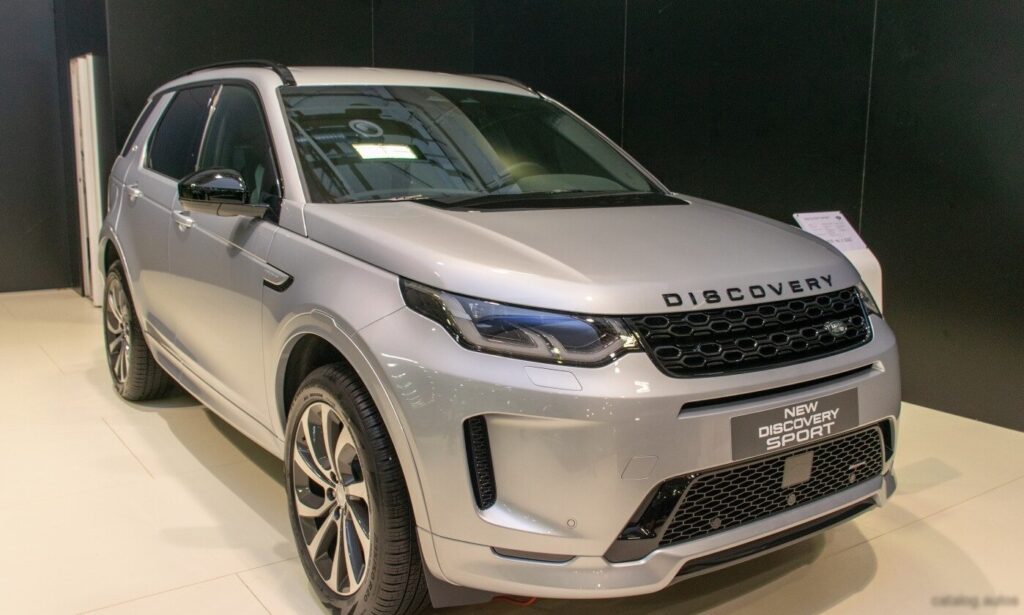
The Land Rover Discovery Sport 2.0 D150, introduced with the facelift in May 2019, represents a key entry point into the Discovery Sport range. Positioned as a more economical and accessible option, this variant featured a 2.0-liter four-cylinder diesel engine producing 150 horsepower, paired with a six-speed manual transmission. Notably, it was offered with the option of five or seven-seat configurations, making it a versatile choice for families. This model falls within the L550 series, built on the Land Rover-Jaguar LR-MS platform, and aimed to broaden the appeal of the Discovery Sport by offering a balance of capability, practicality, and fuel efficiency.
Technical Specifications
| Brand | Land Rover |
| Model | Discovery Sport |
| Generation | Discovery Sport (facelift 2019) |
| Type (Engine) | 2.0 D150 (150 Hp) 5+2 Seating |
| Start of production | May, 2019 |
| Powertrain Architecture | Internal Combustion engine |
| Body type | SUV |
| Seats | 7 |
| Doors | 5 |
| Fuel consumption at Low speed (WLTP) | 7.8-8.4 l/100 km (30.2 – 28 US mpg, 36.2 – 33.6 UK mpg, 12.8 – 11.9 km/l) |
| Fuel consumption at Medium speed (WLTP) | 6.1-6.8 l/100 km (38.6 – 34.6 US mpg, 46.3 – 41.5 UK mpg, 16.4 – 14.7 km/l) |
| Fuel consumption at high speed (WLTP) | 5.2-6.0 l/100 km (45.2 – 39.2 US mpg, 54.3 – 47.1 UK mpg, 19.2 – 16.7 km/l) |
| Fuel consumption at very high speed (WLTP) | 6.3-7.1 l/100 km (37.3 – 33.1 US mpg, 44.8 – 39.8 UK mpg, 15.9 – 14.1 km/l) |
| Combined fuel consumption (WLTP) | 6.1-6.9 l/100 km (38.6 – 34.1 US mpg, 46.3 – 40.9 UK mpg, 16.4 – 14.5 km/l) |
| CO2 emissions (WLTP) | 165-186 g/km |
| Fuel consumption (economy) – urban (NEDC, WLTP equivalent) | 6.5-6.9 l/100 km (36.2 – 34.1 US mpg, 43.5 – 40.9 UK mpg, 15.4 – 14.5 km/l) |
| Fuel consumption (economy) – extra urban (NEDC, WLTP equivalent) | 4.9-5.3 l/100 km (48 – 44.4 US mpg, 57.6 – 53.3 UK mpg, 20.4 – 18.9 km/l) |
| Fuel consumption (economy) – combined (NEDC, WLTP equivalent) | 5.5-5.9 l/100 km (42.8 – 39.9 US mpg, 51.4 – 47.9 UK mpg, 18.2 – 16.9 km/l) |
| CO2 emissions (NEDC, WLTP equivalent) | 144-154 g/km |
| Fuel Type | Diesel |
| Acceleration 0 – 100 km/h | 11.4 sec |
| Acceleration 0 – 62 mph | 11.4 sec |
| Acceleration 0 – 60 mph | 10.8 sec |
| Maximum speed | 193 km/h (119.92 mph) |
| Emission standard | Euro 6d-TEMP-EVAP-ISC |
| Weight-to-power ratio | 12.3 kg/Hp, 81 Hp/tonne |
| Weight-to-torque ratio | 4.9 kg/Nm, 205.3 Nm/tonne |
| Power | 150 Hp @ 4000 rpm |
| Power per litre | 75 Hp/l |
| Torque | 380 Nm @ 1750-2750 rpm (280.27 lb.-ft. @ 1750-2750 rpm) |
| Engine layout | Front, Transverse |
| Engine Model/Code | Ingenium / 204DTD |
| Engine displacement | 1999 cm3 (121.99 cu. in.) |
| Number of cylinders | 4 |
| Engine configuration | Inline |
| Cylinder Bore | 83 mm (3.27 in.) |
| Piston Stroke | 92.35 mm (3.64 in.) |
| Compression ratio | 15.5:1 |
| Number of valves per cylinder | 4 |
| Fuel injection system | Diesel Commonrail |
| Engine aspiration | Turbocharger, Intercooler |
| Valvetrain | DOHC |
| Engine oil capacity | 6.5 l (6.87 US qt | 5.72 UK qt) |
| Kerb Weight | 1851 kg (4080.76 lbs.) |
| Max. weight | 2640 kg (5820.2 lbs.) |
| Max load | 789 kg (1739.45 lbs.) |
| Trunk (boot) space – minimum | 157 l (5.54 cu. ft.) |
| Trunk (boot) space – maximum | 1651 l (58.3 cu. ft.) |
| Fuel tank capacity | 65 l (17.17 US gal | 14.3 UK gal) |
| AdBlue tank | 17 l (4.49 US gal | 3.74 UK gal) |
| Max. roof load | 75 kg (165.35 lbs.) |
| Permitted trailer load with brakes (12%) | 1800 kg (3968.32 lbs.) |
| Permitted trailer load without brakes | 750 kg (1653.47 lbs.) |
| Permitted towbar download | 100 kg (220.46 lbs.) |
| Length | 4597 mm (180.98 in.) |
| Width with mirrors folded | 2069 mm (81.46 in.) |
| Width including mirrors | 2173 mm (85.55 in.) |
| Height | 1727 mm (67.99 in.) |
| Wheelbase | 2741 mm (107.91 in.) |
| Front track | 1625-1636 mm (63.98 – 64.41 in.) |
| Rear (Back) track | 1623-1642 mm (63.9 – 64.65 in.) |
| Front overhang | 901 mm (35.47 in.) |
| Rear overhang | 955 mm (37.6 in.) |
| Ride height (ground clearance) | 212 mm (8.35 in.) |
| Drag coefficient (Cd) | 0.33 |
| Minimum turning circle (turning diameter) | 12.14 m (39.83 ft.) |
| Approach angle | 22.8-25.0° |
| Departure angle | 28.2-30.2° |
| Ramp-over (brakeover) angle | 20.6° |
| Wading depth | 600 mm (23.62 in.) |
| Drivetrain Architecture | The Internal combustion engine (ICE) drives the front wheels of the vehicle. |
| Drive wheel | Front wheel drive |
| Number of gears and type of gearbox | 6 gears, manual transmission |
| Front suspension | Independent type McPherson |
| Rear suspension | Independent multi-link suspension |
| Front brakes | Ventilated discs, 325-349 mm |
| Rear brakes | Disc, 325 mm |
| Assisting systems | ABS (Anti-lock braking system) |
| Steering type | Steering rack and pinion |
| Power steering | Electric Steering |
| Tires size | 225/65 R17; 235/65 R17; 235/60 R18; 235/55 R19; 235/50 R20 |
| Wheel rims size | 7.0J x 17; 8.0J x 18; 8.0J x 19; 8.0J x 20 |
Powertrain & Engine Architecture
The 2.0 D150 utilizes Land Rover’s Ingenium engine family, specifically the 204DTD code. This engine is a turbocharged, four-cylinder diesel featuring direct injection and a double overhead camshaft (DOHC) valvetrain with four valves per cylinder. The turbocharger, coupled with an intercooler, helps to boost power output while maintaining efficiency. The engine employs a common rail diesel injection system, delivering fuel at high pressure for optimized combustion. The six-speed manual transmission was the standard offering for this variant, providing a more engaging driving experience compared to the optional nine-speed automatic. The engine’s transverse mounting contributes to efficient packaging within the front-wheel-drive layout.
Driving Characteristics
The 150 horsepower and 380 Nm (280 lb-ft) of torque delivered by the 2.0 D150 provided adequate performance for everyday driving. Acceleration from 0-60 mph took around 10.8 seconds, and top speed was limited to 119.92 mph. While not particularly sporty, the engine offered a usable powerband, with peak torque available from 1750-2750 rpm. The manual transmission allowed for greater driver control, but the gear ratios were tuned for fuel economy rather than outright performance. Compared to the higher-output 180 hp or 240 hp versions of the 2.0 Ingenium engine, the D150 felt less responsive, particularly when fully loaded or tackling steep inclines. However, its lower power output also translated to improved fuel efficiency.
Equipment & Trim Levels
The 2.0 D150 typically came equipped with a respectable level of standard features. These included alloy wheels, automatic headlights, rain-sensing wipers, and a touchscreen infotainment system with Bluetooth connectivity. Interior upholstery was generally cloth, with options for leather upgrades. Standard safety features included multiple airbags, ABS, and stability control. Optional extras included a panoramic sunroof, heated seats, and a premium sound system. The five-seat configuration was standard, with the seven-seat option adding a third row of seats suitable for children or occasional use.
Chassis & Braking
The Discovery Sport 2.0 D150 featured an independent McPherson strut suspension at the front and an independent multi-link suspension at the rear. This setup provided a comfortable ride quality, even on uneven surfaces. Disc brakes were fitted to all four wheels, with ventilated discs at the front for improved heat dissipation. ABS (Anti-lock Braking System) was standard, enhancing braking performance and stability. The vehicle’s weight-to-power ratio of 12.3 kg/Hp contributed to its balanced handling characteristics.
Market Reception & Comparison
The 2.0 D150 was generally well-received as an affordable and practical entry point into the Discovery Sport range. Critics praised its fuel efficiency and comfortable ride, but some noted its lack of outright performance compared to higher-powered variants. Compared to the 180 hp diesel, the D150 offered a lower purchase price and slightly better fuel economy, making it an attractive option for budget-conscious buyers. However, the 180 hp model provided a more refined driving experience and greater versatility. The 2.0 D150 also competed with other compact SUVs, such as the Audi Q3 and BMW X1, offering a unique blend of off-road capability and on-road comfort.
Legacy
The Land Rover Discovery Sport 2.0 D150 has proven to be a relatively reliable powertrain, with the Ingenium engine family generally regarded as durable. Common issues reported by owners include occasional problems with the diesel particulate filter (DPF) and the AdBlue system, particularly on vehicles that primarily cover short distances. However, these issues are not unique to this variant and are common to many modern diesel vehicles. On the used car market, the 2.0 D150 represents a good value proposition, offering a practical and capable SUV at a competitive price. Its fuel efficiency and relatively low running costs make it an appealing choice for families and individuals alike.