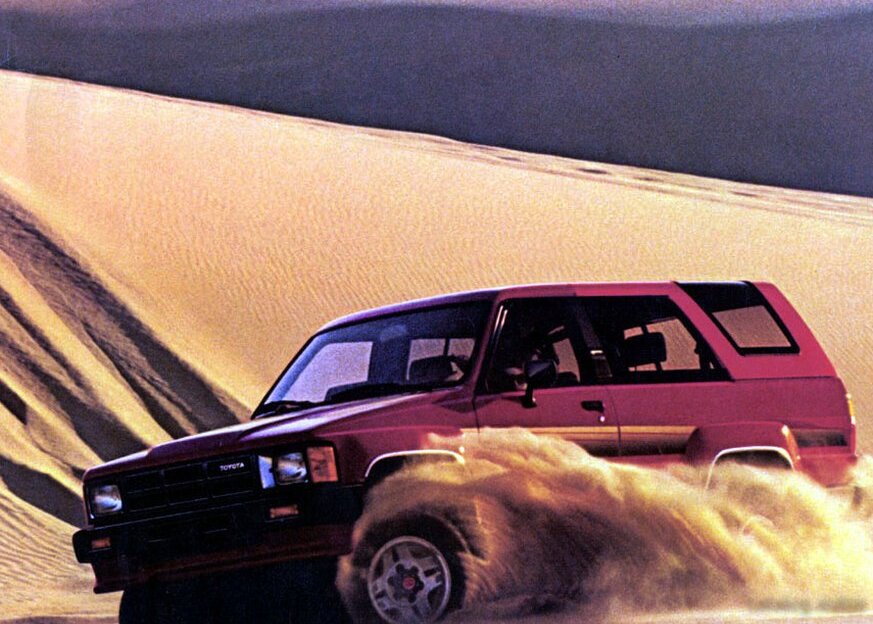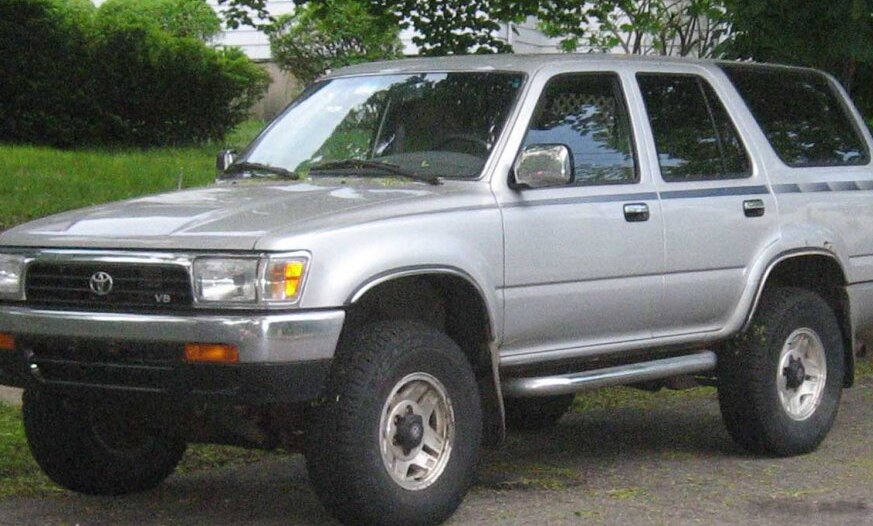
The Toyota 4Runner II, produced between 1989 and 1995, marked a significant step forward for Toyota’s popular SUV. This second-generation model, known internally as the YN80 series, built upon the foundation laid by its predecessor, offering increased refinement, enhanced capability, and a broader selection of engine options. The 2.4-liter (114 hp) 4×4 variant occupied the entry-level position in the lineup, appealing to buyers who desired a rugged, dependable, and affordable SUV suitable for both on-road driving and off-road adventures. It played a crucial role in Toyota’s strategy to expand its presence in the burgeoning SUV market, particularly in North America and Australia.
Technical Specifications
| Brand | Toyota |
| Model | 4Runner |
| Generation | 4Runner II |
| Type (Engine) | 2.4 (114 Hp) 4×4 |
| Start of production | 1989 |
| End of production | 1995 |
| Powertrain Architecture | Internal Combustion engine |
| Body type | SUV |
| Seats | 5 |
| Doors | 5 |
| Fuel consumption (urban) | 18 l/100 km (13.1 US mpg) |
| Fuel consumption (extra urban) | 10 l/100 km (23.5 US mpg) |
| Fuel consumption (combined) | 13.8 l/100 km (17 US mpg) |
| Fuel Type | Petrol (Gasoline) |
| Acceleration 0 – 100 km/h | 18.4 sec |
| Acceleration 0 – 62 mph | 18.4 sec |
| Acceleration 0 – 60 mph | 17.5 sec |
| Maximum speed | 155 km/h (96.31 mph) |
| Weight-to-power ratio | 14 kg/Hp |
| Weight-to-torque ratio | 8.3 kg/Nm |
| Power | 114 Hp @ 4800 rpm |
| Torque | 192 Nm @ 3600 rpm (141.61 lb.-ft. @ 3600 rpm) |
| Engine layout | Front, Longitudinal |
| Engine Model/Code | 22R-E |
| Engine displacement | 2366 cm3 (144.38 cu. in.) |
| Number of cylinders | 4 |
| Engine configuration | Inline |
| Cylinder Bore | 92 mm (3.62 in.) |
| Piston Stroke | 89 mm (3.5 in.) |
| Number of valves per cylinder | 2 |
| Fuel injection system | Multi-port manifold injection |
| Engine aspiration | Naturally aspirated engine |
| Valvetrain | SOHC |
| Engine oil capacity | 4.3 l (4.54 US qt | 3.78 UK qt) |
| Coolant | 8.5 l (8.98 US qt | 7.48 UK qt) |
| Kerb Weight | 1600 kg (3527.4 lbs.) |
| Trunk (boot) space – minimum | 1200 l (42.38 cu. ft.) |
| Trunk (boot) space – maximum | 2100 l (74.16 cu. ft.) |
| Fuel tank capacity | 65 l (17.17 US gal | 14.3 UK gal) |
| Length | 4490 mm (176.77 in.) |
| Width | 1690 mm (66.54 in.) |
| Height | 1775 mm (69.88 in.) |
| Wheelbase | 2625 mm (103.35 in.) |
| Front track | 1430 mm (56.3 in.) |
| Rear (Back) track | 1425 mm (56.1 in.) |
| Ride height (ground clearance) | 210 mm (8.27 in.) |
| Drive wheel | All wheel drive (4×4) |
| Number of gears and type of gearbox | 5 gears, manual transmission |
| Front suspension | Double wishbone |
| Rear suspension | dependent spring suspension |
| Front brakes | Ventilated discs |
| Rear brakes | Drum |
| Steering type | Worm-reduction unit |
| Power steering | Hydraulic Steering |
| Tires size | 225/75 R15 |
| Wheel rims size | 15 |
Powertrain & Engine Architecture
The 2.4-liter 22R-E engine powering this 4Runner variant was a naturally aspirated, inline-four cylinder gasoline engine. It featured a single overhead camshaft (SOHC) valvetrain and multi-port fuel injection. This engine was well-regarded for its durability and relatively straightforward design, contributing to ease of maintenance. The 22R-E produced 114 horsepower at 4,800 rpm and 141.61 lb-ft of torque at 3,600 rpm. The engine’s longitudinal mounting facilitated a traditional front-engine, rear-wheel-drive layout with on-demand four-wheel drive engagement. A 5-speed manual transmission was the sole transmission option available with this engine, providing a direct mechanical link to the drivetrain. This configuration prioritized fuel efficiency and reliability over outright performance.
Driving Characteristics
The 4Runner II 2.4L 4×4, with its 114 horsepower, wasn’t engineered for brisk acceleration. Acceleration from 0 to 60 mph required approximately 17.5 seconds, and its top speed was limited to around 96 mph. The engine’s torque curve was relatively flat, delivering sufficient pulling power for everyday driving and moderate off-road conditions. The manual transmission offered precise control, though it demanded more driver engagement compared to the automatic transmissions found in higher trim levels. In comparison to the more powerful V6 options within the 4Runner II lineup, this variant felt noticeably slower, particularly when fully loaded or navigating steep inclines. However, its lighter weight and simpler design contributed to improved fuel economy and a more agile feel on paved roads.
Equipment & Trim Levels
The 2.4-liter 4×4 4Runner typically represented the base trim level. Standard features generally included basic cloth upholstery, manual windows and locks, and a simple AM/FM radio. Air conditioning was frequently offered as an optional extra, alongside power windows and upgraded audio systems. The interior was functional and durable, emphasizing practicality over luxury. Exterior features were similarly modest, featuring steel wheels, black plastic bumpers, and minimal chrome trim. The emphasis was on providing a capable and affordable SUV, rather than a lavishly equipped one.
Chassis & Braking
The 4Runner II employed a body-on-frame construction, providing robust durability and off-road capability. The front suspension utilized a double wishbone design, while the rear suspension featured a more conventional dependent spring setup with a solid axle. This configuration prioritized off-road articulation and load-carrying capacity. Braking was handled by ventilated discs at the front and drum brakes at the rear. The braking system was adequate for the vehicle’s weight and performance, but lacked the stopping power of more contemporary systems. Steering was accomplished via a worm-reduction unit with hydraulic power assistance, providing reasonable maneuverability.
Market Reception & Comparison
The 2.4-liter 4Runner II 4×4 was generally well-received as a value-oriented SUV. Critics lauded its reliability, durability, and off-road capability, but acknowledged its lack of power and refinement compared to competitors. Fuel economy was considered average for its class. Compared to the V6-powered 4Runners, the 2.4-liter variant offered a more accessible entry point into the 4Runner lineup, albeit at the cost of performance. It appealed to buyers who prioritized practicality and dependability over speed and luxury. The 2.4L was often benchmarked against the Nissan Pathfinder and Isuzu Trooper, offering a comparable blend of affordability and off-road prowess.
Legacy
The 22R-E engine, found in the 4Runner II 2.4L, is celebrated for its longevity and relatively low maintenance requirements. Numerous examples of this engine continue to operate reliably today, even with substantial mileage. The 4Runner II, as a whole, has cultivated a strong reputation for durability and resale value. While the 2.4-liter variant isn’t as highly sought after as the V6 models, it remains a popular choice for budget-conscious buyers seeking a dependable and capable SUV. Its simplicity and robust construction make it a relatively straightforward vehicle to maintain and repair, ensuring its continued presence on roads and trails for years to come.