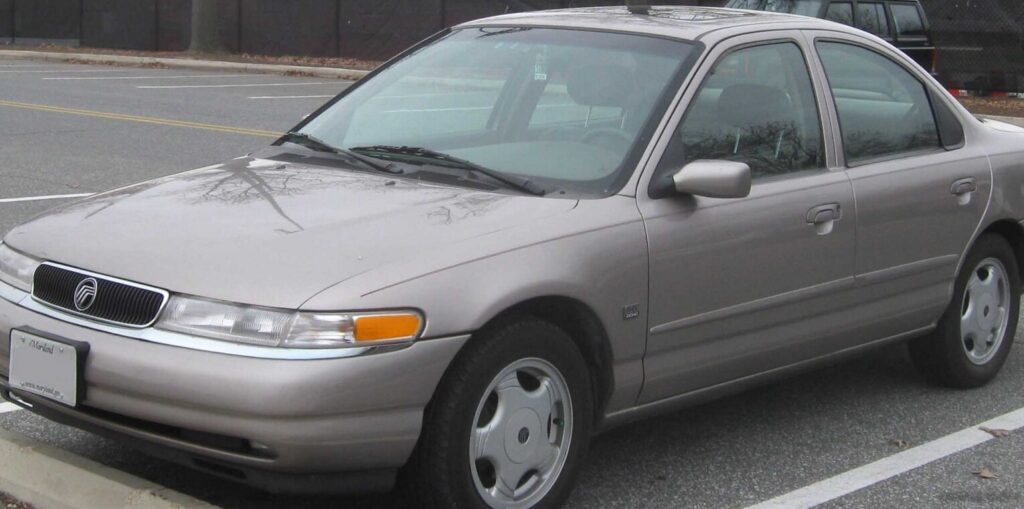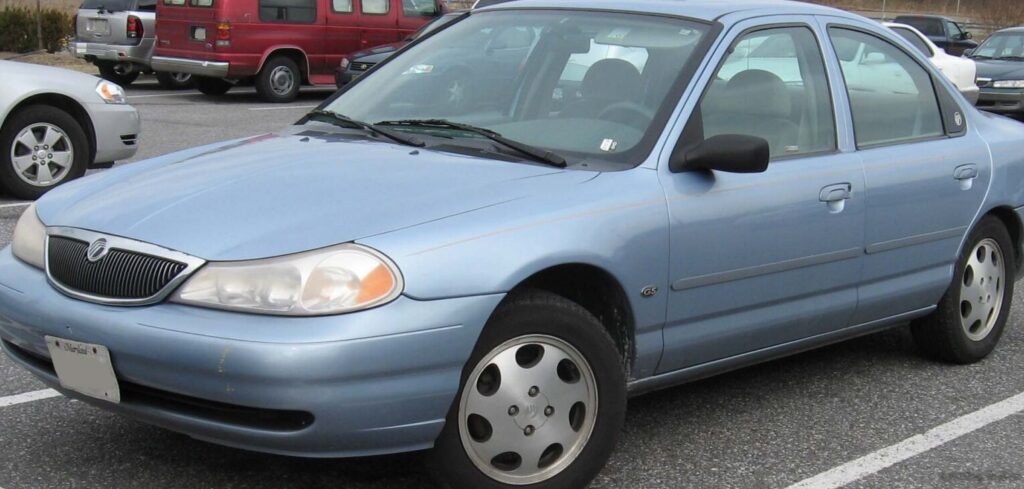
The Mercury Mystique, particularly the facelifted version produced from 1997 to 2000, represented Mercury’s entry into the mid-size sedan market. Positioned as a more upscale alternative to the Ford Taurus, the Mystique aimed to attract buyers seeking a blend of comfort, style, and value. The 2.5L V6 variant, producing 170 horsepower, was a significant offering within the Mystique lineup, serving as a step up from the base 2.0L four-cylinder engine and offering a more refined driving experience. It was built on the Ford CD270 platform, shared with the Ford Taurus and Windstar, and represented a substantial redesign from the original Mystique introduced in 1996.
Technical Specifications
| Brand | Mercury |
| Model | Mystique |
| Generation | Mystique (facelift 1997) |
| Type (Engine) | 2.5 V6 (170 Hp) |
| Start of production | 1997 |
| End of production | 2000 |
| Powertrain Architecture | Internal Combustion engine |
| Body type | Sedan |
| Seats | 5 |
| Doors | 4 |
| Fuel consumption (urban) | 11.8-12.4 l/100 km (19.9 – 20 US mpg) |
| Fuel consumption (extra urban) | 8.1-8.4 l/100 km (29 – 28 US mpg) |
| Fuel consumption (combined) | 10.2-10.7 l/100 km (23.1 – 22 US mpg) |
| Fuel Type | Petrol (Gasoline) |
| Power | 170 Hp @ 6250 rpm |
| Power per litre | 66.8 Hp/l |
| Torque | 224 Nm @ 4250 rpm (165.21 lb.-ft. @ 4250 rpm) |
| Maximum engine speed | 6925 rpm |
| Engine layout | Front, Transverse |
| Engine Model/Code | Duratec |
| Engine displacement | 2544 cm3 (155.24 cu. in.) |
| Number of cylinders | 6 |
| Engine configuration | V-engine |
| Compression ratio | 9.7:1 |
| Number of valves per cylinder | 4 |
| Fuel injection system | Multi-port manifold injection |
| Engine aspiration | Naturally aspirated engine |
| Valvetrain | DOHC |
| Engine oil capacity | 5.5 l (5.81 US qt | 4.84 UK qt) |
| Coolant capacity | 9.5 l (10.04 US qt | 8.36 UK qt) |
| Trunk (boot) space | 394 l (13.91 cu. ft.) |
| Fuel tank capacity | 55 l (14.53 US gal | 12.1 UK gal) |
| Length | 4694 mm (184.8 in.) |
| Width | 1755 mm (69.09 in.) |
| Height | 1384 mm (54.49 in.) |
| Wheelbase | 2704 mm (106.46 in.) |
| Front track | 1504 mm (59.21 in.) |
| Rear track | 1486 mm (58.5 in.) |
| Drivetrain Architecture | Front wheel drive |
| Number of gears | 5 |
| Type of gearbox | Manual transmission |
| Front suspension | Independent, McPherson with coil spring and anti-roll bar |
| Rear suspension | Independent multi-link spring suspension with stabilizer |
| Front brakes | Disc, 260 mm |
| Rear brakes | Disc, 252 mm |
| Assisting systems | ABS (Anti-lock braking system) |
| Steering type | Steering rack and pinion |
| Power steering | Hydraulic |
| Tires size | 205/60 R15 |
| Wheel rims size | 6J x 15 |
Powertrain & Engine Architecture
The heart of the 1997-2000 Mercury Mystique 2.5 V6 was the Ford Duratec 2.5-liter V6 engine. This engine, part of Ford’s modular engine family, featured a 60-degree V-angle and a double overhead camshaft (DOHC) design with four valves per cylinder. The Duratec engine utilized a multi-port fuel injection system, delivering fuel directly into each intake port for improved combustion efficiency. The engine’s block was constructed from cast iron, while the cylinder heads were made of aluminum, contributing to a relatively lightweight design. The 5-speed manual transmission paired with this engine provided a balance between fuel efficiency and performance. The transmission’s gear ratios were tuned to maximize the engine’s torque output, providing adequate acceleration for everyday driving.
Driving Characteristics
The 2.5L V6-equipped Mystique offered a noticeable improvement in performance compared to the base four-cylinder models. While not a sports sedan, the 170 horsepower and 165 lb-ft of torque provided sufficient power for confident highway merging and passing maneuvers. The manual transmission allowed for greater driver control, although the shift quality wasn’t particularly sporty. The Mystique’s suspension, tuned for comfort, provided a smooth ride, but handling was somewhat less precise than some of its competitors. The front-wheel-drive configuration contributed to a slight tendency towards understeer during aggressive cornering.
Equipment & Trim Levels
The 1997-2000 Mystique 2.5 V6 typically came standard with features such as air conditioning, power windows and locks, and an AM/FM stereo. Higher trim levels, such as the GSR, added features like alloy wheels, a premium sound system, and upgraded interior trim. Optional extras included a power sunroof, leather upholstery, and a CD player. The interior design was generally functional and comfortable, with a focus on ergonomics. The dashboard layout was straightforward, with easy-to-read gauges and well-placed controls.
Chassis & Braking
The Mystique’s chassis featured an independent front suspension with McPherson struts and a multi-link independent rear suspension. This setup provided a comfortable ride and reasonable handling characteristics. The braking system consisted of disc brakes on all four wheels, providing adequate stopping power for most driving situations. Anti-lock braking system (ABS) was standard, enhancing safety by preventing wheel lockup during hard braking. The steering system utilized a rack-and-pinion design with hydraulic power assist, offering responsive and precise steering feel.
Market Reception & Comparison
The Mercury Mystique 2.5 V6 was generally well-received by automotive critics as a comfortable and practical mid-size sedan. However, it wasn’t considered a standout performer in its class. Compared to the base four-cylinder models, the V6 offered a significant improvement in performance, but it came at a higher price. Fuel economy was comparable to other V6-powered sedans of the time. Reliability was generally good, although some owners reported minor issues with the engine’s cooling system. Compared to the Ford Taurus, the Mystique offered a slightly more upscale interior and a more refined driving experience.
Legacy
The Mercury Mystique, and specifically the 2.5L V6 variant, has become a relatively affordable and reliable used car option. The Duratec V6 engine is known for its durability and relatively low maintenance costs. While not a collector’s item, well-maintained examples of the Mystique 2.5 V6 can still provide years of dependable transportation. Parts availability is generally good, as many components are shared with other Ford and Mercury models. The Mystique represents a transitional period for Mercury, as the brand sought to establish a distinct identity separate from Ford.