
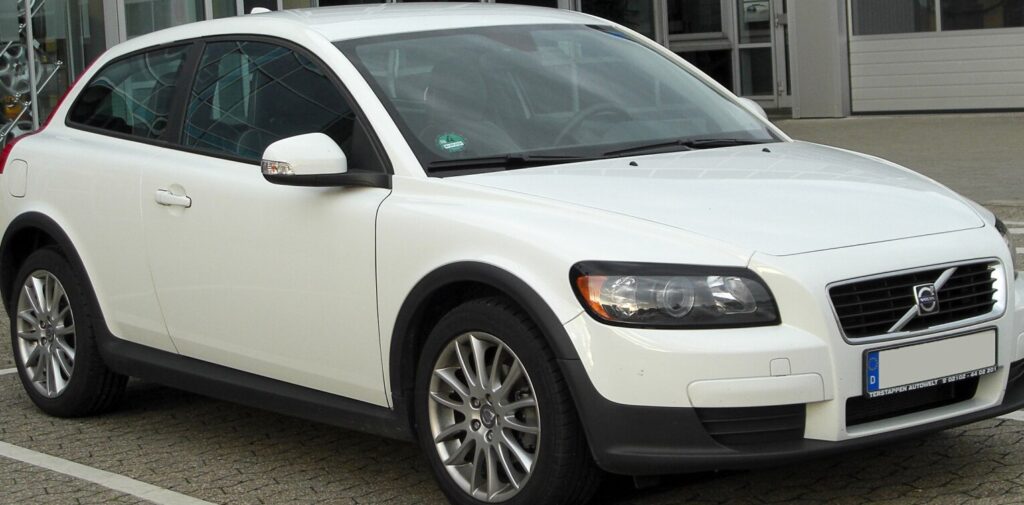
The Volvo C30 1.6 D, produced between 2006 and 2010, represented Volvo’s entry into the premium compact coupe market. Positioned as a stylish and relatively economical option within the broader C30 range, this diesel-powered variant aimed to attract buyers seeking a blend of Scandinavian design, practicality, and fuel efficiency. It was built on Volvo’s P1 platform, shared with the first-generation Ford Focus and Mazda 3, but distinguished itself through unique styling and a more upscale interior. The 1.6 D model served as the base engine option in many European markets, offering a lower price point compared to the more powerful gasoline variants.
Technical Specifications
| Brand | Volvo |
| Model | C30 |
| Generation | C30 |
| Type (Engine) | 1.6 D (109 Hp) |
| Start of production | 2006 |
| End of production | 2010 |
| Powertrain Architecture | Internal Combustion engine |
| Body type | Coupe |
| Seats | 4 |
| Doors | 3 |
| Fuel consumption (urban) | 5.7 l/100 km (41.3 US mpg, 49.6 UK mpg, 17.5 km/l) |
| Fuel consumption (extra urban) | 3.8 l/100 km (61.9 US mpg, 74.3 UK mpg, 26.3 km/l) |
| Fuel consumption (combined) | 4.9 l/100 km (48 US mpg, 57.6 UK mpg, 20.4 km/l) |
| CO2 emissions | 129 g/km |
| Fuel Type | Diesel |
| Acceleration 0 – 100 km/h | 11.3 sec |
| Acceleration 0 – 62 mph | 11.3 sec |
| Acceleration 0 – 60 mph | 10.7 sec |
| Maximum speed | 190 km/h (118.06 mph) |
| Weight-to-power ratio | 12.6 kg/Hp, 79.4 Hp/tonne |
| Weight-to-torque ratio | 5.7 kg/Nm, 174.8 Nm/tonne |
| Power | 109 Hp @ 4000 rpm |
| Power per litre | 69.9 Hp/l |
| Torque | 240 Nm @ 1750 rpm (177.01 lb.-ft. @ 1750 rpm) |
| Engine layout | Front, Transverse |
| Engine Model/Code | D4164T |
| Engine displacement | 1560 cm3 (95.2 cu. in.) |
| Number of cylinders | 4 |
| Engine configuration | Inline |
| Cylinder Bore | 75 mm (2.95 in.) |
| Piston Stroke | 88.3 mm (3.48 in.) |
| Compression ratio | 18.3:1 |
| Number of valves per cylinder | 4 |
| Fuel injection system | Diesel Commonrail |
| Engine aspiration | Turbocharger, Intercooler |
| Engine oil capacity | 3.7 l (3.91 US qt | 3.26 UK qt) |
| Coolant | 7.2 l (7.61 US qt | 6.34 UK qt) |
| Kerb Weight | 1373 kg (3026.95 lbs.) |
| Max. weight | 1780 kg (3924.23 lbs.) |
| Max load | 407 kg (897.28 lbs.) |
| Trunk (boot) space – minimum | 233 l (8.23 cu. ft.) |
| Fuel tank capacity | 52 l (13.74 US gal | 11.44 UK gal) |
| Length | 4252 mm (167.4 in.) |
| Width | 1782 mm (70.16 in.) |
| Height | 1447 mm (56.97 in.) |
| Wheelbase | 2640 mm (103.94 in.) |
| Front track | 1548 mm (60.94 in.) |
| Rear (Back) track | 1544 mm (60.79 in.) |
| Minimum turning circle | 11.1 m (36.42 ft.) |
| Drivetrain Architecture | The Internal combustion engine (ICE) drives the front wheels of the vehicle. |
| Drive wheel | Front wheel drive |
| Number of gears | 5 gears, manual transmission |
| Front suspension | Independent type McPherson |
| Rear suspension | Independent multi-link suspension |
| Front brakes | Ventilated discs |
| Rear brakes | Disc |
| Assisting systems | ABS (Anti-lock braking system) |
| Steering type | Steering rack and pinion |
| Power steering | Hydraulic Steering |
Powertrain & Engine Architecture
The C30 1.6 D was powered by Volvo’s D4164T engine, a 1.6-liter inline-four cylinder diesel. This engine was part of Volvo’s global engine family developed in collaboration with Peugeot-Citroën. It featured a common-rail direct fuel injection system, delivering fuel at extremely high pressure for improved combustion efficiency and reduced emissions. A turbocharger with an intercooler was employed to boost power output, providing 109 horsepower at 4000 rpm and a respectable 240 Nm (177 lb-ft) of torque at just 1750 rpm. The engine utilized four valves per cylinder and a compression ratio of 18.3:1. The engine was transversely mounted in the front of the vehicle. The transmission was a five-speed manual gearbox, chosen for its efficiency and cost-effectiveness in this entry-level trim.
Driving Characteristics
The 1.6 D C30 offered a comfortable, if not particularly sporty, driving experience. Acceleration was adequate for everyday driving, with a 0-60 mph time of around 10.7 seconds. The engine’s strong low-end torque made it feel responsive in city traffic and provided sufficient power for overtaking maneuvers. However, compared to the more powerful 2.0-liter gasoline versions of the C30, the 1.6 D felt noticeably slower, especially at higher speeds. The five-speed manual transmission was well-matched to the engine’s characteristics, with gear ratios optimized for fuel economy. The gear ratios were relatively long, prioritizing efficiency over outright performance. The C30’s suspension provided a good balance between comfort and handling, absorbing bumps and imperfections in the road while maintaining a stable feel in corners.
Equipment & Trim Levels
The C30 1.6 D typically came with a reasonable level of standard equipment, reflecting its position as an entry-level model. Standard features generally included air conditioning, power windows, power mirrors, a CD stereo system, and ABS brakes. Interior upholstery was typically cloth, and the dashboard featured a simple, functional design. Optional extras included alloy wheels, a sunroof, leather upholstery, and a premium audio system. Safety features were a Volvo hallmark, and even the base 1.6 D model included features such as side airbags and whiplash protection system (WHIPS) in the front seats.
Chassis & Braking
The C30 1.6 D utilized an independent McPherson strut suspension at the front and an independent multi-link suspension at the rear. This setup provided a comfortable ride and good handling characteristics. Brakes consisted of ventilated discs at the front and solid discs at the rear. ABS (Anti-lock Braking System) was standard, enhancing braking performance and stability. The steering was a rack and pinion system with hydraulic power assistance, providing precise and responsive steering feel. The C30’s relatively low weight, at around 1373 kg (3027 lbs), helped to contribute to its nimble handling.
Market Reception & Comparison
The Volvo C30 1.6 D was generally well-received by critics as a stylish and economical coupe. Its fuel economy, averaging around 48 US mpg, was a major selling point. However, some reviewers criticized its relatively slow acceleration and lack of outright performance compared to other C30 variants, such as the 2.5-liter five-cylinder models. Compared to the gasoline-powered C30s, the 1.6 D offered significantly better fuel economy but at the expense of performance. The 1.6 D was often seen as a practical choice for urban drivers and those prioritizing fuel efficiency over sporty driving dynamics.
Legacy
The Volvo C30 1.6 D has proven to be a relatively reliable vehicle, with the D4164T engine generally considered durable. Common issues are typically related to diesel particulate filter (DPF) clogging, particularly on vehicles used primarily for short trips. The C30’s unique styling and Scandinavian design have ensured its continued appeal on the used car market. While not as sought-after as some of the higher-performance C30 variants, the 1.6 D remains a viable option for buyers seeking an affordable and fuel-efficient coupe with a touch of Volvo luxury.
