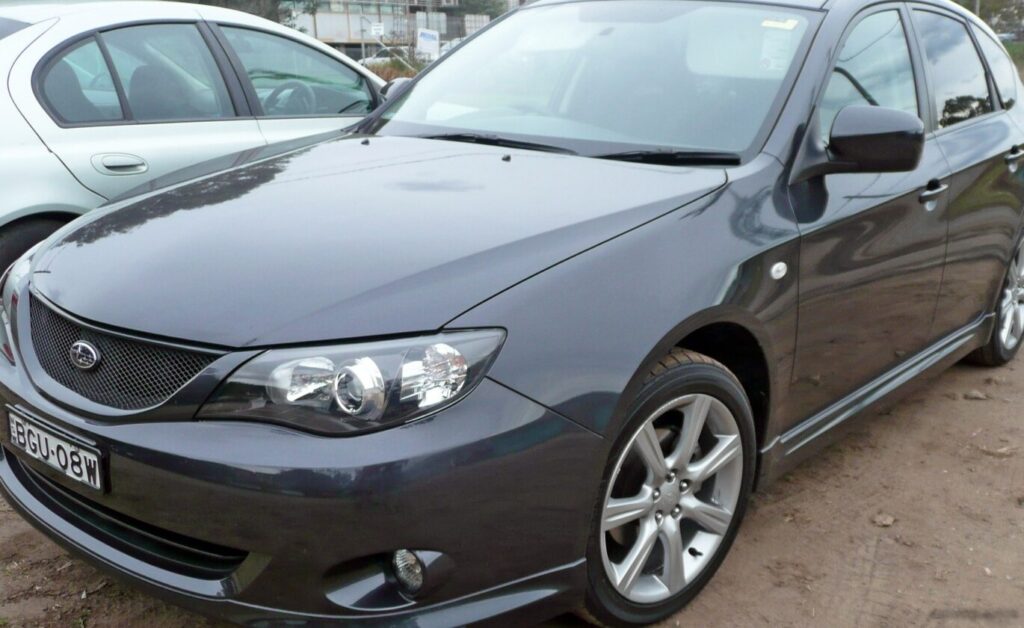
The Subaru Impreza III Hatchback WRX 2.5, produced between 2007 and 2011, represents a significant iteration of Subaru’s rally-bred compact car. Positioned as the performance variant within the third-generation Impreza (GE/GH/GR/GP) lineup, the WRX 2.5 aimed to deliver accessible all-wheel-drive performance. It served as a stepping stone between the naturally aspirated Impreza models and the more potent STI variant, appealing to enthusiasts seeking a blend of practicality and spirited driving. This particular model was primarily sold in markets like North America, Europe, and Australia, where the Impreza held a strong reputation for reliability and all-weather capability.
Technical Specifications
| Brand | Subaru |
| Model | Impreza |
| Generation | Impreza III Hatchback |
| Type (Engine) | WRX 2.5 (265 Hp) AWD |
| Start of production | 2007 |
| End of production | 2011 |
| Powertrain Architecture | Internal Combustion engine |
| Body type | Hatchback |
| Seats | 5 |
| Doors | 5 |
| Fuel consumption (urban) | 14.4 l/100 km (16.3 US mpg, 19.6 UK mpg, 6.9 km/l) |
| Fuel consumption (extra urban) | 8.1 l/100 km (29 US mpg, 34.9 UK mpg, 12.3 km/l) |
| Fuel consumption (combined) | 10.4 l/100 km (22.6 US mpg, 27.2 UK mpg, 9.6 km/l) |
| Fuel Type | Petrol (Gasoline) |
| Acceleration 0 – 100 km/h | 6 sec |
| Acceleration 0 – 62 mph | 6 sec |
| Acceleration 0 – 60 mph | 5.7 sec |
| Maximum speed | 209 km/h (129.87 mph) |
| Emission standard | Euro 4 |
| Weight-to-power ratio | 5.3 kg/Hp, 187.9 Hp/tonne |
| Weight-to-torque ratio | 4.1 kg/Nm, 243.3 Nm/tonne |
| Power | 265 Hp @ 6000 rpm |
| Power per litre | 107.9 Hp/l |
| Torque | 343 Nm @ 4000 rpm (252.98 lb.-ft. @ 4000 rpm) |
| Engine layout | Front, Longitudinal |
| Engine Model/Code | EJ255 |
| Engine displacement | 2457 cm3 (149.94 cu. in.) |
| Number of cylinders | 4 |
| Engine configuration | Boxer |
| Cylinder Bore | 99.5 mm (3.92 in.) |
| Piston Stroke | 79 mm (3.11 in.) |
| Number of valves per cylinder | 4 |
| Fuel injection system | Multi-port manifold injection |
| Engine aspiration | Turbocharger, Intercooler |
| Valvetrain | DOHC |
| Engine oil capacity | 4.2 l (4.44 US qt | 3.7 UK qt) |
| Coolant | 7.5 l (7.93 US qt | 6.6 UK qt) |
| Kerb Weight | 1410 kg (3108.52 lbs.) |
| Trunk (boot) space – maximum | 538 l (19 cu. ft.) |
| Fuel tank capacity | 60 l (15.85 US gal | 13.2 UK gal) |
| Length | 4415 mm (173.82 in.) |
| Width | 1740 mm (68.5 in.) |
| Height | 1475 mm (58.07 in.) |
| Wheelbase | 2620 mm (103.15 in.) |
| Front track | 1495 mm (58.86 in.) |
| Rear (Back) track | 1500 mm (59.06 in.) |
| Minimum turning circle | 10.6 m (34.78 ft.) |
| Drive wheel | All wheel drive (4×4) |
| Number of gears and type of gearbox | 5 gears, manual transmission |
| Rear suspension | Several levers and rods |
| Front brakes | Ventilated discs |
| Rear brakes | Disc |
| Assisting systems | ABS (Anti-lock braking system) |
| Steering type | Steering rack and pinion |
| Tires size | 225/45 R17 |
| Wheel rims size | 17 |
Powertrain & Engine Architecture
The heart of the Impreza WRX 2.5 is the EJ255 2.5-liter turbocharged boxer-four engine. This engine, a hallmark of Subaru’s engineering, features a horizontally opposed configuration, which contributes to a lower center of gravity and improved balance. The EJ255 utilizes multi-port fuel injection and an intercooled turbocharger to produce 265 horsepower at 6,000 rpm and 253 lb-ft of torque at 4,000 rpm. The engine’s robust construction, including forged pistons and strengthened connecting rods, allowed it to withstand the stresses of forced induction. The transmission is a five-speed manual, chosen for its direct feel and driver engagement. The all-wheel-drive system, a Subaru signature, employs a variable torque distribution system, actively managing power delivery between the front and rear axles for optimal traction.
Driving Characteristics
The WRX 2.5 offered a noticeable step up in performance compared to the base Impreza models. Acceleration from 0 to 60 mph was achieved in around 5.7 seconds, making it a genuinely quick hatchback. The turbocharger provides a surge of power in the mid-range, offering strong acceleration for overtaking and merging. While not as sharp or refined as the STI, the WRX 2.5 provided a rewarding driving experience, particularly on winding roads. The all-wheel-drive system instilled confidence in various weather conditions, and the manual transmission allowed for precise control. Compared to the STI, the WRX 2.5’s power delivery was more linear and less peaky, making it more accessible for everyday driving. The gear ratios were tuned for a balance between acceleration and fuel efficiency, though fuel economy remained a weak point.
Equipment & Trim Levels
The WRX 2.5 typically came equipped with a range of features designed to enhance both performance and comfort. Standard equipment included sport seats, a leather-wrapped steering wheel, air conditioning, and a basic audio system. Alloy wheels were also standard. Optional extras included a sunroof, upgraded audio systems, and various cosmetic enhancements. The interior, while functional, was not particularly luxurious, reflecting the car’s performance-oriented focus. The dashboard layout was straightforward and driver-centric, with clearly marked gauges and controls.
Chassis & Braking
The Impreza WRX 2.5 featured a MacPherson strut front suspension and a multi-link rear suspension, providing a good balance between ride comfort and handling precision. Stabilizer bars were fitted front and rear to reduce body roll during cornering. The braking system consisted of ventilated discs at the front and solid discs at the rear, providing adequate stopping power for most driving situations. ABS (Anti-lock Braking System) was standard, enhancing safety in emergency braking scenarios. The chassis was reinforced compared to the standard Impreza to handle the increased power and stresses of the WRX model.
Market Reception & Comparison
The Impreza WRX 2.5 was generally well-received by automotive critics, who praised its performance, all-wheel-drive system, and practicality. However, some criticized its fuel economy and relatively basic interior. Compared to the STI, the WRX 2.5 offered a more affordable entry point into the world of Subaru performance. It also appealed to buyers who preferred a less aggressive driving experience. Against competitors like the Mitsubishi Lancer Evolution, the Impreza WRX 2.5 offered a unique combination of all-wheel-drive capability and everyday usability. Fuel economy figures of around 22.6 US mpg combined were typical, which was considered relatively poor for a compact car.
Legacy
The EJ255 engine, found in the Impreza WRX 2.5, has proven to be a relatively reliable powertrain when properly maintained. Common issues include oil consumption and potential turbocharger failure, but these can often be mitigated with regular servicing and preventative maintenance. Today, the Impreza WRX 2.5 remains a popular choice among enthusiasts seeking an affordable and capable all-wheel-drive performance car. Its robust construction and readily available parts make it a relatively easy car to maintain and modify. The model has secured a place in automotive history as a capable and fun-to-drive hatchback that embodies Subaru’s rally heritage.