
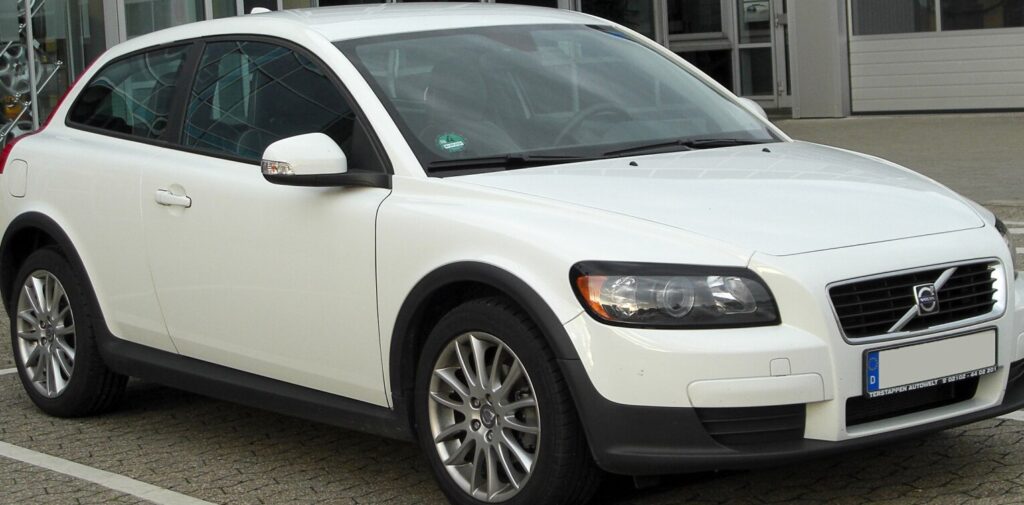
Technical Specifications
| Brand | Volvo |
| Model | C30 |
| Generation | C30 |
| Type (Engine) | 1.8F 16V (125 Hp) Ethanol |
| Start of production | 2006 |
| End of production | 2009 |
| Powertrain Architecture | Internal Combustion engine |
| Body type | Coupe |
| Seats | 4 |
| Doors | 3 |
| Fuel consumption (urban) | 13.1 l/100 km (18 US mpg, 21.6 UK mpg, 7.6 km/l) |
| Fuel consumption (extra urban) | 5.8 l/100 km (40.6 US mpg, 48.7 UK mpg, 17.2 km/l) |
| Fuel consumption (combined) | 7.3 l/100 km (32.2 US mpg, 38.7 UK mpg, 13.7 km/l) |
| CO2 emissions | 174 g/km |
| Fuel Type | Petrol / Ethanol – E85 |
| Acceleration 0 – 100 km/h | 10.8 sec |
| Acceleration 0 – 62 mph | 10.8 sec |
| Acceleration 0 – 60 mph | 10.3 sec |
| Maximum speed | 200 km/h (124.27 mph) |
| Weight-to-power ratio | 10.6 kg/Hp, 94.2 Hp/tonne |
| Weight-to-torque ratio | 8 kg/Nm, 124.3 Nm/tonne |
| Power | 125 Hp @ 6000 rpm |
| Power per litre | 69.5 Hp/l |
| Torque | 165 Nm @ 4000 rpm (121.7 lb.-ft. @ 4000 rpm) |
| Engine layout | Front, Transverse |
| Engine Model/Code | B4184S8 |
| Engine displacement | 1798 cm3 (109.72 cu. in.) |
| Number of cylinders | 4 |
| Engine configuration | Inline |
| Cylinder Bore | 83 mm (3.27 in.) |
| Piston Stroke | 83.1 mm (3.27 in.) |
| Compression ratio | 10.8:1 |
| Number of valves per cylinder | 4 |
| Fuel injection system | Multi-port manifold injection |
| Engine aspiration | Naturally aspirated engine |
| Valvetrain | DOHC |
| Engine oil capacity | 4.3 l (4.54 US qt | 3.78 UK qt) |
| Coolant | 7.5 l (7.93 US qt | 6.6 UK qt) |
| Kerb Weight | 1327 kg (2925.53 lbs.) |
| Max. weight | 1750 kg (3858.09 lbs.) |
| Max load | 423 kg (932.56 lbs.) |
| Trunk (boot) space – minimum | 233 l (8.23 cu. ft.) |
| Fuel tank capacity | 55 l (14.53 US gal | 12.1 UK gal) |
| Permitted trailer load with brakes (12%) | 1300 kg (2866.01 lbs.) |
| Permitted trailer load without brakes | 700 kg (1543.24 lbs.) |
| Permitted towbar download | 75 kg (165.35 lbs.) |
| Length | 4252 mm (167.4 in.) |
| Width | 1782 mm (70.16 in.) |
| Width including mirrors | 2039 mm (80.28 in.) |
| Height | 1447 mm (56.97 in.) |
| Wheelbase | 2640 mm (103.94 in.) |
| Front track | 1535 mm (60.43 in.) |
| Rear (Back) track | 1531 mm (60.28 in.) |
| Minimum turning circle | 11.1 m (36.42 ft.) |
| Drivetrain Architecture | ICE, Front wheel drive |
| Drive wheel | Front wheel drive |
| Number of gears and type of gearbox | 5 gears, manual transmission |
| Front suspension | Spring Strut |
| Rear suspension | Transverse stabilizer |
| Front brakes | Ventilated discs |
| Rear brakes | Ventilated discs |
| Assisting systems | ABS (Anti-lock braking system) |
| Steering type | Steering rack and pinion |
| Tires size | 195/65 R15 |
| Wheel rims size | 15 |
The Volvo C30 1.8F, produced between 2006 and 2009, represents a distinctive offering within the first generation (2006-2013) of Volvo’s compact coupe. Specifically designed to appeal to a younger demographic, the C30 aimed to introduce a sense of style and sportiness into Volvo’s traditionally conservative lineup. This particular variant, powered by a 1.8-liter naturally aspirated engine producing 125 horsepower and capable of running on ethanol (E85) fuel, served as the entry point into the C30 range, prioritizing fuel efficiency and affordability over outright performance. It was positioned below the more powerful 2.4i and T5 turbocharged models, offering a different driving experience and targeting a cost-conscious buyer.
Powertrain & Engine Architecture
The heart of the C30 1.8F is Volvo’s B4184S8 engine, a 1.8-liter inline-four cylinder powerplant. This engine, part of Volvo’s modular engine family, utilizes a cast iron block with an aluminum cylinder head. It features a double overhead camshaft (DOHC) valvetrain with four valves per cylinder, contributing to improved breathing and efficiency. Fuel delivery is managed by a multi-port fuel injection system. The engine’s ability to run on E85 ethanol fuel – a blend of 85% ethanol and 15% gasoline – was a key selling point, appealing to environmentally conscious buyers and those seeking to reduce their reliance on fossil fuels. The 125 horsepower and 165 Nm (121.7 lb-ft) of torque are delivered to the front wheels through a 5-speed manual transmission. While an automatic transmission was available in some C30 models, the 1.8F was primarily offered with the manual, emphasizing a more engaging driving experience, albeit one focused on efficiency rather than outright speed.
Driving Characteristics
The C30 1.8F, with its 125 hp and relatively lightweight body (1327 kg / 2925.53 lbs), offered adequate, though not exhilarating, performance. Acceleration from 0-60 mph took around 10.3 seconds, and top speed was limited to 200 km/h (124 mph). The 5-speed manual transmission provided a decent spread of gears, but the engine lacked the low-end torque of larger displacement or turbocharged engines. Drivers often needed to downshift to maintain momentum, particularly when overtaking or climbing hills. Compared to the more powerful C30 T5, the 1.8F felt noticeably slower, but it offered a more forgiving and fuel-efficient driving experience. The gear ratios were tuned for economy, prioritizing fuel consumption over rapid acceleration. The steering was precise, and the suspension provided a comfortable ride, making it a suitable daily driver.
Equipment & Trim Levels
The C30 1.8F typically came with a reasonable level of standard equipment. This included power windows and locks, air conditioning, a basic audio system, and ABS brakes. Interior upholstery was typically cloth, with a relatively minimalist Scandinavian design. Optional extras included alloy wheels, a sunroof, upgraded audio systems, leather upholstery, and parking sensors. Trim levels were relatively simple, with the 1.8F serving as the base model. Higher trim levels, available with the more powerful engines, added features like automatic climate control, heated seats, and more sophisticated infotainment systems.
Chassis & Braking
The C30’s chassis was designed to provide a balance between comfort and handling. It utilized independent front suspension with MacPherson struts and a multi-link rear suspension. Front and rear brakes were ventilated discs, providing adequate stopping power for the vehicle’s weight and performance. ABS (Anti-lock Braking System) was standard, enhancing safety. The relatively narrow tires (195/65 R15) contributed to fuel efficiency but limited grip during aggressive cornering. A transverse stabilizer bar was included on both axles to reduce body roll.
Market Reception & Comparison
The Volvo C30 1.8F was generally well-received by critics as an affordable and stylish entry point into the Volvo brand. However, its performance was often criticized as being underwhelming, particularly compared to its turbocharged siblings. Fuel economy was a strong point, and the ability to run on E85 fuel was seen as a positive attribute. Compared to the C30 2.4i and T5, the 1.8F offered a lower purchase price and better fuel efficiency, but at the expense of performance and refinement. It competed with other compact coupes like the Audi A3 and the BMW 1 Series, but often offered a more affordable alternative.
Legacy
The Volvo C30 1.8F, while not the most powerful or fastest version of the C30, has proven to be a relatively reliable and durable vehicle. The B4184S8 engine is known for its longevity, and the simple mechanical design makes it relatively easy to maintain. On the used car market, the C30 1.8F represents a good value for buyers seeking a stylish and economical coupe. Its unique design and Scandinavian aesthetic continue to appeal to a niche audience, and its ability to run on E85 fuel remains a relevant feature in areas where ethanol is readily available. While not a performance icon, the C30 1.8F played an important role in broadening Volvo’s appeal and attracting a younger generation of buyers.
