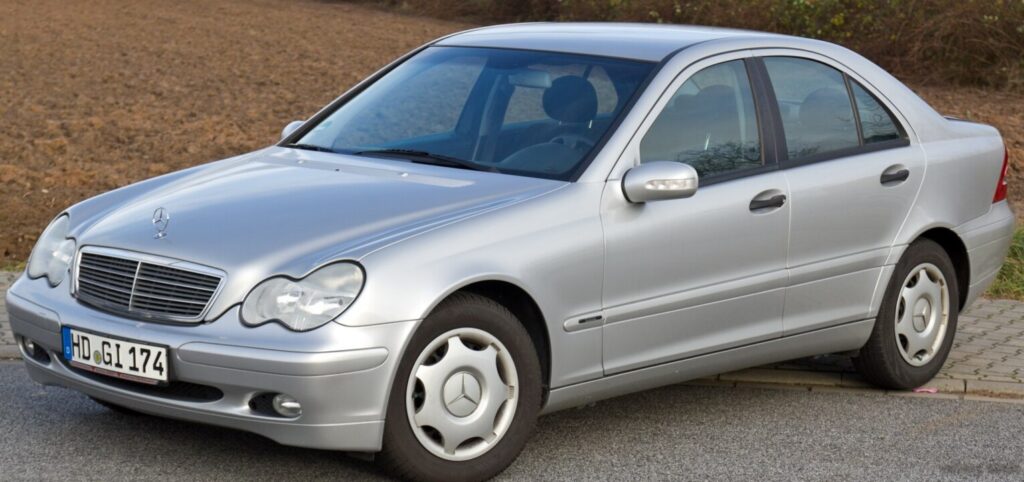
The Mercedes-Benz C 180 Kompressor, produced between May 2002 and March 2004, was a key variant within the W203 C-Class range. Positioned as an entry-level offering, it aimed to provide a balance of Mercedes-Benz luxury and performance at a more accessible price point. This model represented a significant update to the W203 platform, introduced in 2000, incorporating refinements in styling, technology, and engine options. The C 180 Kompressor specifically targeted buyers seeking a comfortable and refined sedan with reasonable fuel economy, making it a popular choice in European markets where smaller displacement engines were favored due to taxation and fuel costs.
Technical Specifications
| Brand | Mercedes-Benz |
| Model | C-class |
| Generation | C-class (W203) |
| Type (Engine) | C 180 Kompressor (143 Hp) |
| Start of production | May, 2002 |
| End of production | March, 2004 |
| Powertrain Architecture | Internal Combustion engine |
| Body type | Sedan |
| Seats | 5 |
| Doors | 4 |
| Fuel consumption (economy) – urban (NEDC) | 11.4 l/100 km (20.6 US mpg, 24.8 UK mpg, 8.8 km/l) |
| Fuel consumption (economy) – extra urban (NEDC) | 5.9 l/100 km (39.9 US mpg, 47.9 UK mpg, 16.9 km/l) |
| Fuel consumption (economy) – combined (NEDC) | 7.9 l/100 km (29.8 US mpg, 35.8 UK mpg, 12.7 km/l) |
| CO2 emissions (NEDC) | 190 g/km |
| Fuel Type | Petrol (Gasoline) |
| Acceleration 0 – 100 km/h | 9.7 sec |
| Acceleration 0 – 62 mph | 9.7 sec |
| Acceleration 0 – 60 mph | 9.2 sec |
| Maximum speed | 222 km/h (137.94 mph) |
| Weight-to-power ratio | 9.8 kg/Hp, 102.1 Hp/tonne |
| Weight-to-torque ratio | 6.4 kg/Nm, 157.1 Nm/tonne |
| Power | 143 Hp @ 5200 rpm |
| Power per litre | 79.6 Hp/l |
| Torque | 220 Nm @ 2500-4200 rpm (162.26 lb.-ft. @ 2500-4200 rpm) |
| Maximum engine speed | 5700 rpm |
| Engine layout | Front, Longitudinal |
| Engine Model/Code | M 271.946 |
| Engine displacement | 1796 cm3 (109.6 cu. in.) |
| Number of cylinders | 4 |
| Engine configuration | Inline |
| Cylinder Bore | 82 mm (3.23 in.) |
| Piston Stroke | 85 mm (3.35 in.) |
| Compression ratio | 10.2:1 |
| Number of valves per cylinder | 4 |
| Fuel injection system | Multi-port manifold injection |
| Engine aspiration | Supercharger, Intercooler |
| Valvetrain | DOHC |
| Engine oil capacity | 5.5 l (5.81 US qt | 4.84 UK qt) |
| Coolant | 8 l (8.45 US qt | 7.04 UK qt) |
| Kerb Weight | 1400 kg (3086.47 lbs.) |
| Max. weight | 1955 kg (4310.04 lbs.) |
| Max load | 555 kg (1223.57 lbs.) |
| Trunk (boot) space – minimum | 455 l (16.07 cu. ft.) |
| Fuel tank capacity | 62 l (16.38 US gal | 13.64 UK gal) |
| Max. roof load | 100 kg (220.46 lbs.) |
| Permitted trailer load with brakes (12%) | 1500 kg (3306.93 lbs.) |
| Permitted trailer load without brakes | 740 kg (1631.42 lbs.) |
| Length | 4526 mm (178.19 in.) |
| Width | 1728 mm (68.03 in.) |
| Width including mirrors | 1980 mm (77.95 in.) |
| Height | 1426 mm (56.14 in.) |
| Wheelbase | 2715 mm (106.89 in.) |
| Front track | 1505 mm (59.25 in.) |
| Rear (Back) track | 1476 mm (58.11 in.) |
| Front overhang | 755 mm (29.72 in.) |
| Rear overhang | 1056 mm (41.57 in.) |
| Drag coefficient (Cd) | 0.27 |
| Minimum turning circle (turning diameter) | 10.76 m (35.3 ft.) |
| Drivetrain Architecture | The Internal combustion engine (ICE) drives the rear wheels of the vehicle. |
| Drive wheel | Rear wheel drive |
| Number of gears and type of gearbox | 6 gears, manual transmission |
| Front suspension | Independent type McPherson, Transverse stabilizer |
| Rear suspension | Independent multi-link suspension, Transverse stabilizer |
| Front brakes | Ventilated discs, 288 mm |
| Rear brakes | Disc, 278 mm |
| Assisting systems | ABS (Anti-lock braking system) |
| Steering type | Steering rack and pinion |
| Power steering | Hydraulic Steering |
| Tires size | 195/65 R 15 91 V |
| Wheel rims size | 6 J x 15 H 2 |
Powertrain & Engine Architecture
The C 180 Kompressor was powered by the M271.946 engine, a 1.8-liter (1796 cc) inline-four cylinder gasoline engine. This engine was a significant departure from previous Mercedes-Benz four-cylinder designs, utilizing an aluminum block and head to reduce weight. The “Kompressor” designation indicates the presence of a mechanically driven supercharger, providing increased torque and responsiveness compared to naturally aspirated engines. The engine employed multi-port fuel injection and a double overhead camshaft (DOHC) valvetrain with four valves per cylinder. The supercharger, coupled with an intercooler, boosted output to 143 horsepower at 5200 rpm and 220 Nm (162 lb-ft) of torque between 2500 and 4200 rpm. The engine’s relatively high compression ratio of 10.2:1 contributed to its efficiency. The standard transmission was a 6-speed manual, although a 5-speed automatic transmission was also available, impacting performance and fuel economy.
Driving Characteristics
The C 180 Kompressor with the manual transmission offered a reasonably engaging driving experience. While not a sports car, the supercharger provided a noticeable boost in acceleration, making overtaking maneuvers relatively effortless. The 0-60 mph time of around 9.2 seconds was respectable for its class. The automatic transmission, while offering convenience, resulted in slightly slower acceleration and a less direct feel. Gear ratios were tuned for a balance of fuel efficiency and usability, with a focus on providing adequate power for everyday driving. The rear-wheel-drive configuration contributed to balanced handling, although it lacked the all-weather capability of all-wheel-drive variants. Compared to the C 200 Kompressor or the C 220 CDI, the C 180 offered less outright performance but provided a more economical option.
Equipment & Trim Levels
The C 180 Kompressor typically came standard with features such as air conditioning, power windows, central locking, and an audio system. Interior upholstery was generally cloth, although leather options were available. Dashboard trim was typically wood or aluminum, depending on the package selected. Optional extras included a sunroof, upgraded audio systems, automatic climate control, and parking sensors. The C 180 Kompressor was often seen as a base model, so many examples were equipped with relatively few options. However, it provided a solid foundation for customization.
Chassis & Braking
The W203 C-Class featured an independent suspension system at all four wheels. The front suspension utilized a McPherson strut design with a transverse stabilizer bar, while the rear suspension employed a multi-link setup, also with a stabilizer bar. This configuration provided a comfortable ride and good handling characteristics. Braking duties were handled by ventilated discs at the front and solid discs at the rear. Anti-lock Braking System (ABS) was standard. The chassis was designed to provide a balance of rigidity and weight reduction, contributing to the car’s overall handling and safety.
Market Reception & Comparison
The C 180 Kompressor was generally well-received by automotive critics as a sensible and refined entry-level luxury sedan. It was praised for its comfortable ride, fuel efficiency, and the responsive nature of the supercharged engine. However, some critics noted that the engine lacked the outright power of larger displacement alternatives. Compared to the C 200 Kompressor, the C 180 offered lower running costs but sacrificed some performance. The C 220 CDI, a diesel variant, provided even better fuel economy but with a different driving experience. The C 180 Kompressor’s fuel economy figures of around 29.8 US mpg combined were competitive for its class.
Legacy
The M271 engine family, including the 1.8-liter variant found in the C 180 Kompressor, proved to be relatively reliable, although regular maintenance is crucial. Common issues include oil leaks from the valve cover gasket and occasional problems with the supercharger clutch. Today, the W203 C 180 Kompressor represents an affordable entry point into Mercedes-Benz ownership. Well-maintained examples are still relatively common on the used car market, offering a comfortable and reliable driving experience for those seeking a classic Mercedes-Benz sedan. Its relatively simple mechanicals make it a potentially attractive option for DIY mechanics.