
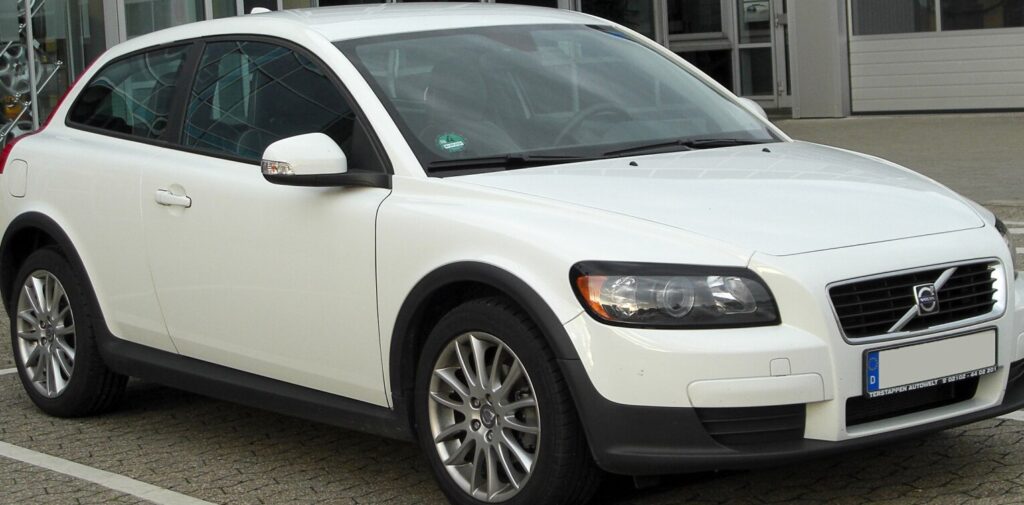
The Volvo C30 2.0i 16V, produced between 2006 and 2010, represents a unique offering in Volvo’s lineup. Positioned as a premium compact coupe, the C30 aimed to attract a younger demographic with its sporty styling and focus on driver engagement. Built on the Volvo S40/V50 platform (designated as the 197 platform), the C30 distinguished itself with a distinctive, sharply-angled rear end and a 2+2 seating configuration. The 2.0i 16V variant, producing 145 horsepower, served as a core model within the C30 range, offering a balance between performance and fuel efficiency. It was often seen as a step up from the base 1.8L engine, providing a more spirited driving experience without the higher price tag of the T5 turbocharged model.
Technical Specifications
| Brand | Volvo |
| Model | C30 |
| Generation | C30 |
| Type (Engine) | 2.0 i 16V (145 Hp) |
| Start of production | 2006 |
| End of production | 2010 |
| Powertrain Architecture | Internal Combustion engine |
| Body type | Coupe |
| Seats | 4 |
| Doors | 3 |
| Fuel consumption (urban) | 10.2 l/100 km (23.1 US mpg) |
| Fuel consumption (extra urban) | 5.8 l/100 km (40.6 US mpg) |
| Fuel consumption (combined) | 7.4 l/100 km (31.8 US mpg) |
| CO2 emissions | 174 g/km |
| Fuel Type | Petrol (Gasoline) |
| Acceleration 0 – 100 km/h | 9.4 sec |
| Acceleration 0 – 62 mph | 9.4 sec |
| Acceleration 0 – 60 mph | 8.9 sec |
| Maximum speed | 210 km/h (130.49 mph) |
| Emission standard | Euro 4 |
| Weight-to-power ratio | 9.2 kg/Hp |
| Weight-to-torque ratio | 7.2 kg/Nm |
| Power | 145 Hp @ 6000 rpm |
| Torque | 185 Nm @ 4500 rpm (136.45 lb.-ft. @ 4500 rpm) |
| Engine layout | Front, Transverse |
| Engine Model/Code | B4204S3 |
| Engine displacement | 1999 cm3 (121.99 cu. in.) |
| Number of cylinders | 4 |
| Engine configuration | Inline |
| Cylinder Bore | 87.5 mm (3.44 in.) |
| Piston Stroke | 83.1 mm (3.27 in.) |
| Compression ratio | 10.8:1 |
| Number of valves per cylinder | 4 |
| Fuel injection system | Multi-port manifold injection |
| Engine aspiration | Naturally aspirated engine |
| Valvetrain | DOHC |
| Engine oil capacity | 4.3 l (4.54 US qt | 3.78 UK qt) |
| Coolant | 7.5 l (7.93 US qt | 6.6 UK qt) |
| Kerb Weight | 1327 kg (2925.53 lbs.) |
| Max. weight | 1750 kg (3858.09 lbs.) |
| Max load | 423 kg (932.56 lbs.) |
| Trunk (boot) space – minimum | 233 l (8.23 cu. ft.) |
| Fuel tank capacity | 55 l (14.53 US gal | 12.1 UK gal) |
| Length | 4252 mm (167.4 in.) |
| Width | 1782 mm (70.16 in.) |
| Height | 1447 mm (56.97 in.) |
| Wheelbase | 2640 mm (103.94 in.) |
| Front track | 1548 mm (60.94 in.) |
| Rear (Back) track | 1544 mm (60.79 in.) |
| Minimum turning circle | 11.1 m (36.42 ft.) |
| Drivetrain Architecture | ICE, Front wheel drive |
| Number of gears | 5 |
| Gearbox type | Manual transmission |
| Front suspension | Spring Strut |
| Rear suspension | Transverse stabilizer |
| Front brakes | Ventilated discs |
| Rear brakes | Ventilated discs |
| Assisting systems | ABS |
| Steering type | Steering rack and pinion |
Powertrain & Engine Architecture
The C30 2.0i 16V is powered by Volvo’s B4204S3 engine, a naturally aspirated 2.0-liter inline-four cylinder. This engine is part of Volvo’s modular engine family, known for its relatively compact size and efficient design. The “16V” designation indicates the engine features four valves per cylinder, contributing to improved breathing and power output. Fuel delivery is managed by a multi-port fuel injection system, providing precise fuel metering for optimal combustion. The engine utilizes a double overhead camshaft (DOHC) valvetrain, further enhancing valve control and performance. The 5-speed manual transmission was the standard offering, providing a direct connection between the engine and the front wheels. This transmission was chosen for its simplicity and reliability, offering a traditional driving experience.
Driving Characteristics
The 145 horsepower and 185 Nm (136 lb-ft) of torque delivered by the 2.0i engine provided adequate, though not exhilarating, performance. Acceleration from 0-60 mph took approximately 8.9 seconds, and the car had a top speed of 130 mph. The 5-speed manual transmission offered a reasonably well-spaced gear ratio, allowing the engine to operate efficiently across a range of speeds. Compared to the more powerful T5 turbocharged version, the 2.0i felt less urgent in its acceleration, but it offered a more linear power delivery, making it easier to modulate in everyday driving situations. The manual transmission provided a more engaging driving experience than the optional automatic, offering greater control and responsiveness.
Equipment & Trim Levels
The C30 2.0i 16V typically came standard with features such as air conditioning, power windows and locks, a CD stereo system, and alloy wheels. Safety was a key Volvo priority, and the C30 included standard features like ABS brakes, airbags, and side impact protection. Optional extras included leather upholstery, a sunroof, premium audio systems, and parking assist. Trim levels were relatively simple, with the 2.0i serving as the mid-range option. It offered a step up in features and performance compared to the base 1.8L model, but lacked the luxury appointments and performance upgrades of the T5.
Chassis & Braking
The C30’s chassis was based on the S40/V50 platform, featuring a MacPherson strut front suspension and a multi-link rear suspension. This setup provided a good balance between ride comfort and handling. The 2.0i model typically featured ventilated disc brakes on all four wheels, providing ample stopping power. ABS (Anti-lock Braking System) was standard, enhancing safety and control during emergency braking situations. The suspension tuning was geared towards a slightly sportier feel compared to the more comfort-oriented S40 and V50 models.
Market Reception & Comparison
The Volvo C30 2.0i 16V was generally well-received by automotive critics. It was praised for its stylish design, comfortable interior, and safe driving characteristics. However, some reviewers noted that the 2.0i engine could feel underpowered, particularly when fully loaded or driving uphill. Compared to the T5 model, the 2.0i offered better fuel economy, but at the expense of performance. The 1.8L model was even more fuel efficient but lacked the responsiveness of the 2.0i. Reliability was generally good, with the B4204S3 engine proving to be a durable and dependable unit.
Legacy
The Volvo C30, while not a massive sales success, left a lasting impression as a stylish and distinctive coupe. The 2.0i 16V variant remains a popular choice in the used car market, offering a good balance of affordability, fuel efficiency, and reliability. The B4204S3 engine is known for its longevity, and well-maintained examples can provide many years of trouble-free service. The C30’s unique design and focus on driver engagement have earned it a dedicated following among Volvo enthusiasts, ensuring its place in automotive history as a stylish and innovative offering from the Swedish automaker.
