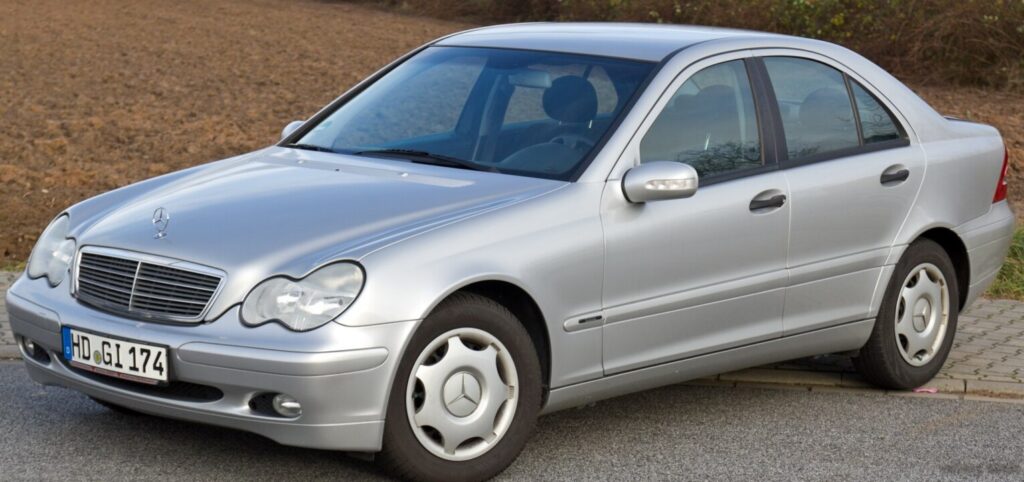
The Mercedes-Benz C 180 Kompressor automatic, produced between May 2002 and March 2004, represented an entry point into the W203 C-Class range. Positioned as a more accessible option within the lineup, it aimed to deliver the Mercedes-Benz experience to a broader customer base. This variant utilized a supercharged 1.8-liter inline-four engine paired with a five-speed automatic transmission, offering a balance of fuel efficiency and reasonable performance. It was primarily sold in Europe and other markets where smaller displacement engines were favored, and served as a competitor to BMW 318i and Audi A4 models with similar engine configurations.
Technical Specifications
| Brand | Mercedes-Benz |
| Model | C-class |
| Generation | C-class (W203) |
| Type (Engine) | C 180 Kompressor (143 Hp) Automatic |
| Start of production | May, 2002 |
| End of production | March, 2004 |
| Powertrain Architecture | Internal Combustion engine |
| Body type | Sedan |
| Seats | 5 |
| Doors | 4 |
| Fuel consumption (urban) | 11.8 l/100 km (19.9 US mpg, 23.9 UK mpg, 8.5 km/l) |
| Fuel consumption (extra urban) | 5.9 l/100 km (39.9 US mpg, 47.9 UK mpg, 16.9 km/l) |
| Fuel consumption (combined) | 7.9 l/100 km (29.8 US mpg, 35.8 UK mpg, 12.7 km/l) |
| CO2 emissions | 190 g/km |
| Fuel Type | Petrol (Gasoline) |
| Acceleration 0 – 100 km/h | 9.9 sec |
| Acceleration 0 – 62 mph | 9.9 sec |
| Acceleration 0 – 60 mph | 9.4 sec |
| Maximum speed | 220 km/h (136.7 mph) |
| Emission standard | Euro 4 |
| Weight-to-power ratio | 9.8 kg/Hp, 102.1 Hp/tonne |
| Weight-to-torque ratio | 6.4 kg/Nm, 157.1 Nm/tonne |
| Power | 143 Hp @ 5200 rpm |
| Power per litre | 79.6 Hp/l |
| Torque | 220 Nm @ 2500-4200 rpm (162.26 lb.-ft. @ 2500-4200 rpm) |
| Engine layout | Front, Longitudinal |
| Engine Model/Code | M 271.946 |
| Engine displacement | 1796 cm3 (109.6 cu. in.) |
| Number of cylinders | 4 |
| Engine configuration | Inline |
| Cylinder Bore | 82 mm (3.23 in.) |
| Piston Stroke | 85 mm (3.35 in.) |
| Compression ratio | 10.2:1 |
| Number of valves per cylinder | 4 |
| Fuel injection system | Multi-port manifold injection |
| Engine aspiration | Supercharger, Intercooler |
| Valvetrain | DOHC |
| Engine oil capacity | 5.5 l (5.81 US qt | 4.84 UK qt) |
| Coolant capacity | 8 l (8.45 US qt | 7.04 UK qt) |
| Kerb Weight | 1400 kg (3086.47 lbs.) |
| Max. weight | 1955 kg (4310.04 lbs.) |
| Max load | 555 kg (1223.57 lbs.) |
| Trunk (boot) space (minimum) | 455 l (16.07 cu. ft.) |
| Fuel tank capacity | 62 l (16.38 US gal | 13.64 UK gal) |
| Max. roof load | 100 kg (220.46 lbs.) |
| Permitted trailer load (with brakes) | 1500 kg (3306.93 lbs.) |
| Permitted trailer load (without brakes) | 740 kg (1631.42 lbs.) |
| Length | 4526 mm (178.19 in.) |
| Width | 1728 mm (68.03 in.) |
| Width including mirrors | 1980 mm (77.95 in.) |
| Height | 1426 mm (56.14 in.) |
| Wheelbase | 2715 mm (106.89 in.) |
| Front track | 1505 mm (59.25 in.) |
| Rear track | 1476 mm (58.11 in.) |
| Front overhang | 755 mm (29.72 in.) |
| Rear overhang | 1056 mm (41.57 in.) |
| Drag coefficient (Cd) | 0.27 |
| Minimum turning circle | 10.76 m (35.3 ft.) |
| Drivetrain Architecture | Rear wheel drive |
| Number of gears | 5 |
| Gearbox type | Automatic transmission |
| Front suspension | Independent type McPherson, Transverse stabilizer |
| Rear suspension | Independent multi-link suspension, Transverse stabilizer |
| Front brakes | Ventilated discs |
| Rear brakes | Disc |
| Assisting systems | ABS (Anti-lock braking system) |
| Steering type | Steering rack and pinion |
| Power steering | Hydraulic Steering |
| Tires size | 195/65 R 15 91 V |
| Wheel rims size | 6 J x 15 H 2 |
Powertrain & Engine Architecture
The heart of the C 180 Kompressor was the M271.946 engine, a 1.8-liter (1796 cc) inline-four cylinder powerplant. This engine was notable for its Lysholm-type mechanical supercharger, which provided increased torque at lower engine speeds compared to naturally aspirated engines. The supercharger, along with an intercooler, boosted output to 143 horsepower at 5200 rpm and 220 Nm (162 lb-ft) of torque between 2500 and 4200 rpm. Fuel delivery was managed by a multi-port fuel injection system. The engine featured a double overhead camshaft (DOHC) valvetrain with four valves per cylinder, contributing to its relatively high specific output. The five-speed automatic transmission, a common unit in Mercedes-Benz vehicles of the era, was designed for smooth shifting and comfortable cruising.
Driving Characteristics
The C 180 Kompressor automatic offered a comfortable and refined driving experience, typical of Mercedes-Benz. While not a performance-oriented model, the supercharger provided adequate acceleration for everyday driving. The 0-60 mph sprint took approximately 9.4 seconds, and top speed was limited to 136.7 mph. The automatic transmission, while smooth, could feel somewhat sluggish compared to the available manual gearbox, particularly during quick overtaking maneuvers. The gear ratios were optimized for fuel efficiency and relaxed cruising rather than outright performance. Compared to the more powerful C 200 Kompressor or C 230 Kompressor variants, the C 180 offered less spirited acceleration, but it compensated with improved fuel economy.
Equipment & Trim Levels
The C 180 Kompressor typically came equipped with a respectable level of standard features, including air conditioning, power windows, central locking, and an audio system. Interior upholstery was generally cloth, although leather options were available. The dashboard layout was functional and well-built, reflecting Mercedes-Benz’s commitment to quality. Optional extras included sunroof, upgraded audio systems, automatic climate control, and alloy wheels. The trim level was generally considered entry-level within the W203 range, appealing to buyers prioritizing comfort and practicality over outright performance or luxury.
Chassis & Braking
The W203 C-Class featured an independent suspension system on both the front and rear axles. The front utilized a McPherson strut setup with a transverse stabilizer, while the rear employed a multi-link suspension, also with a stabilizer bar. This configuration provided a good balance of ride comfort and handling. Braking duties were handled by ventilated discs at the front and solid discs at the rear. Anti-lock Braking System (ABS) was standard, enhancing safety and stability during emergency braking. The chassis was designed to provide a stable and predictable driving experience, prioritizing comfort over sporty handling.
Market Reception & Comparison
The C 180 Kompressor automatic received generally positive reviews for its comfort, refinement, and fuel efficiency. Critics noted that it provided a good entry point into the Mercedes-Benz brand, offering a premium experience at a relatively affordable price. However, some reviewers found the performance to be somewhat underwhelming, particularly compared to the more powerful variants. Fuel economy was a strong point, with combined figures around 30 mpg. In terms of reliability, the M271 engine proved to be generally robust, although some owners reported issues with the supercharger and its associated components over the long term. Compared to the C 200 Kompressor, the C 180 offered lower running costs but sacrificed some performance.
Legacy
The C 180 Kompressor automatic, while not the most sought-after variant of the W203 C-Class, remains a relatively common sight on the used car market. Its reputation for reliability and affordability has made it a popular choice for budget-conscious buyers. The M271 engine, despite some potential issues with the supercharger, has proven to be durable when properly maintained. Today, these vehicles represent a relatively inexpensive way to experience the Mercedes-Benz brand, offering a comfortable and refined driving experience for those not prioritizing ultimate performance.