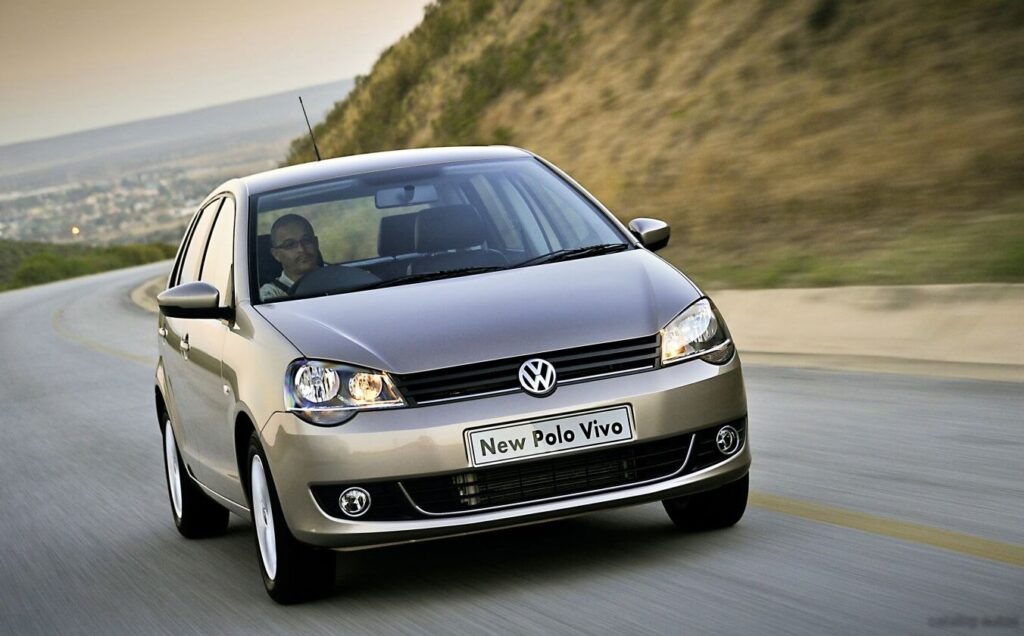
The Volkswagen Polo Vivo II 1.4 (86 hp) is a subcompact hatchback produced by Volkswagen South Africa from 2018 onwards. It represents a continuation of the Polo Vivo line, specifically tailored for the South African market as an affordable and practical entry-level vehicle. The Vivo II is based on the older Polo Mk5 (Typ 6R) platform, offering a familiar design and mechanical layout while providing a cost-effective alternative to newer Polo models. This 1.4-liter variant occupied the base trim level within the Vivo II range, focusing on fuel efficiency and affordability rather than outright performance. It served as a popular choice for first-time car buyers and those seeking a reliable, economical city car.
Technical Specifications
| Brand | Volkswagen |
| Model | Polo Vivo |
| Generation | Polo Vivo II |
| Type (Engine) | 1.4 (86 Hp) |
| Start of production | 2018 |
| Powertrain Architecture | Internal Combustion engine |
| Body type | Hatchback |
| Seats | 5 |
| Doors | 5 |
| Fuel consumption (urban) | 7.9 l/100 km (29.8 US mpg) |
| Fuel consumption (extra urban) | 4.8 l/100 km (49 US mpg) |
| Fuel consumption (combined) | 5.9 l/100 km (39.9 US mpg) |
| CO2 emissions | 140 g/km |
| Fuel Type | Petrol (Gasoline) |
| Maximum speed | 177 km/h (109.98 mph) |
| Weight-to-power ratio | 12.4 kg/Hp |
| Weight-to-torque ratio | 8.1 kg/Nm |
| Power | 86 Hp @ 5000 rpm |
| Power per litre | 61.5 Hp/l |
| Torque | 132 Nm @ 3750 rpm (97.36 lb.-ft. @ 3750 rpm) |
| Engine layout | Front, Transverse |
| Engine Model/Code | CLPA |
| Engine displacement | 1398 cm3 (85.31 cu. in.) |
| Number of cylinders | 4 |
| Engine configuration | Inline |
| Cylinder Bore | 76.5 mm (3.01 in.) |
| Piston Stroke | 75.6 mm (2.98 in.) |
| Compression ratio | 10.5:1 |
| Number of valves per cylinder | 4 |
| Fuel injection system | Multi-port manifold injection |
| Engine aspiration | Naturally aspirated engine |
| Valvetrain | DOHC |
| Engine oil capacity | 3.2 l (3.38 US qt | 2.82 UK qt) |
| Kerb Weight | 1066 kg (2350.13 lbs.) |
| Max. weight | 1540 kg (3395.12 lbs.) |
| Max load | 474 kg (1044.99 lbs.) |
| Trunk (boot) space – minimum | 280 l (9.89 cu. ft.) |
| Trunk (boot) space – maximum | 952 l (33.62 cu. ft.) |
| Fuel tank capacity | 45 l (11.89 US gal | 9.9 UK gal) |
| Permitted trailer load with brakes (12%) | 1000 kg (2204.62 lbs.) |
| Permitted trailer load without brakes | 570 kg (1256.63 lbs.) |
| Length | 3972 mm (156.38 in.) |
| Width | 1682 mm (66.22 in.) |
| Height | 1462 mm (57.56 in.) |
| Wheelbase | 2470 mm (97.24 in.) |
| Front track | 1463 mm (57.6 in.) |
| Rear (Back) track | 1456 mm (57.32 in.) |
| Ride height (ground clearance) | 143 mm (5.63 in.) |
| Minimum turning circle (turning diameter) | 10.6 m (34.78 ft.) |
| Drivetrain Architecture | Front wheel drive |
| Number of gears and type of gearbox | 5 gears, manual transmission |
| Front suspension | Spring Strut, Wishbone |
| Rear suspension | Spring Strut, Trailing arm, Torsion |
| Front brakes | Disc |
| Rear brakes | Drum |
| Assisting systems | ABS (Anti-lock braking system) |
| Steering type | Steering rack and pinion |
| Power steering | Hydraulic Steering |
| Tires size | 175/70 R14 |
| Wheel rims size | 5J x 14 |
INTRODUCTION
The Volkswagen Polo Vivo II 1.4, launched in 2018, is a key model in Volkswagen South Africa’s lineup, designed to provide affordable and reliable transportation. It’s built on the foundation of the Mk5 Polo (Typ 6R), a platform that proved popular globally. The Vivo II was created to fill a gap in the market, offering a modern hatchback at a competitive price point. The 1.4-liter engine with 86 horsepower served as the entry point to the Vivo II range, prioritizing fuel economy and ease of driving over outright performance. This variant was particularly aimed at young drivers, families on a budget, and those needing a dependable daily commuter.
Powertrain & Engine Architecture
The heart of the Polo Vivo II 1.4 is the CLPA engine code, a 1.4-liter inline-four cylinder petrol engine. This engine is a naturally aspirated unit, meaning it doesn’t utilize a turbocharger or supercharger. It employs multi-point fuel injection, delivering fuel directly into the intake manifold. The engine features a double overhead camshaft (DOHC) valvetrain, operating four valves per cylinder, which helps optimize breathing and improve efficiency. The 1.4-liter engine produces 86 horsepower at 5000 rpm and 132 Nm (97.36 lb-ft) of torque at 3750 rpm. The engine is paired with a five-speed manual transmission, chosen for its simplicity and cost-effectiveness. While an automatic transmission was offered on other Vivo II trims, it wasn’t available with the base 1.4-liter engine.
Driving Characteristics
The Polo Vivo II 1.4 (86 hp) offers a predictable and user-friendly driving experience. Acceleration is modest, with a 0-60 mph time estimated around 12-13 seconds. The focus is on providing adequate power for everyday driving situations, such as commuting and navigating city streets. The five-speed manual transmission allows for reasonable control over the engine’s power band. Gear ratios are tuned for fuel efficiency, meaning the engine doesn’t feel particularly responsive at higher speeds. Compared to higher-spec Vivo II models with larger engines, the 1.4 feels noticeably less powerful, especially when fully loaded or tackling uphill climbs. However, its lighter weight contributes to decent handling and maneuverability in urban environments.
Equipment & Trim Levels
The base-level Polo Vivo II 1.4 typically came equipped with essential features. Standard equipment included power steering, air conditioning, central locking, and an audio system with USB connectivity. Safety features such as ABS (Anti-lock Braking System) and dual front airbags were also standard. Interior upholstery was typically cloth, with a functional but basic dashboard layout. Optional extras included alloy wheels, electric windows, and upgraded audio systems. The trim level was deliberately kept simple to maintain affordability, with a focus on providing the core necessities for comfortable and safe transportation.
Chassis & Braking
The Polo Vivo II utilizes a MacPherson strut front suspension and a torsion beam rear suspension. This setup provides a good balance between ride comfort and handling. The front brakes are disc brakes, offering adequate stopping power, while the rear brakes are drum brakes, a cost-saving measure for the base model. The steering is a hydraulic power steering system, providing a reasonably direct and responsive feel. The Vivo II’s chassis is designed for durability and reliability, capable of handling the demands of South African road conditions. Stabilizer bars were included, contributing to reduced body roll during cornering.
Market Reception & Comparison
The Polo Vivo II 1.4 was well-received in the South African market as an affordable and practical hatchback. Critics praised its fuel efficiency, reliability, and ease of driving. However, some noted its lack of power compared to higher-spec models. Compared to the 1.6-liter variants, the 1.4 offered significantly lower running costs but at the expense of performance. The 1.4 was also positioned as a more economical alternative to competitors like the Toyota Yaris and Ford Fiesta, offering a compelling value proposition for budget-conscious buyers. Fuel economy figures of around 39.9 US mpg combined were a major selling point.
Legacy
The Volkswagen Polo Vivo II 1.4 has established a reputation for reliability and affordability in the South African used car market. Its simple engine design and robust mechanical components contribute to its long-term durability. While not a performance-oriented vehicle, it remains a popular choice for those seeking a dependable and economical city car. Parts availability is generally good, and maintenance costs are relatively low. The Vivo II 1.4 continues to be a common sight on South African roads, demonstrating its enduring appeal and practicality.