
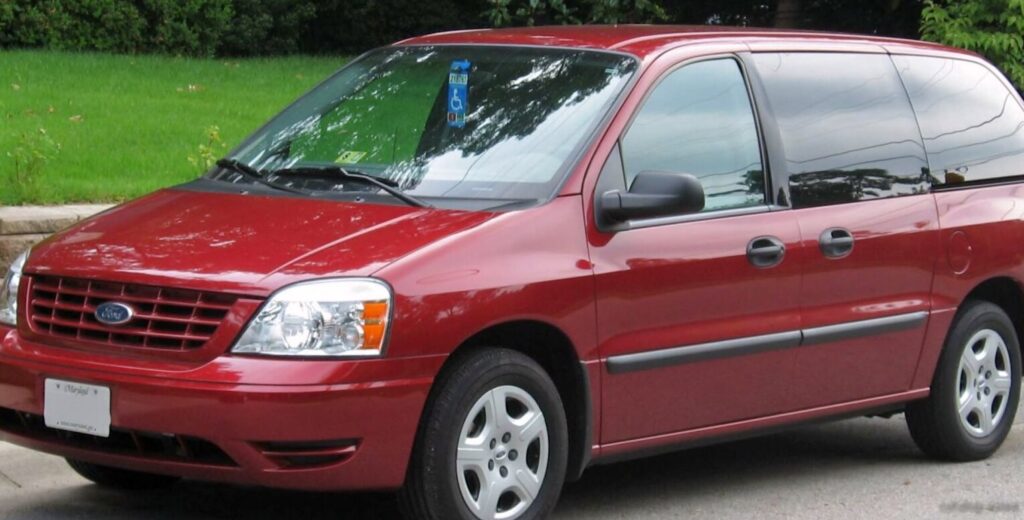
The Ford Freestar 3.9L V6, produced from 2003 to 2007, represented Ford’s entry into the modern minivan segment following the discontinuation of the Windstar. Positioned as a family-focused vehicle, the Freestar aimed to compete with established rivals like the Dodge Caravan and Chrysler Town & Country. The 3.9L V6 engine, paired with an automatic transmission, was a mainstay of the Freestar lineup, offering a balance of power and affordability. It was built on the Ford CD2 platform, shared with the Mercury Monterey, and represented a significant redesign from its predecessor, focusing on improved safety and interior space. While not a performance leader, the 3.9L Freestar served as a practical and reasonably well-equipped option for families needing substantial passenger and cargo capacity.
Technical Specifications
| Brand | Ford |
| Model | Freestar |
| Generation | Freestar |
| Type (Engine) | 3.9 i V6 (195 Hp) |
| Start of production | 2003 |
| End of production | 2007 |
| Powertrain Architecture | Internal Combustion engine |
| Body type | Minivan |
| Fuel Type | Petrol (Gasoline) |
| Power | 195 Hp |
| Engine aspiration | Naturally aspirated engine |
| Engine oil capacity | 4.7 l / 4.97 US qt / 4.14 UK qt |
| Coolant capacity | 14 l / 14.79 US qt / 12.32 UK qt |
Powertrain & Engine Architecture
The heart of the Freestar 3.9L was the 3.9-liter Vulcan V6 engine. This engine, part of Ford’s Vulcan family, was a 60-degree V6 known for its durability and relatively simple design. It featured a cast iron block and aluminum cylinder heads. The 3.9L utilized a single overhead camshaft (SOHC) design with two valves per cylinder. Fuel delivery was managed by a multi-port fuel injection system, providing adequate, though not exceptional, performance. The engine produced 195 horsepower at 5,500 rpm and 265 lb-ft of torque at 3,250 rpm.
The Freestar 3.9L was exclusively paired with a 4-speed automatic transmission (4F50E). This transmission was a workhorse unit used in many Ford vehicles of the era. While reliable, it wasn’t known for its particularly quick or smooth shifts. The transmission’s gear ratios were geared towards fuel economy and comfortable cruising rather than sporty acceleration. The 4F50E featured electronic control, adapting shift points based on throttle position and vehicle speed.
Driving Characteristics
The Freestar 3.9L offered adequate, but not thrilling, performance. Acceleration was sufficient for everyday driving and highway merging, but the minivan wasn’t designed for quick sprints. The 4-speed automatic transmission, while reliable, contributed to a somewhat leisurely driving experience. The engine’s torque curve provided decent low-end grunt, making it easy to get the Freestar moving from a stop, even when fully loaded with passengers and cargo. Compared to the later, more powerful 4.2L V6 option offered on the Freestar, the 3.9L felt noticeably less responsive, especially when climbing hills or towing. The automatic transmission’s shift points were programmed for smoothness and fuel efficiency, sometimes resulting in the engine feeling strained during aggressive acceleration. The Freestar’s suspension was tuned for comfort, providing a relatively smooth ride, but at the expense of sharp handling.
Equipment & Trim Levels
The Freestar 3.9L was available in several trim levels, including base, Limited, and SEL. The base model offered essential features like air conditioning, power windows and locks, and an AM/FM stereo. The Limited trim added features such as alloy wheels, upgraded interior trim, and a CD player. The SEL trim, the most luxurious option, included leather upholstery, heated front seats, and a premium sound system.
Standard interior features across most trims included a three-row seating configuration, accommodating up to seven passengers. Optional extras included a DVD entertainment system, power sliding doors, and a navigation system. Interior upholstery was typically cloth on the base model, with leather available on higher trims. The dashboard layout was functional and straightforward, with easy-to-use controls.
Chassis & Braking
The Freestar utilized a front-wheel-drive layout. The suspension consisted of independent front struts and a solid rear axle with leaf springs. This setup prioritized ride comfort over handling precision. The Freestar’s chassis was designed to maximize interior space and provide a stable platform for carrying passengers and cargo.
Braking duties were handled by disc brakes on the front wheels and drum brakes on the rear wheels. Anti-lock brakes (ABS) were standard on all trims. The braking system provided adequate stopping power for a vehicle of its size and weight, but it wasn’t particularly powerful or responsive. The Freestar’s steering was power-assisted, providing light and easy steering effort.
Market Reception & Comparison
The Ford Freestar 3.9L received mixed reviews from automotive critics. While praised for its spacious interior and comfortable ride, it was often criticized for its lackluster performance and somewhat dated design. Compared to the 4.2L V6 Freestar, the 3.9L offered lower fuel economy gains, but at a noticeable performance penalty. The 3.9L Freestar was generally considered a more affordable option, appealing to budget-conscious families. Fuel economy was rated at around 18 mpg city and 24 mpg highway, which was typical for a minivan of its size and era. Reliability was generally good, with the 3.9L V6 engine proving to be a durable and long-lasting powerplant. However, the 4F50E automatic transmission was known to have occasional issues.
Legacy
The Ford Freestar, and specifically the 3.9L V6 variant, represents a transitional period for Ford’s minivan offerings. While it didn’t achieve the same level of success as some of its competitors, it provided a practical and affordable option for families. The 3.9L Vulcan V6 engine is known for its longevity and relatively low maintenance costs. Today, used Freestars are often found at very affordable prices, making them an attractive option for those needing a large, inexpensive vehicle. However, potential buyers should be aware of the potential for transmission issues and the vehicle’s age-related wear and tear. The Freestar paved the way for Ford’s subsequent minivan models, incorporating lessons learned from its design and engineering.
