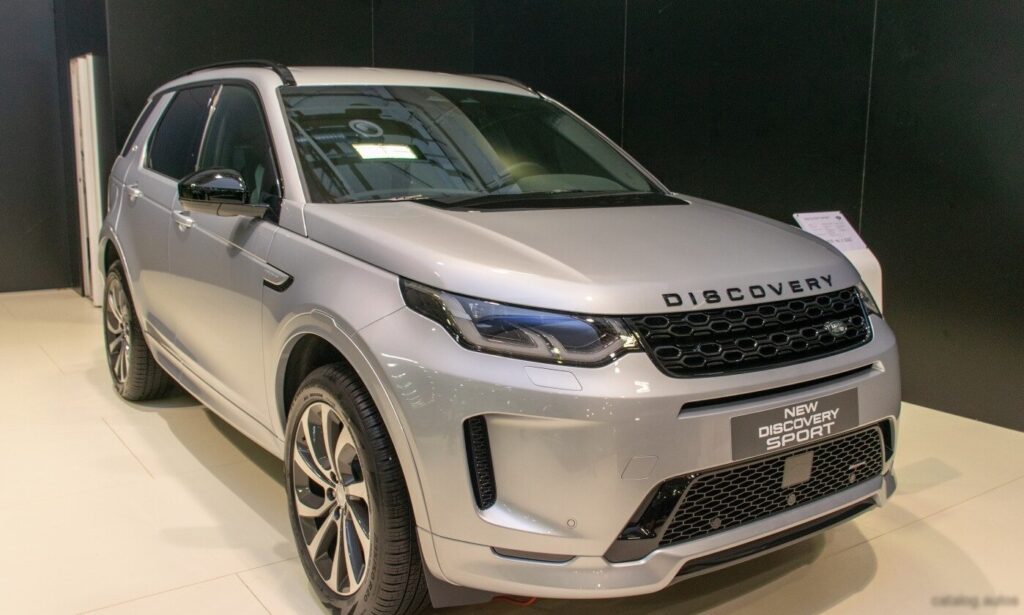
The Land Rover Discovery Sport 2.0 D200 (204 Hp) Mild Hybrid AWD Automatic, introduced in August 2020, represents a significant evolution within the second generation of the Discovery Sport (L550) model range. This variant, part of the facelifted 2019 model year, positioned itself as a mid-range offering, balancing performance, fuel efficiency, and technology within the compact luxury SUV segment. It leverages Land Rover’s Ingenium engine family and incorporates mild hybrid technology to enhance both power delivery and economy. The Discovery Sport, as a whole, aimed to bridge the gap between the larger Range Rover Evoque and the more utilitarian Land Rover Freelander, offering a blend of on-road refinement and off-road capability.
Technical Specifications
| Brand | Land Rover |
| Model | Discovery Sport |
| Generation | Discovery Sport (facelift 2019) |
| Type (Engine) | 2.0 D200 (204 Hp) Mild Hybrid AWD Automatic |
| Start of production | August, 2020 |
| Powertrain Architecture | MHEV (Mild Hybrid Electric Vehicle) |
| Body type | SUV |
| Seats | 5 |
| Doors | 5 |
| Combined fuel consumption (WLTP) | 6.7-7.2 l/100 km (35.1 – 32.7 US mpg, 42.2 – 39.2 UK mpg, 14.9 – 13.9 km/l) |
| CO2 emissions (WLTP) | 175-190 g/km |
| Fuel consumption (NEDC, WLTP equivalent) | 5.3 l/100 km (44.4 US mpg, 53.3 UK mpg, 18.9 km/l) |
| CO2 emissions (NEDC, WLTP equivalent) | 140 g/km |
| Fuel Type | Diesel |
| Acceleration 0 – 100 km/h | 8.6 sec |
| Acceleration 0 – 62 mph | 8.6 sec |
| Acceleration 0 – 60 mph | 8.1 sec |
| Maximum speed | 209 km/h (129.87 mph) |
| Emission standard | Euro 6 |
| Weight-to-power ratio | 9.2 kg/Hp, 108.9 Hp/tonne |
| Weight-to-torque ratio | 4.4 kg/Nm, 229.6 Nm/tonne |
| Power | 204 Hp @ 3750 rpm |
| Power per litre | 102.2 Hp/l |
| Torque | 430 Nm @ 1750-2500 rpm (317.15 lb.-ft. @ 1750-2500 rpm) |
| Engine layout | Front, Transverse |
| Engine Model/Code | Ingenium / 204DTY |
| Engine displacement | 1997 cm3 (121.86 cu. in.) |
| Number of cylinders | 4 |
| Engine configuration | Inline |
| Cylinder Bore | 83.01 mm (3.27 in.) |
| Piston Stroke | 92.3 mm (3.63 in.) |
| Compression ratio | 16.5:1 |
| Number of valves per cylinder | 4 |
| Fuel injection system | Diesel Commonrail |
| Engine aspiration | Turbocharger, Intercooler |
| Valvetrain | DOHC |
| Engine oil capacity | 6.5 l (6.87 US qt | 5.72 UK qt) |
| Kerb Weight | 1873 kg (4129.26 lbs.) |
| Trunk (boot) space – minimum | 897 l (31.68 cu. ft.) |
| Trunk (boot) space – maximum | 1794 l (63.35 cu. ft.) |
| Fuel tank capacity | 65 l (17.17 US gal | 14.3 UK gal) |
| AdBlue tank | 17.3 l (4.57 US gal | 3.81 UK gal) |
| Permitted trailer load with brakes (12%) | 2500 kg (5511.56 lbs.) |
| Permitted trailer load without brakes | 750 kg (1653.47 lbs.) |
| Length | 4597 mm (180.98 in.) |
| Width with mirrors folded | 2069 mm (81.46 in.) |
| Width including mirrors | 2173 mm (85.55 in.) |
| Height | 1727 mm (67.99 in.) |
| Wheelbase | 2741 mm (107.91 in.) |
| Front track | 1625-1636 mm (63.98 – 64.41 in.) |
| Rear (Back) track | 1631-1643 mm (64.21 – 64.69 in.) |
| Front overhang | 901 mm (35.47 in.) |
| Rear overhang | 955 mm (37.6 in.) |
| Ride height (ground clearance) | 212 mm (8.35 in.) |
| Drag coefficient (Cd) | 0.33 |
| Minimum turning circle (turning diameter) | 11.8 m (38.71 ft.) |
| Approach angle | 25° |
| Departure angle | 30.2° |
| Ramp-over (brakeover) angle | 20.6° |
| Wading depth | 600 mm (23.62 in.) |
| Drivetrain Architecture | ICE and electric motor drive front wheels, rear wheels engaged via clutch |
| Drive wheel | All wheel drive (4×4) |
| Number of gears and type of gearbox | 9 gears, automatic transmission |
| Front suspension | Independent type McPherson |
| Rear suspension | Independent multi-link suspension |
| Front brakes | Ventilated discs, 325-349 mm |
| Rear brakes | Disc, 300-325 mm |
| Assisting systems | ABS (Anti-lock braking system) |
| Steering type | Steering rack and pinion |
| Power steering | Electric Steering |
| Wheel rims size | 17; 18 |
Powertrain & Engine Architecture
At the heart of the D200 lies Land Rover’s 2.0-liter Ingenium diesel engine, specifically the 204DTY code. This engine is a four-cylinder, inline configuration, featuring a turbocharger and intercooler to boost power and efficiency. The Ingenium family was designed for modularity and scalability, allowing for various power outputs and configurations. The 204DTY utilizes a sophisticated diesel commonrail fuel injection system, delivering precise fuel metering for optimal combustion. The engine boasts a high compression ratio of 16.5:1, contributing to its thermal efficiency. The mild hybrid system incorporates a 48-volt electrical architecture and a belt-integrated starter generator (BiSG). This system allows for regenerative braking, capturing energy during deceleration and providing a small power boost during acceleration, improving fuel economy and reducing emissions. The engine is paired with a ZF-sourced nine-speed automatic transmission, known for its smooth shifting and wide gear ratio spread.
Driving Characteristics
The 204 horsepower and 430 Nm (317 lb-ft) of torque delivered by the D200 powertrain provide a comfortable and capable driving experience. Acceleration from 0-60 mph takes approximately 8.1 seconds, making it adequately quick for everyday driving. The nine-speed automatic transmission is well-tuned, offering smooth gear changes and keeping the engine within its optimal power band. Compared to the higher-output D240 variant, the D200 feels slightly less urgent in acceleration, but the difference is not dramatic. The mild hybrid system provides a subtle but noticeable boost during initial acceleration. The all-wheel-drive system provides excellent traction in various conditions, making it a confident performer on both paved and unpaved surfaces. The Discovery Sport’s suspension is tuned for comfort, absorbing bumps and providing a relatively smooth ride.
Equipment & Trim Levels
The D200 trim typically included features such as leather upholstery, a touchscreen infotainment system with Apple CarPlay and Android Auto compatibility, automatic climate control, and a suite of safety features including autonomous emergency braking and lane departure warning. Optional extras included a panoramic sunroof, premium audio system, and adaptive cruise control. The interior design is modern and functional, with a focus on practicality and usability. The Discovery Sport offers a spacious cabin for its size, with ample headroom and legroom for both front and rear passengers.
Chassis & Braking
The Discovery Sport utilizes a monocoque chassis construction, providing a good balance of strength and rigidity. The front suspension features independent McPherson struts, while the rear suspension employs an independent multi-link setup. This configuration provides a comfortable ride and good handling characteristics. The braking system consists of ventilated discs at the front and solid discs at the rear. Anti-lock braking system (ABS) and electronic stability control (ESC) are standard features, enhancing safety and control.
Market Reception & Comparison
The Discovery Sport 2.0 D200 was generally well-received by automotive critics. It was praised for its comfortable ride, spacious interior, and capable all-wheel-drive system. The mild hybrid technology was seen as a positive step towards improving fuel efficiency and reducing emissions. Compared to the D240 variant, the D200 offered a more affordable entry point into the Discovery Sport range, while still providing a respectable level of performance. Fuel economy figures of 6.7-7.2 l/100 km (35.1-32.7 US mpg) were competitive within its class.
Legacy
The Land Rover Discovery Sport 2.0 D200 Mild Hybrid AWD Automatic has proven to be a reliable and durable vehicle. The Ingenium engine family has a good reputation for longevity, and the ZF nine-speed automatic transmission is known for its robustness. In the used car market, these models hold their value reasonably well, reflecting their popularity and reputation for quality. Regular maintenance, including oil changes and filter replacements, is crucial for ensuring the long-term reliability of this powertrain. The Discovery Sport continues to be a popular choice for buyers seeking a compact luxury SUV with a blend of on-road refinement and off-road capability.