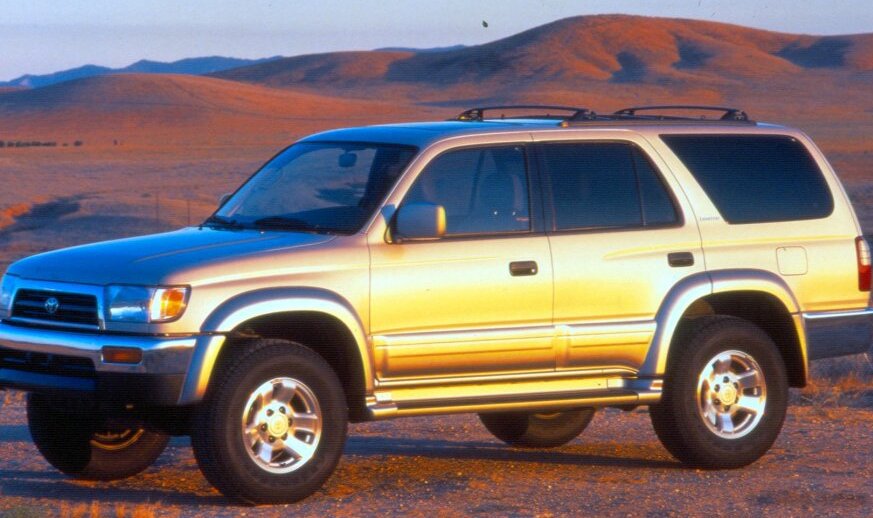
The Toyota 4Runner III, produced between 1995 and 1999, represented a significant evolution of Toyota’s popular mid-size SUV. This generation, known internally as the 180 series, continued the 4Runner’s reputation for ruggedness and off-road capability while introducing increased refinement and comfort. The 3.0 TD (125 Hp) 4×4 Automatic variant occupied a specific niche within the lineup, offering a diesel-powered option with the convenience of an automatic transmission, primarily aimed at buyers seeking fuel efficiency and ease of use for both on-road driving and moderate off-road excursions. This model was particularly popular in markets outside of North America, where diesel engines held a larger share of the SUV segment.
Technical Specifications
| Brand | Toyota |
| Model | 4Runner |
| Generation | 4Runner III |
| Type (Engine) | 3.0 TD (125 Hp) 4×4 Automatic |
| Start of production | 1995 |
| End of production | 1999 |
| Powertrain Architecture | Internal Combustion engine |
| Body type | SUV |
| Seats | 5 |
| Doors | 5 |
| Fuel consumption (urban) | 15 l/100 km (15.7 US mpg, 18.8 UK mpg, 6.7 km/l) |
| Fuel consumption (extra urban) | 10 l/100 km (23.5 US mpg, 28.2 UK mpg, 10 km/l) |
| Fuel Type | Diesel |
| Acceleration 0 – 100 km/h | 14.7 sec |
| Acceleration 0 – 62 mph | 14.7 sec |
| Acceleration 0 – 60 mph | 14 sec |
| Maximum speed | 150 km/h (93.21 mph) |
| Weight-to-power ratio | 13.8 kg/Hp, 72.3 Hp/tonne |
| Weight-to-torque ratio | 5.9 kg/Nm, 170.5 Nm/tonne |
| Power | 125 Hp @ 3600 rpm |
| Power per litre | 41.9 Hp/l |
| Torque | 295 Nm @ 2000 rpm (217.58 lb.-ft. @ 2000 rpm) |
| Engine layout | Front, Longitudinal |
| Engine Model/Code | 1KZ-TE |
| Engine displacement | 2982 cm3 (181.97 cu. in.) |
| Number of cylinders | 4 |
| Engine configuration | Inline |
| Cylinder Bore | 96 mm (3.78 in.) |
| Piston Stroke | 103 mm (4.06 in.) |
| Compression ratio | 21.2:1 |
| Number of valves per cylinder | 2 |
| Fuel injection system | Precombustion chamber injection |
| Engine aspiration | Turbocharger |
| Valvetrain | OHC |
| Engine oil capacity | 7 l (7.4 US qt | 6.16 UK qt) |
| Coolant capacity | 10 l (10.57 US qt | 8.8 UK qt) |
| Kerb Weight | 1730 kg (3814 lbs.) |
| Max. weight | 2430 kg (5357.23 lbs.) |
| Max load | 700 kg (1543.24 lbs.) |
| Trunk (boot) space – minimum | 1263 l (44.6 cu. ft.) |
| Trunk (boot) space – maximum | 2257 l (79.71 cu. ft.) |
| Fuel tank capacity | 70 l (18.49 US gal | 15.4 UK gal) |
| Length | 4539 mm (178.7 in.) |
| Width | 1689 mm (66.5 in.) |
| Height | 1689-1745 mm (66.5 – 68.7 in.) |
| Wheelbase | 2675 mm (105.31 in.) |
| Front track | 1506 mm (59.29 in.) |
| Rear (Back) track | 1496-1509 mm (58.9 – 59.41 in.) |
| Ride height (ground clearance) | 216-241 mm (8.5 – 9.49 in.) |
| Minimum turning circle | 11.4 m (37.4 ft.) |
| Approach angle | 32-36° |
| Departure angle | 26-29° |
| Drive wheel | All wheel drive (4×4) |
| Number of gears | 4 |
| Gearbox type | Automatic transmission |
| Front suspension | Double wishbone |
| Rear suspension | Independent multi-link suspension |
| Front brakes | Ventilated discs |
| Rear brakes | Drum |
| Assisting systems | ABS (Anti-lock braking system) |
| Steering type | Steering rack and pinion |
| Power steering | Hydraulic |
| Tires size | 225/75 R15; 265/70 R16 |
| Wheel rims size | 7J x 15; 7J x 16 |
Powertrain & Engine Architecture
The heart of the 4Runner III 3.0 TD was the 1KZ-TE, a 2.982-liter inline-four cylinder diesel engine. This engine utilized a precombustion chamber injection system, a common design for diesel engines of the era, which improved combustion efficiency and reduced noise compared to direct injection systems. The 1KZ-TE was turbocharged, boosting power output to 125 horsepower at 3600 rpm and 295 Nm (217.58 lb.-ft.) of torque at 2000 rpm. The engine featured an overhead camshaft (OHC) valvetrain with two valves per cylinder. The automatic transmission was a four-speed unit, chosen for its ease of use and suitability for a wider range of drivers. While not known for blistering acceleration, the combination provided adequate power for highway cruising and off-road driving.
Driving Characteristics
The 3.0 TD Automatic 4Runner offered a relaxed driving experience. The automatic transmission, while providing convenience, did impact performance compared to the available manual transmission options. Acceleration from 0-60 mph took around 14 seconds, and top speed was limited to 150 km/h (93.21 mph). The engine’s torque peak at 2000 rpm meant that usable power was readily available for everyday driving and tackling moderate inclines. However, the engine could feel strained when fully loaded or attempting steeper climbs. The automatic transmission’s gear ratios were geared towards fuel efficiency rather than outright performance.
Equipment & Trim Levels
The 3.0 TD Automatic trim typically included features such as power windows, power locks, and air conditioning as standard equipment. Interior upholstery was usually cloth, with optional upgrades to leather available. Depending on the market, features like a CD player, alloy wheels, and a sunroof could be added as optional extras. The dashboard layout was functional and straightforward, prioritizing usability over luxury. The 4Runner III offered a relatively spartan interior compared to some of its competitors, focusing on durability and practicality.
Chassis & Braking
The 4Runner III utilized a body-on-frame construction, providing a robust and durable platform for off-road use. The front suspension consisted of a double wishbone setup, while the rear featured an independent multi-link suspension. This configuration aimed to balance ride comfort with off-road capability. Braking duties were handled by ventilated discs at the front and drum brakes at the rear. An Anti-lock Braking System (ABS) was included as standard, enhancing safety. The 4Runner’s relatively high ground clearance (216-241 mm) and approach/departure angles contributed to its off-road prowess.
Market Reception & Comparison
The 3.0 TD Automatic 4Runner was generally well-received in markets where diesel engines were popular. Critics praised its fuel efficiency and comfortable ride, but noted its relatively slow acceleration. Compared to the gasoline-powered 2.7-liter and 3.4-liter versions, the diesel offered superior fuel economy and torque, but less overall power. The 3.0 TD was often seen as a more practical choice for those who prioritized fuel efficiency and durability over outright performance. It was also positioned as a more affordable alternative to the higher-end trims.
Legacy
The 1KZ-TE engine, found in the 4Runner III 3.0 TD, is known for its reliability and longevity. Properly maintained examples can accumulate high mileage with minimal issues. The 4Runner III, in general, has developed a strong reputation for durability and off-road capability, making it a popular choice in the used car market. While not as sought after as some of the gasoline-powered versions, the 3.0 TD Automatic remains a viable option for buyers seeking a rugged and reliable SUV with good fuel economy. Parts availability is generally good, and the relatively simple mechanical design makes it easier to maintain and repair compared to more modern vehicles.